Most TV programmes that feature prison are deeply depressing and the first episode of Ch4's Crime and Punishment is no exception. Two years in the making and billed as highlighting the work of all parts of the criminal justice journey, last night's offering that focused on the iniquities of Imprisonment for Public Protection sentences amply demonstrates the folly of politicians using crime as a way to win votes. Quite ironic really as we are already hearing Boris Johnson doing exactly the same thing as a key plank of his current election campaign.
Right from the beginning when brought in by Tony Blair and his dreadful Home Secretary David Blunkett, everyone involved knew that IPP was likely to be a disaster and so it turned out to be with politicians and judges blaming each other to this day for the ongoing disaster so painfully evidenced by the documentary makers. It's such a clear message that no wonder they chose this aspect of the criminal justice system for the first hard-hitting episode.
Although quite sensibly abolished by Ken Clarke in 2012 and despite sterling efforts by the Parole Board to progress release of those who are many years over tariff, the IPP agony still has many years to run with hundreds of men cruelly trapped in a system that is simply not resourced or designed to deal with. It's bad enough to hear the frequent refrain from a prisoner that they're 'on their fourth probation officer and only met their current one via video link', but it's a professional disgrace to hear that the officer has been refused permission to attend the Parole Board hearing because of cost. In such circumstances and particularly with so obviously psychologically damaged individuals, how on earth can it be expected to do any meaningful work, yet alone treat the prisoner with any degree of respect and earn their trust?
Of particular concern highlighted last night is the prevalence of serious self-harming by prisoners who feel trapped in a system with no obvious way out and hence this extreme exercising of control in order to gain attention and engagement with a frankly bureaucratic and managerial approach by many. In fact precisely the command and control aspect of HMPPS that is currently being highlighted as a reason why probation must break free of these civil service shackles if it is to survive as a worthwhile endeavour at all.
It was particularly interesting to note the very strong and independent words of the Duty Governor in over-ruling the views of the health professionals regarding a proposed transfer out of the medical wing and his criticism of the recommendations by a 'remote' management - "sending two people to a meeting with a script is not helpful". It struck me forcefully that it was only really the Governor who displayed genuine concern for the prisoner and what might be the best and most pragmatic way of dealing with a very difficult issue. What should be noteworthy is that a Governor is largely independent, autonomous, experienced and not hidebound by bureaucracy, indeed just like probation used to be.
Tuesday, 17 September 2019

Friday, 13 September 2019
TV Alert
Oh, look what's coming and starts on Monday at 9pm:-
Crime and Punishment looks at the criminal justice system from top to toe. The results are not always pretty
Channel 4‘s Crime and Punishment is a hard-hitting documentary series exploring every area of the criminal justice system from both sides of the law.
Filmed over two years, it follows the work of police, probation, prison, prosecution and parole as all the limbs of the criminal justice system manage risks to the public using limited resources, while also dealing with offenders who can’t seem to escape the system.
This first episode shines a light on the 3,000-plus prisoners who are serving IPP (Imprisonment for Public Protection) sentences. Even though IPP was abolished in 2012, these prisoners still don’t know when or if they’ll be released.
Monday, 9 September 2019
Remembering Paul Senior
At a time when we once again find ourselves embroiled in a struggle to keep the probation ethos alive, the profession is without a high profile champion. In the summer we lost Paul Senior and I notice the Probation Institute have dedicated the latest issue of Probation Quarterly to his memory:-
I first met Paul when he was chairing Napo Probation Practice Committee circa 1980: articulate, confident and knowledgeable with strong left wing politics.
“He was a friend to many people and his legacy is huge. The world of probation is much diminished with his passing. He was a great doer and I remember the weekend in the Lakes where he guided us to produce much thoughtful discussion and eventually the edition of the British Journal of Community Justice. A truly great and strong, brave person.”
I don’t think I fully understood Paul’s passion for Probation and everything that it stands for until the then higher education social work qualification, the Diploma in Social Work, was challenged as the requirement for appointment as a Probation Officer. In 1994 the Conservative Government through Michael Howard and Baroness Blatch threatened simultaneously to remove the qualification requirement for appointment as a probation officer from both social work and higher education and to replace it with a statement of work based competence. The ensuing struggle between Conservative ministers, Napo and the Association of Chief Officers of Probation was resolved by incoming Labour Government in 1997 promising to retain the qualification in higher education but not in social work. As Home Secretary, Jack Straw agreed to introduce the Diploma in Probation Studies. By this time Paul had become the first ever Professor of Probation Studies at Sheffield Hallam University. He was asked to develop the qualification and worked tirelessly to create a specific Vocational Qualification embedded into a Degree.
Without Paul’s achievement in enabling the translation of social work theory and practice into probation theory and practice the ethos of probation would have been completely overridden by enforcement and control twenty years ago. Paul went on to lead at Sheffield Hallam one of the three funded Probation Programmes now known as PQIP and to develop the Hallam Centre for Community Justice. Paul shared the huge disappointment of Transforming Rehabilitation. He continued his robust defence of compassionate, empowering approaches to rehabilitation. Although struggling with illness, in 2015 Paul took over as Chair of the Probation Institute which he led with passion to become a stronger, clearer voice for professional recognition, research and post qualification learning. Paul was a brave warrior and champion for Probation. We miss him hugely and it is our responsibility to walk in his footsteps.
Helen Schofield - Acting CEO, Probation Institute
Although our paths had crossed throughout our probation and academic careers, I only got to know Paul well when I interviewed him in 2011 for the research project I was undertaking with Rob Mawby on the occupational cultures and identities of probation workers. His passion for probation work shone through and he was also very supportive of our research and its subsequent publication. Although I am technically breaching research ethics by identifying an interviewee, I’m sure Paul would have been happy for me to disseminate his response to my question about the value of home visits in probation, which demonstrates both his gently self-mocking character and his empathy with offenders and their communities:
And then, probably after lunch, because I can remember the days we used to have lunch and we’d go and have a beer sometimes, I would set off to my patch. I’d have a few appointments, but I’d also just drive around and I’d see some of the lads on the street and stop and have a chat. And I’d spend most afternoons on my own, without complicated telephone systems, booking in to see if I was still alive and, you know, no one would know where I was really. I’d just go and have cups of tea and talk to people and occasionally have some difficult times. I ran little groups at the school sometimes and we had a report centre out there, so one afternoon a week, I would be there and people would come in.
But Paul was emphatically not someone who hankered after the “golden age” of probation. His commitment to the Probation Institute was one of the many ways he demonstrated, throughout his life, his desire to be at the forefront of discussion about the future of probation work.
Anne Worrall - Editor, Probation Quarterly
“I first met Paul during my doctoral studies when he recorded an interview with me for a video to go on the community justice portal – he was immediately supportive and enthusiastic about my research on probation. I then moved to SHU and worked more closely with him through the British Journal of Community Justice – again, his support for early career researchers was really something that stood out for me. I’ll never forget the days we spent at the Heaves Hotel discussing probation in preparation for writing the special issue of the Journal which was published in 2016 – his drive and ability to get us working together and, even more impressively, sticking to deadlines was something to behold! The world of probation is undoubtedly poorer without him.”
Anne Worrall - Editor, Probation Quarterly
“I first met Paul during my doctoral studies when he recorded an interview with me for a video to go on the community justice portal – he was immediately supportive and enthusiastic about my research on probation. I then moved to SHU and worked more closely with him through the British Journal of Community Justice – again, his support for early career researchers was really something that stood out for me. I’ll never forget the days we spent at the Heaves Hotel discussing probation in preparation for writing the special issue of the Journal which was published in 2016 – his drive and ability to get us working together and, even more impressively, sticking to deadlines was something to behold! The world of probation is undoubtedly poorer without him.”
Jake Phillips
“I knew Paul for over 15 years as a fellow practitioner who had become an academic and who continued to fight ardently for the probation profession. Paul always was generous in his encouragement of others, and his contributions to maintaining high standards and quality in probation practice are well known. He published numerous articles and books/chapters to promote these standards and challenged government policies which undermined probation officer autonomy and skill. He will be sadly missed particularly in this climate where people of principle are increasingly rare. The last time I saw Paul reinforced my high estimation of him and I had great respect for his bravery, particularly at the last Portal lecture which he kindly chaired despite being very unwell. He had so much pride in enabling communication between academics, policy makers and practitioners.”
“I knew Paul for over 15 years as a fellow practitioner who had become an academic and who continued to fight ardently for the probation profession. Paul always was generous in his encouragement of others, and his contributions to maintaining high standards and quality in probation practice are well known. He published numerous articles and books/chapters to promote these standards and challenged government policies which undermined probation officer autonomy and skill. He will be sadly missed particularly in this climate where people of principle are increasingly rare. The last time I saw Paul reinforced my high estimation of him and I had great respect for his bravery, particularly at the last Portal lecture which he kindly chaired despite being very unwell. He had so much pride in enabling communication between academics, policy makers and practitioners.”
Wendy Fitzgibbon
“He was a friend to many people and his legacy is huge. The world of probation is much diminished with his passing. He was a great doer and I remember the weekend in the Lakes where he guided us to produce much thoughtful discussion and eventually the edition of the British Journal of Community Justice. A truly great and strong, brave person.”
Anthony Goodman
“Paul was a giant of the probation world for so long and his wisdom and insight will be very much missed. I entered higher education from probation to teach on the DiPS in 2001 at Newport. At that time we ran the programme on behalf of Sheffield Hallam and Paul was very kind to me, encouraging and supportive and did a great deal to ease my way into the academic world. I will always be very grateful for this.”
“Paul was a giant of the probation world for so long and his wisdom and insight will be very much missed. I entered higher education from probation to teach on the DiPS in 2001 at Newport. At that time we ran the programme on behalf of Sheffield Hallam and Paul was very kind to me, encouraging and supportive and did a great deal to ease my way into the academic world. I will always be very grateful for this.”
John Deering
“A few years ago, Paul was a guest speaker at our yearly conference (when we were Humberside Probation Trust), Paul’s slot was just before lunch – he was simply captivating. It was the first, and only time that no one actually wanted to finish for lunch – I could have listened to him all day – he is one of only a handful of people I would have liked to invite to a dinner party.”
“A few years ago, Paul was a guest speaker at our yearly conference (when we were Humberside Probation Trust), Paul’s slot was just before lunch – he was simply captivating. It was the first, and only time that no one actually wanted to finish for lunch – I could have listened to him all day – he is one of only a handful of people I would have liked to invite to a dinner party.”
Sue Beulah
“At all stages of my probation career – as practitioner, teacher and researcher – I have admired the determined and practical way that Paul championed the profession, its practice, its expertise and its values. I was fortunate to work alongside him on two projects: as part of the editorial board of the British Journal of Community Justice and in the development of the Probation Institute. On a personal level, the more I came to know Paul the more I appreciated his kindness and wisdom. I felt very privileged to be part of the group that met, at Paul’s invitation, for two days at the start of 2016 to talk about probation. The challenge now, in a world without Paul, is to ensure that conversations about the ‘essence of probation’ continue loudly and clearly.”
“At all stages of my probation career – as practitioner, teacher and researcher – I have admired the determined and practical way that Paul championed the profession, its practice, its expertise and its values. I was fortunate to work alongside him on two projects: as part of the editorial board of the British Journal of Community Justice and in the development of the Probation Institute. On a personal level, the more I came to know Paul the more I appreciated his kindness and wisdom. I felt very privileged to be part of the group that met, at Paul’s invitation, for two days at the start of 2016 to talk about probation. The challenge now, in a world without Paul, is to ensure that conversations about the ‘essence of probation’ continue loudly and clearly.”
Jane Dominey
“Paul Senior played a central role in the delivery of the new Diploma in Probation Studies in 1999. This followed a successful campaign, in which I was centrally involved, to resist the then Home Secretary, Michael Howard’s, decision to end the requirement that probation officers hold a recognised professional qualification. The campaign was successful because of the united front presented by the Central Probation Council, the Association of Chief Officers of Probation and the National Association of Probation Officers. In this campaign, we were greatly assisted by the support of leading academics, notable amongst whom was Paul. When Jack Straw became Home Secretary after the election of the New Labour Government in 1997, he accepted the need to establish a new professional qualification for probation officers.
“Paul Senior played a central role in the delivery of the new Diploma in Probation Studies in 1999. This followed a successful campaign, in which I was centrally involved, to resist the then Home Secretary, Michael Howard’s, decision to end the requirement that probation officers hold a recognised professional qualification. The campaign was successful because of the united front presented by the Central Probation Council, the Association of Chief Officers of Probation and the National Association of Probation Officers. In this campaign, we were greatly assisted by the support of leading academics, notable amongst whom was Paul. When Jack Straw became Home Secretary after the election of the New Labour Government in 1997, he accepted the need to establish a new professional qualification for probation officers.
Almost a decade later, to mark the 100th anniversary of the Probation Service, Paul had the idea of 365 members, former members and friends of the Service recalling a memory of their time in Probation and a new reminiscence appearing daily on what Paul called the Community Justice Portal. I was a contributor, but like others, doubted that Paul could find 365 people willing to participate. However, he did and later, 100 of those memories were compiled into a book entitled ‘Moments in Probation’, which, for me, is a fitting legacy for Paul”.
Mike Worthington
Tuesday, 3 September 2019
Napo's Vision
We may be in the middle of the most serious constitutional crises in years, with historic votes in Parliament imminent; both main political parties about to split; a snap General Election likely; many political careers soon to be terminated and a government threatening to ignore the law, but life must go on, as the latest Napo blog demonstrates:-
Napo steps up reunification arguments in advance of TUC and Party Conference season
Napo’s campaign and negotiating teams have joined up to produce the latest ‘no holds barred’ position statement around the future of Probation. In a document that will form the basis of our contributions at the upcoming TUC and Labour Party conference fringe events, cross-party MPs, Peers and the media, the union sets out its negotiating demands on behalf of all members working in the NPS or a CRC as well as outlining Napo’s vision for the future structure of Probation under full public ownership and control.
The report focusses on:
Ian Lawrence, General Secretary
Napo steps up reunification arguments in advance of TUC and Party Conference season
Napo’s campaign and negotiating teams have joined up to produce the latest ‘no holds barred’ position statement around the future of Probation. In a document that will form the basis of our contributions at the upcoming TUC and Labour Party conference fringe events, cross-party MPs, Peers and the media, the union sets out its negotiating demands on behalf of all members working in the NPS or a CRC as well as outlining Napo’s vision for the future structure of Probation under full public ownership and control.
The report focusses on:
- The restoration of all probation work back into public control and ownership
- The need to ensure that the earlier and already scheduled transfer of offender management work to the NPS in Wales becomes the benchmark for the process to follow in England
- All probation staff to be placed on NPS pay, terms and conditions in advance of the move to transfer offender management work and the letting of any new contracts to so-called Innovation Partners and sub-contractors who would form part of a Dynamic Framework.
- Continuity of employment for the appx 8,000 CRC staff transferring into the NPS
- A fully integrated and unified service, with all core functions, including unpaid work and interventions, delivered from a single organisation in an integrated way;
- A Probation Services that exists outside of the Civil Service but in the public sector, as a non-departmental government body in the same way as organisations like Cafcass and many others. This would allow for a degree of consistency through a national structure but would enable the development of culture and values that support Probation Practice.
- Probation Practice to be based on evidence and ‘what works’. Changes need to be made to ways of working when indicated by research and evidence and best practice should be modelled on this research and evidence, not the convenience of the organisation or the needs of a contract.
- The link to the community to be prioritised. What works in one village, town or city might not work elsewhere. There must be a facility to respond to local needs and priorities and to shape service delivery to suit. Frontline practitioners must be empowered to work in a way that meets the needs of both their client and their community rather than to an agenda set central. There should not be a separation between Probation Services and other services and for this to work in a joined up way there needs to be local control of the system.
Ian Lawrence, General Secretary
--oo00oo--
Probation reunification – the next steps
A briefing from Napo (August 2019)
Napo warmly welcomes the government’s decision to reunify probation but is concerned that plans include the provision that vital parts of the service are still to be run for profit. We sincerely thank all supportive parliamentarians for their decisive pressure on ministers to help bring about this historic U-turn.
The decision to return 80% of work currently managed by private-sector Community Rehabilitation Companies (CRCs) back to the public-sector National Probation Service (NPS), when contracts expire in April 2021 is a major victory for common sense – and a clear government admission that the grandiose vanity project to privatise probation has well and truly failed.
Alongside many others, Napo has campaigned tirelessly against the devastating Transforming Rehabilitation (TR) reforms in 2014, led by then-justice secretary Chris Grayling. We warned that probation could not, and should never be, run for profit, and that splitting the award-winning service would undermine public safety. Unfortunately, our member’s serious misgivings have been proved right, with failing CRCs needing to be bailed out with at least an additional £280 million of taxpayers money. Meanwhile, the number of serious further offences (SFO’s) most usually involving murder and/or sexual assault have soared by a staggering 23% over the last two years and over 40% since TR was implemented.
Going forward, Napo insists there are still serious public-protection problems within the new plans to retain a so-called “mixed market” model, with vitally important interventions and unpaid work placements remaining in private hands. The track record of the private sector in supervising a client base from which serious reoffending frequently occurs is lamentable, and it is scandalous that ministers are prepared to run that risk against all empirical evidence to the contrary.
Scapegoating of staff is unacceptable
Serious questions also need to be raised about the culpability and potential criminality of some of the private probation providers following a number of serious further offences that have taken place under their governance. This is especially the case within the South West and Wales areas previously run by Working Links (who entered into Administration in February this year), and who have been replaced by the CRC previously covering Kent, Surrey and Sussex. Many warnings were raised by Napo with Ministers and the employer about their reckless operational model, but these went unheeded.
As a result of unmanageable workloads and operational systems that were (and still are) unfit for purpose, we are also seeing an alarming rise in SFO disciplinary investigations involving our hard pressed and exhausted practitioners working for the NPS. Many staff in the NPS who are supervising high-risk clients are typically facing workloads of almost twice their capacity, due to 1000 unfilled vacancies across the NPS (which are another direct result of the fragmented service created by Grayling).
Napo is not prepared to see our members scapegoated following these investigations, (or during the increasing number of inquests that they are being asked to provide evidence to), in order for politicians to lay the blame somewhere else for their complicity in destroying a once Gold-Standard Public Service.
We are grateful to shadow Labour minister Laura Pidcock for raising this specific issue at May’s Justice Questions, telling MPs that “Napo has called for the scapegoating of probation officers to end, especially after the reviewing of cases that have already been covered by a review,” and asking: “Does the Minister agree that the probation service should take responsibility for structural failures leading to serious further offences, rather than hanging its workers out to dry?”
In response, Minister Robert Buckland paid tribute to probation officers, saying: “They are dedicated public servants who use their professional judgment and skill to help assess risk, which is an onerous task. I do not approve of scapegoating. I expect the service to support probation officers who are under pressure, but for cases where there needs to be an investigation, due process then has to take place.”
Our vision for the future
In our current negotiations with Ministers and senior MoJ and HMPPS leaders, Napo has made it clear to that we have a number of ‘red lines’, including:
Napo have four key demands for the future of Probation:
Fully integrated service provision
In all of the many criticisms of TR the split in the service between the NPS and CRCs has been universally acknowledged as a cause of poor service provision, increased bureaucracy, duplication of work and communication issues. Napo want a fully integrated and unified service, with all core functions - including unpaid work and interventions delivered from a single organisation. This does not preclude the involvement of specialist provision by the third sector in a partnership arrangement but ensures that the management and delivery of core services is carried out in a co-ordinated manner.
Keeping probation in the public sector and never for profit, but out of the civil service
Our members agree that nobody should profit from crime and equally no one should profit from the delivery of Justice as a result of those crimes. The delivery of Probation Services belongs in the public sector but the move to the Civil Service as a result of TR has meant that the National Probation Service is now overly bureaucratic and follows a top down “command and control” culture. This means that the responsivity to local priorities that was once a key feature of Probation has been lost and innovation is reserved to those promoted to senior positions rather than open to all. Probation Officers are, as part of their training, encouraged to think critically about the work that they are doing and the systems in which they are doing it. This is almost impossible from within the Civil Service where criticism of the establishment is forbidden.
For many years Probation has struggled for recognition and focus against the forced partnership with the Prison Service. Although we recognise the advantages of working closely with our colleagues in the Prison Service we are not an adjunct to that service and while there are many areas where our work and ways of working align, there are also many areas where they do not. Successive Governments have failed to understand this reality making it nigh on impossible for the Probation Service to focus on developing its own culture and values.
Our demand is for Probation Services to exist outside of the Civil Service but in the public sector, as a non-departmental government body( in the same way as organisations like CAFCASS and many others). This would allow for a degree of consistency through a national structure but would enable the development of more effective probation practices.
A service built on evidence based practice
There is a wealth of evidence about how to support people to desist from offending. Research into desistance and risk assessment and management is abundant, yet little of this knowledge is being employed in redesigning Probation Services. Much of the pressure that staff leaving the service describe is about being asked to work in ways which they feel do not represent good practice and which in some cases are dangerous. There is no sign of these lessons being learned. In addition there have been attempts to silence those who raise concerns about practice and the evidence of a need for change has been suppressed, for example in the case of the report exposing serious problems about Sex Offender Treatment Programmes in prisons.
At the same time as the feted reintegration of offender management work following TR, the other big project is the Offender Management in Custody (OMiC) project. OMiC builds in multiple changes of Offender Manager despite the fact that such changes were criticised so much in the TR model that it caused a significant change of policy and hastened the move to reintegration.
All probation practice should be based on evidence, and changes should be made to ways of working based on this and not the convenience of the organisation or the needs of a private contract.
Rooting Probation in the local community and partnering with local specialist providers
Probation is about people; and people exist in communities. The link to the community is vital and must be prioritised. What works in one village, town or city might not work elsewhere. There must be a facility to respond to local needs and priorities and to shape service delivery to suit. Frontline practitioners must be empowered to work in a way that meets the needs of both their client and their community rather than to a centralised agenda.
There are many third sector providers working in response to local needs that might be excellent future partners for the delivery of probation services, either as a contractor or in other arrangements. Sadly, many of these very local services were simply frozen out of the system due to TR but where they exist they should be involved in an appropriate way. Large contracts are not the way to deliver such innovative and responsive partnerships; as smaller third-sector organisations cannot compete with large companies who are better able to offer cash guarantees and present artificially low bids. There should never be a separation between probation services and the support mechanisms that exist, but working together in a joined up way is often impossible when there is no local control or accountability over the system.
Suggested actions by Parliamentarians
Supportive MPs and Peers are encouraged to consider asking one of the following questions when opportunities arise.
Katie Lomas National Chair
Probation reunification – the next steps
A briefing from Napo (August 2019)
Napo warmly welcomes the government’s decision to reunify probation but is concerned that plans include the provision that vital parts of the service are still to be run for profit. We sincerely thank all supportive parliamentarians for their decisive pressure on ministers to help bring about this historic U-turn.
The decision to return 80% of work currently managed by private-sector Community Rehabilitation Companies (CRCs) back to the public-sector National Probation Service (NPS), when contracts expire in April 2021 is a major victory for common sense – and a clear government admission that the grandiose vanity project to privatise probation has well and truly failed.
Alongside many others, Napo has campaigned tirelessly against the devastating Transforming Rehabilitation (TR) reforms in 2014, led by then-justice secretary Chris Grayling. We warned that probation could not, and should never be, run for profit, and that splitting the award-winning service would undermine public safety. Unfortunately, our member’s serious misgivings have been proved right, with failing CRCs needing to be bailed out with at least an additional £280 million of taxpayers money. Meanwhile, the number of serious further offences (SFO’s) most usually involving murder and/or sexual assault have soared by a staggering 23% over the last two years and over 40% since TR was implemented.
Going forward, Napo insists there are still serious public-protection problems within the new plans to retain a so-called “mixed market” model, with vitally important interventions and unpaid work placements remaining in private hands. The track record of the private sector in supervising a client base from which serious reoffending frequently occurs is lamentable, and it is scandalous that ministers are prepared to run that risk against all empirical evidence to the contrary.
Scapegoating of staff is unacceptable
Serious questions also need to be raised about the culpability and potential criminality of some of the private probation providers following a number of serious further offences that have taken place under their governance. This is especially the case within the South West and Wales areas previously run by Working Links (who entered into Administration in February this year), and who have been replaced by the CRC previously covering Kent, Surrey and Sussex. Many warnings were raised by Napo with Ministers and the employer about their reckless operational model, but these went unheeded.
As a result of unmanageable workloads and operational systems that were (and still are) unfit for purpose, we are also seeing an alarming rise in SFO disciplinary investigations involving our hard pressed and exhausted practitioners working for the NPS. Many staff in the NPS who are supervising high-risk clients are typically facing workloads of almost twice their capacity, due to 1000 unfilled vacancies across the NPS (which are another direct result of the fragmented service created by Grayling).
Napo is not prepared to see our members scapegoated following these investigations, (or during the increasing number of inquests that they are being asked to provide evidence to), in order for politicians to lay the blame somewhere else for their complicity in destroying a once Gold-Standard Public Service.
We are grateful to shadow Labour minister Laura Pidcock for raising this specific issue at May’s Justice Questions, telling MPs that “Napo has called for the scapegoating of probation officers to end, especially after the reviewing of cases that have already been covered by a review,” and asking: “Does the Minister agree that the probation service should take responsibility for structural failures leading to serious further offences, rather than hanging its workers out to dry?”
In response, Minister Robert Buckland paid tribute to probation officers, saying: “They are dedicated public servants who use their professional judgment and skill to help assess risk, which is an onerous task. I do not approve of scapegoating. I expect the service to support probation officers who are under pressure, but for cases where there needs to be an investigation, due process then has to take place.”
Our vision for the future
In our current negotiations with Ministers and senior MoJ and HMPPS leaders, Napo has made it clear to that we have a number of ‘red lines’, including:
- The restoration of all probation work back into public control and ownership
- The need to ensure that the earlier and already scheduled transfer of offender management work to the NPS in Wales becomes the benchmark for the process to follow in England
- All probation staff to be placed on NPS pay, terms and conditions in advance of the move to transfer offender management work and the letting of any new contracts to so-called Innovation Partners and sub-contractors who would form part of a Dynamic Framework.
- Continuity of employment for the appx 8,000 CRC staff transferring into the NPS
Napo have four key demands for the future of Probation:
Fully integrated service provision
In all of the many criticisms of TR the split in the service between the NPS and CRCs has been universally acknowledged as a cause of poor service provision, increased bureaucracy, duplication of work and communication issues. Napo want a fully integrated and unified service, with all core functions - including unpaid work and interventions delivered from a single organisation. This does not preclude the involvement of specialist provision by the third sector in a partnership arrangement but ensures that the management and delivery of core services is carried out in a co-ordinated manner.
Keeping probation in the public sector and never for profit, but out of the civil service
Our members agree that nobody should profit from crime and equally no one should profit from the delivery of Justice as a result of those crimes. The delivery of Probation Services belongs in the public sector but the move to the Civil Service as a result of TR has meant that the National Probation Service is now overly bureaucratic and follows a top down “command and control” culture. This means that the responsivity to local priorities that was once a key feature of Probation has been lost and innovation is reserved to those promoted to senior positions rather than open to all. Probation Officers are, as part of their training, encouraged to think critically about the work that they are doing and the systems in which they are doing it. This is almost impossible from within the Civil Service where criticism of the establishment is forbidden.
For many years Probation has struggled for recognition and focus against the forced partnership with the Prison Service. Although we recognise the advantages of working closely with our colleagues in the Prison Service we are not an adjunct to that service and while there are many areas where our work and ways of working align, there are also many areas where they do not. Successive Governments have failed to understand this reality making it nigh on impossible for the Probation Service to focus on developing its own culture and values.
Our demand is for Probation Services to exist outside of the Civil Service but in the public sector, as a non-departmental government body( in the same way as organisations like CAFCASS and many others). This would allow for a degree of consistency through a national structure but would enable the development of more effective probation practices.
A service built on evidence based practice
There is a wealth of evidence about how to support people to desist from offending. Research into desistance and risk assessment and management is abundant, yet little of this knowledge is being employed in redesigning Probation Services. Much of the pressure that staff leaving the service describe is about being asked to work in ways which they feel do not represent good practice and which in some cases are dangerous. There is no sign of these lessons being learned. In addition there have been attempts to silence those who raise concerns about practice and the evidence of a need for change has been suppressed, for example in the case of the report exposing serious problems about Sex Offender Treatment Programmes in prisons.
At the same time as the feted reintegration of offender management work following TR, the other big project is the Offender Management in Custody (OMiC) project. OMiC builds in multiple changes of Offender Manager despite the fact that such changes were criticised so much in the TR model that it caused a significant change of policy and hastened the move to reintegration.
All probation practice should be based on evidence, and changes should be made to ways of working based on this and not the convenience of the organisation or the needs of a private contract.
Rooting Probation in the local community and partnering with local specialist providers
Probation is about people; and people exist in communities. The link to the community is vital and must be prioritised. What works in one village, town or city might not work elsewhere. There must be a facility to respond to local needs and priorities and to shape service delivery to suit. Frontline practitioners must be empowered to work in a way that meets the needs of both their client and their community rather than to a centralised agenda.
There are many third sector providers working in response to local needs that might be excellent future partners for the delivery of probation services, either as a contractor or in other arrangements. Sadly, many of these very local services were simply frozen out of the system due to TR but where they exist they should be involved in an appropriate way. Large contracts are not the way to deliver such innovative and responsive partnerships; as smaller third-sector organisations cannot compete with large companies who are better able to offer cash guarantees and present artificially low bids. There should never be a separation between probation services and the support mechanisms that exist, but working together in a joined up way is often impossible when there is no local control or accountability over the system.
Suggested actions by Parliamentarians
Supportive MPs and Peers are encouraged to consider asking one of the following questions when opportunities arise.
- Privatising probation has proved to be a costly and dangerous failure, so why are ministers still insisting on keeping the profit motive at the heart of core probation services? Does the Minister agree that probation officers currently working at the failed private probation companies should be placed on public-sector pay, terms and conditions in advance of transferring to the National Probation Service?
- What assurances can the Minister give to this House that probation officers will not be scapegoated for serious further offences where they have not received the necessary support from senior management or have suffered from systemic operational failures not of their making?
- Does the Minister agree that the failure of TR (as evidenced by numerous HMI Probation reports, the Justice Committee and NAO), along with the massive amount of additional taxpayer’s money used to shore up failing CRC contracts now warrants a Public Enquiry?
Katie Lomas National Chair
Monday, 2 September 2019
A Forlorn Hope
As we all contemplate what the future holds for the probation ethos under the secretive command and control bureaucracy of the Civil Service, here's a forlorn hope from HM Probation Inspectorate:-
"a focus on practitioners’ skills suggests a shift away from managerialist top-down approaches which rely on the elaboration of guidance and procedural requirements."The quote is from an Academic Insight paper 'Supervision Skills for Probation Practitioners' by Peter Raynor published last Friday. Here's the nub of it:-
2.4 Skills, personal attributes and values
When we talk about ‘using’ skills, this does not usually mean selecting a skill from a behavioural repertoire like selecting the right spanner from a toolbox. What we are really talking about is skilled interviewing and interaction, and this is related to personal attributes and aptitudes. Some people intuitively and spontaneously engage and influence with or without training, but most people can benefit from being more aware of what they are doing in their professional roles, how they impact on others, and what options they have for making their contacts more productive. Analysing recorded interviews with an experienced colleague seems to be one effective way to do this. Training makes it more likely that people will choose a helpful approach, and for some people this will become something they do without having to think about it. People show natural variations in aptitude but most people can improve. Not everyone will improve to the same extent or maintain the improvement successfully, and some people might improve from a low starting point without reaching a level at which they can be consistently effective, but the message from research is that on average, training initiatives have led to real improvements and have enabled people to exercise a positive influence leading to reduced offending.
As well as personal attributes, people have values and personal commitments to what they want to achieve. These will not always coincide: some people have well developed skills of engagement and influence and use them for anti-social purposes, like confidence tricksters, card sharps and doorstep fraudsters. Readers will easily think of other examples in the public eye. Others have prosocial goals but lack the interpersonal awareness or skills to be as helpful as they want to be. Effective practitioners need skills as well as values and commitment, and now we know more than we used to about the relevance and impact of skills.
3. Conclusion and practical implications
3. Conclusion and practical implications
Recent and current research give us good reasons to expect that an investment in practitioner skills could, if well managed, have a significant positive effect on the effectiveness of probation services. The research shows that staff who consistently use a wider range of skills, with high levels of both relationship skills and structuring skills, usually help the people they supervise to achieve, on average, lower reconviction rates. In addition, practitioners can be trained to improve the range and level of skills they use in their individual supervision of service users. When practitioners’ views are reported they show that after initial anxieties, attention to skills is usually welcomed. The advantages are clear: improving the effectiveness of staff who are already employed and paid looks like a cost-effective strategy.
However, it also presents challenges to organisations: this type of staff development, which requires staff to take what often feels like a risk by exposing their practice to scrutiny, needs an environment in which staff feel safe, valued and supported by trusted management. It is likely to work best in organisations which are well informed about effective practice and committed to its development, and with practitioners who are resourceful, well informed and creative. There is also evidence that improved skills are more likely to be maintained and used when staff have access to regular supervision by experienced colleagues who have a good understanding of practice skills.
Initiatives and experiments need to be set up in a way which lends itself to evaluation (for example, with appropriate comparison groups and adequate recording of data) so that impacts can be identified and measured. Unfortunately, attention to evaluability has sometimes been missing in probation initiatives in England and Wales, and this means that learning opportunities are lost. In addition, a focus on practitioners’ skills suggests a shift away from managerialist top-down approaches which rely on the elaboration of guidance and procedural requirements. Instead, a full implementation of what we now know about skills would put the trained, skilled and resourceful front-line practitioner where she/he belongs, at the centre of evidence-based effective practice.
Saturday, 31 August 2019
So, Who Is Running Things?
Here we are in the middle of a very British constitutional crisis with the normal democratic process shortly to be suspended, so it seems appropriate to go off piste with this comment piece from Civil Service World:-
Dominic Cummings might be box office, but the prime minister runs the country
I was invited to a BBQ on bank holiday Saturday. I didn’t know many people there but I thought – give it a go, free beer and there’s an extra day to recover from food poisoning.
Anyway, as the awkward conversation petered out, someone tried to start one of those games that adults weirdly like to play: “Who would you get to play you in a movie?”
I was a few “gratis bierres” down, so immediately jumped in with Clooney. It’s the obvious choice I know, not only due to the passing resemblance but also because I’d get him to direct. It would be shot in black and white like Good Night and Good Luck – which would work great for the gritty early life scenes set in Glasgow’s East End.
Unfortunately for Dominic Cummings, he didn’t get to choose who played him in Channel 4’s Brexit biopic The Uncivil War. I’m not sure if he does awkward BBQs but if he did, I’m sure “Benedict Cumberbatch in a wig last used by Gregor Fisher in The Baldy Man” is not what he would have shouted out.
It may not have been an aesthetically flattering portrayal but it did cement his reputation somewhat. A rather mixed career previously – from implausible Russian airline start-up to special adviser at DfE – was all good and well, but it don’t get “the Batch” auditioning for the role. Brexit has been the graveyard for prime ministers and assorted politicos, but it was the making of CummingsBatch.
Now, if reports are to be believed, he’s running the country. Prorogation is his “war gamed” strategy (among many others) and every paper seems to refer to him as “de facto chief of staff” to the prime minister and, by all accounts, he’s running a command and control operation with the government’s special advisers (spads). Tales are regularly emerging of weekly meetings with the spads where they’re hauled over the coals for leaks or off-grid messaging, expected to dib on wayward ministers and then receive their instructions for the coming week. This is apparently followed by lashings of beer and wine because, “hell yeah, we work hard and we play hard!”. All very 1980s Wall St if you ask me and if his reported summary dismissal of the chancellor’s spad is true, CummingsBatch is sending a clear signal of who’s the boss and how he plans to operate.
CummingBatch may be de facto many things but, ultimately, he’s a spad to the prime minister and, as such, has no real power. Everything he does is in the name of the prime minister. Now, the PM can abdicate or delegate that authority as he sees fit but CummingsBatch doesn’t act alone: he is for all intents and purposes the voice of the PM.
But just as CummingsBatch only speaks with the PM’s authority, spads only speak with the authority of the minister who appointed them.
The ministerial code is clear: “The responsibility for the management and conduct of special advisers, including discipline, rests with the minister who made the appointment. Individual ministers will be accountable to the prime minister, Parliament and the public for their actions and decisions in respect of their special advisers.”
This is not some notional accountability. They are appointed directly by ministers as exceptions to the civil service code of open and fair selection, and the person who appoints them is directly accountable for their actions. In theory, should it all go Pete Tong, the minister should carry the can.
So whilst it may suit the PM to let CummingsBatch off the leash, as the IfG’s Jill Rutter puts it, “the image of hardman Cummings whipping Whitehall into shape, while a beaming Johnson is on a splash and selfie tour on a virtual battle bus, suits both parties – but no one should fall for it. There is only one person in charge, and that is emphatically not Dominic Cummings”.
That may be a risk the PM believes he’s politically impervious to, but what of his ministers? The relationship between spads and their ministers is one of the closest and well – special – in Whitehall. Ministers rely on their trusted appointees to have their back, provide political advice and work closely with the departmental team. Whilst they’ve always had to serve the government as a whole, why would a minister accept divided loyalties in this relationship, never mind the risk of carrying the can for actions they did not authorise?
Under Theresa May, cabinet government had all but broken down, as any lobby journalist’s WhatsApp would tell you from 11am on a Tuesday. Indiscipline and self-interest appeared to be the watchwords back then, but a cabinet being run through a centrally controlled Spad structure is equally dysfunctional.
Cabinet government works best when ministers are departmental champions, with authority and confidence to debate what’s in the public interest, then abide by cabinet responsibility or resign to speak out. That’s true at any time but essential as we approach our “do or die” moment over Brexit.
Dave Penman
I was invited to a BBQ on bank holiday Saturday. I didn’t know many people there but I thought – give it a go, free beer and there’s an extra day to recover from food poisoning.
Anyway, as the awkward conversation petered out, someone tried to start one of those games that adults weirdly like to play: “Who would you get to play you in a movie?”
I was a few “gratis bierres” down, so immediately jumped in with Clooney. It’s the obvious choice I know, not only due to the passing resemblance but also because I’d get him to direct. It would be shot in black and white like Good Night and Good Luck – which would work great for the gritty early life scenes set in Glasgow’s East End.
Unfortunately for Dominic Cummings, he didn’t get to choose who played him in Channel 4’s Brexit biopic The Uncivil War. I’m not sure if he does awkward BBQs but if he did, I’m sure “Benedict Cumberbatch in a wig last used by Gregor Fisher in The Baldy Man” is not what he would have shouted out.
It may not have been an aesthetically flattering portrayal but it did cement his reputation somewhat. A rather mixed career previously – from implausible Russian airline start-up to special adviser at DfE – was all good and well, but it don’t get “the Batch” auditioning for the role. Brexit has been the graveyard for prime ministers and assorted politicos, but it was the making of CummingsBatch.
Now, if reports are to be believed, he’s running the country. Prorogation is his “war gamed” strategy (among many others) and every paper seems to refer to him as “de facto chief of staff” to the prime minister and, by all accounts, he’s running a command and control operation with the government’s special advisers (spads). Tales are regularly emerging of weekly meetings with the spads where they’re hauled over the coals for leaks or off-grid messaging, expected to dib on wayward ministers and then receive their instructions for the coming week. This is apparently followed by lashings of beer and wine because, “hell yeah, we work hard and we play hard!”. All very 1980s Wall St if you ask me and if his reported summary dismissal of the chancellor’s spad is true, CummingsBatch is sending a clear signal of who’s the boss and how he plans to operate.
CummingBatch may be de facto many things but, ultimately, he’s a spad to the prime minister and, as such, has no real power. Everything he does is in the name of the prime minister. Now, the PM can abdicate or delegate that authority as he sees fit but CummingsBatch doesn’t act alone: he is for all intents and purposes the voice of the PM.
But just as CummingsBatch only speaks with the PM’s authority, spads only speak with the authority of the minister who appointed them.
The ministerial code is clear: “The responsibility for the management and conduct of special advisers, including discipline, rests with the minister who made the appointment. Individual ministers will be accountable to the prime minister, Parliament and the public for their actions and decisions in respect of their special advisers.”
This is not some notional accountability. They are appointed directly by ministers as exceptions to the civil service code of open and fair selection, and the person who appoints them is directly accountable for their actions. In theory, should it all go Pete Tong, the minister should carry the can.
So whilst it may suit the PM to let CummingsBatch off the leash, as the IfG’s Jill Rutter puts it, “the image of hardman Cummings whipping Whitehall into shape, while a beaming Johnson is on a splash and selfie tour on a virtual battle bus, suits both parties – but no one should fall for it. There is only one person in charge, and that is emphatically not Dominic Cummings”.
That may be a risk the PM believes he’s politically impervious to, but what of his ministers? The relationship between spads and their ministers is one of the closest and well – special – in Whitehall. Ministers rely on their trusted appointees to have their back, provide political advice and work closely with the departmental team. Whilst they’ve always had to serve the government as a whole, why would a minister accept divided loyalties in this relationship, never mind the risk of carrying the can for actions they did not authorise?
Under Theresa May, cabinet government had all but broken down, as any lobby journalist’s WhatsApp would tell you from 11am on a Tuesday. Indiscipline and self-interest appeared to be the watchwords back then, but a cabinet being run through a centrally controlled Spad structure is equally dysfunctional.
Cabinet government works best when ministers are departmental champions, with authority and confidence to debate what’s in the public interest, then abide by cabinet responsibility or resign to speak out. That’s true at any time but essential as we approach our “do or die” moment over Brexit.
General Secretary FDA union.
Thursday, 29 August 2019
Devil in the Detail
As the following news reaches me:-
"I have heard on the grapevine that the date to move us back to NPS has slipped to June 2021"thanks go to the reader for forwarding the following:-
SUMMER NEWSLETTER 2 2019
“Goodwill is a reciprocal thing”
As we approach the reunification of Offender Management, planned for 2nd December 2019, there is still much to be clarified and finalised. Your national and branch officers are working flat out to protect both your interests and your profession.
What follows is pertinent to CRC staff transferring to NPS, NPS staff, and staff in interventions and unpaid work.
The recently completed office briefings for CRC and NPS staff have given you a general picture of the future shape of probation both in the reunified OM functions, and in Interventions and Unpaid Work, also moving to the KSS operating model.
We continue to campaign for the full reunification of Probation. Unpaid work and programmes are core probation business, and in the wake of the abject failure of Grayling’s “reforms”, we have yet to hear any cogent argument for, instead of reunifying probation, moving the dividing line between public and private sector keeping unpaid work and interventions in the for-profit sector. This is not over yet, and it won’t be over in December.
We are however where we are, so Napo is on the case to protect the interests of our members and our profession as we go through the planned changes in December.
From our negotiations and from the briefings you have attended, we get a picture of the headlines, the broad shape of the proposed operating model, and that the devil is in the detail and there is much yet to be finalised.
Given how near these changes are, thoughts naturally turn to the basics, namely how much will I get paid, when will I get paid, where will I be based? Suffice to say that we are still negotiating.
All staff have been invited to send questions regarding the changes to these two addresses
For NPS staff futurepsw@justice.gov.uk
For CRC staff comms@ksscrc.probationservices.co.uk
And we strongly urge you to do so.
You have been told in briefings that “nobody will be disadvantaged”. You have also been repeatedly urged to extend goodwill and tolerance through the change process. You may wish to probe these generalisations a bit in your questions to the email addresses above:
- Goodwill is a reciprocal thing: staff moving from CRC to NPS should not under any circumstances have a six-week gap between pay-checks. A modicum of goodwill by your employers (and it will be in the season of goodwill to all that this will occur) would see measures being put in place to smooth this pay disruption. Napo is pressing for interim payments
- Training: There is a planned three-month period during which staff transferred from CRC to NPS will receive induction training in Civil Service processes and policies. The inference is that cover will be provided from those already in situ. Those already in situ look to have full workloads already, so in the spirit of goodwill we are being exhorted to extend, staff shouldering extra work should expect suitable rewards (overtime, TOIL for example). Napo is pressing for this.
- On the subject of caseloads, the very high caseloads carried by (“heroic” according to HMIP) CRC staff will eventually be dispersed across the newly reunified NPS offender management staff under the mixed caseload plans. From the briefings to date we hear that there is “a bigger pool” of staff, and of a new WMT. Napo is seeking clarification of the new WMT calculation
Staff transferring from the CRC need to ensure that their Napo subs are paid by direct debit. There is no facility for NPS members to have their subs paid from payroll: this cancellation of the “check-off” agreement was made by Chris Grayling as a move designed to weaken the position of Unions. Don’t let him get away with this. It is easy to arrange: click on the button on this link https://www.napo.org.uk/SWITCH
Wednesday, 28 August 2019
Policy Dictated by Politics Not Evidence
Thanks go to regular reader and contributor 'Getafix for spotting this article on the LSE website:-
The American physicist Richard Feynman once said that, ‘if you think you understand quantum mechanics, you don’t understand quantum mechanics…’. He could just as easily have been talking about British penal policy. In the space of just 24 days during the summer of 2019, the government’s approach to crime and criminal justice has been turned on its head.
On 16 July 2019, David Gauke delivered what would prove to be his final speech as Justice Secretary. Returning to the themes that defined his tenure at the Ministry of Justice, Gauke set out his vision for a “smarter” justice system:
I believe the public therefore expect the justice system to focus on rehabilitation to reduce the risk of subsequent offending – and the likelihood of them becoming a victim of crime…. We need to punish for a purpose.Gauke cast doubt on the effectiveness of short-prison sentences and drew attention to recent analysis by the Ministry of Justice which demonstrated that individuals serving custodial sentences of under 12 months demonstrate considerably higher levels of reoffending than those serving community sentences. With reoffending estimated to cost the taxpayer £18bn per year, Gauke expressed his hope that a future Conservative government would follow the Scottish example and introduce a statutory presumption against immediate custodial sentences of six months or less. These choices were outlined more in hope than expectation. Boris Johnson was announced as Prime Minister on the 24 July 2019 and Gauke subsequently resigned from the government.
During the Conservative Party leadership campaign Johnson had used his regular column in the Daily Telegraph to advocate for longer sentences for violent and sexual offenders. This overtly populist rhetoric was quickly translated into government policy. Launching what Downing Street would describe internally as ‘crime week’, Johnson set out his law and order credentials in The Mail on Sunday. His government would come down hard on crime and, with an eye to a possible Autumn election, pledged additional funding for crime control:
- The recruitment of 20,000 new police officers.
- The removal of restrictions on the use of stop and search and the launch of a new pilot programmethat will enable 8,000 police officers to authorise enhanced procedures.
- A sentencing review of the most dangerous and prolific offenders.
- A £2.5bn investment in the construction of 10,000 new prison places.
- A £100m investment in prison security; including the installation of ‘airport-style ‘scanners throughout the prison estate.
While it is tempting to view this volte-face through the narrow lens of personality politics, these events are jut as interesting for what they reveal about contemporary conservativism and the fluid balance of power within the Conservative Party. From Leon Brittan’s reforms of the parole system in 1983 to Chris Grayling’s much criticised privatization of the probation service in 2013, the shifting constellations of power between the One-Nation and Thatcherite voices within Cabinet have often gone hand-in-hand with periods of performative penal populism.
Crime may be a quintessentially conservative issue, but it cuts across several major fault lines within conservative thought and new right politics more generally; pragmatism and authoritarian populism; neo-liberalism and neo-conservatism; the local and the global, a fear of moral decline and an embrace of the free-market. These ideological traditions yield very different perspectives on penal policy-making, but it is impossible to understand how and why these ideas come to find expression in official policy without some reference to the competing demands of political statecraft. As the political scientist Jim Bulpitt noted:
What is statecraft? The crude answer is that it is the art of winning elections and achieving some necessary degree of governing competence in office… It is concerned primarily to resolve the electoral and governing problems facing a party at any particular time.Commentators have rightly drawn attention to the highly questionable effectiveness, fairness and penological basis of these measures, but this is somewhat to miss the point.
‘Crime week’ decoded
Viewed through the lens of political statecraft, the current revival of law and order politics has less to do with crime and rather more to do with current parliamentary arithmetic and the Conservative Party’s future electoral prospects:
First, Johnson’s advisors have borrowed from the Thatcher play-book in seeking to position crime as a ‘wedge issue’ that puts clear blue water between the current government, the Labour Party, and Thresa May’s tenure as Prime Minister. This may prove altogether more difficult to pull off in the current climate.
Law and order has barely featured in British general elections since 2001 and it is far from clear that public concern over knife crime and the release of high-profile offenders – such as John Worboys – will break through as a big-ticket electoral issue. As Figure 1 reveals, concern over crime has increased significantly in the past year, but still lags behind Europe and the NHS in the public’s priorities.
Figure 1
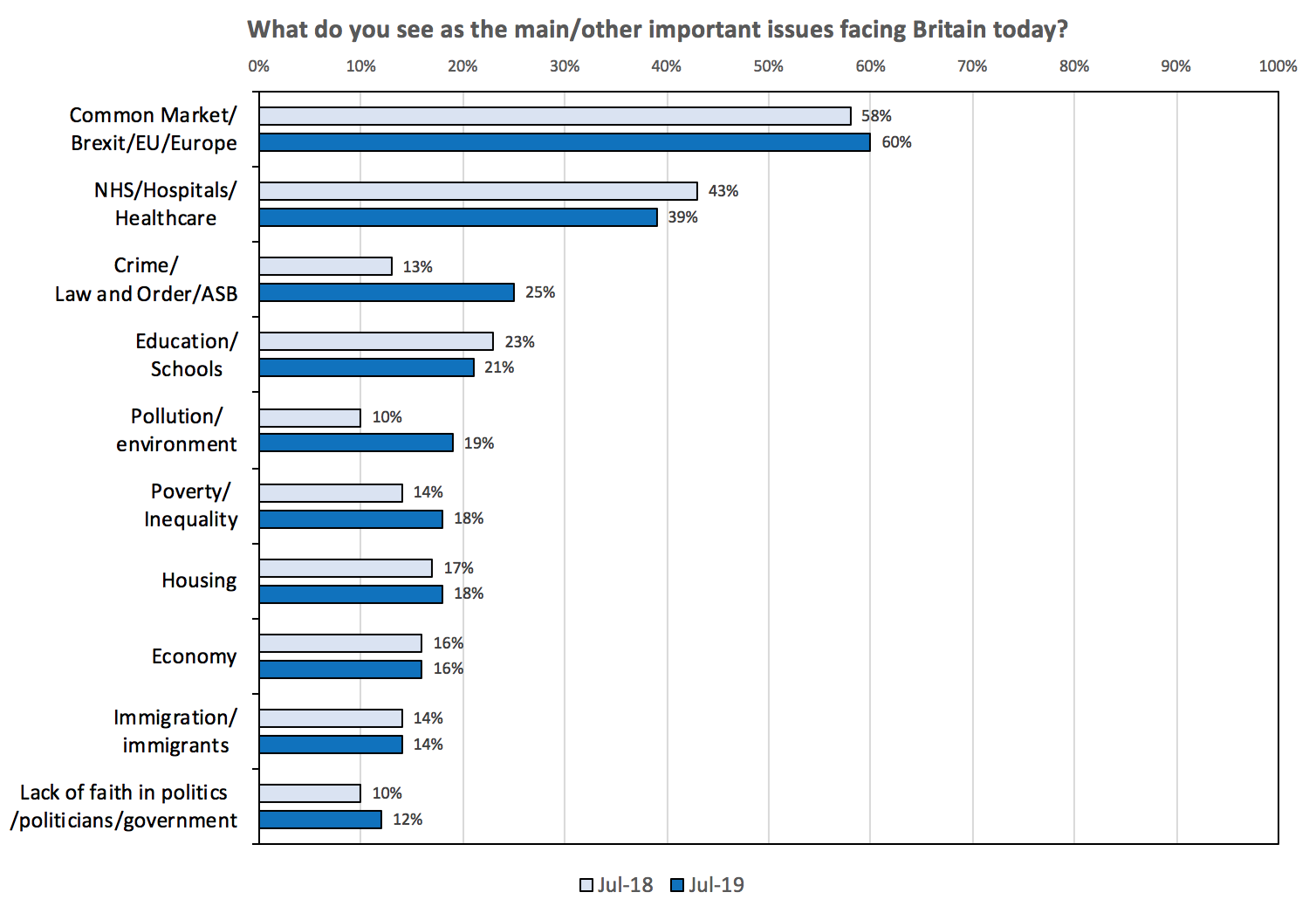
Ipsos Mori Issues Index, 2018-2019
Second, in the eyes of many voters Johnson suffers from a credibility gap that was exposed during the leadership contest. His record in government was decidedly mixed and many have questioned whether he possess the temperament to be an effective Prime Minister. In recognition of this, Johnson’s team have repeatedly turned to criminal justice in order to present a counter-narrative based upon his experience as the Mayor of London and the successes (real or perceived) that he had in reducing knife crime across the capital.
Third, Johnson’s government has extremely limited room for policy manoeuvre. The Conservatives have a working majority in Parliament of just one, the civil service is consumed by Brexit planning, and the latitude for additional spending is severely constrained by the current budget settlement. Within such a restrictive operating environment, rhetorical shifts on emotive issues such as crime and immigration can deliver marginal gains despite the fact the underlying legislative or policy framework has remained largely unchanged; a process Steve Farrell et al have characterised as ‘communicative dissonance’.
Fourth, it is increasingly apparent that ten-years of austerity has become an electoral liability for the Conservative Party and a firm point of difference for Labour.
Decoupling the Conservative brand from its cornerstone economic policy, while maintaining a reputation for fiscal prudence, has proved extremely difficult. In this context investment in ‘frontline services’, such as the police, presents an attractive option for policy-makers seeking to square the circle of post-austerity politics.
Brexit: The ‘elephant in the room’….
Ordinarily these measures – in conjunction with recent announcements on public sector pay and the NHS – might be expected to appeal to the Conservative base and some swing voters. But these are very far from ordinary times. The fate of the current government is inexorably linked to Brexit and this single issue will continue to dominate the political agenda to the exclusion of all else. Europe has accentuated longstanding ideological differences within the Conservative Party (as it has within the Labour movement) and this promoted diametrically opposed positions on how best to respond to the challenges of contemporary statecraft.
The sudden change of direction on penal policy this summer may be the latest manifestation of this conflict, but it is unlikely to be the last.
Thomas Guiney
Second, in the eyes of many voters Johnson suffers from a credibility gap that was exposed during the leadership contest. His record in government was decidedly mixed and many have questioned whether he possess the temperament to be an effective Prime Minister. In recognition of this, Johnson’s team have repeatedly turned to criminal justice in order to present a counter-narrative based upon his experience as the Mayor of London and the successes (real or perceived) that he had in reducing knife crime across the capital.
Third, Johnson’s government has extremely limited room for policy manoeuvre. The Conservatives have a working majority in Parliament of just one, the civil service is consumed by Brexit planning, and the latitude for additional spending is severely constrained by the current budget settlement. Within such a restrictive operating environment, rhetorical shifts on emotive issues such as crime and immigration can deliver marginal gains despite the fact the underlying legislative or policy framework has remained largely unchanged; a process Steve Farrell et al have characterised as ‘communicative dissonance’.
Fourth, it is increasingly apparent that ten-years of austerity has become an electoral liability for the Conservative Party and a firm point of difference for Labour.
Decoupling the Conservative brand from its cornerstone economic policy, while maintaining a reputation for fiscal prudence, has proved extremely difficult. In this context investment in ‘frontline services’, such as the police, presents an attractive option for policy-makers seeking to square the circle of post-austerity politics.
Brexit: The ‘elephant in the room’….
Ordinarily these measures – in conjunction with recent announcements on public sector pay and the NHS – might be expected to appeal to the Conservative base and some swing voters. But these are very far from ordinary times. The fate of the current government is inexorably linked to Brexit and this single issue will continue to dominate the political agenda to the exclusion of all else. Europe has accentuated longstanding ideological differences within the Conservative Party (as it has within the Labour movement) and this promoted diametrically opposed positions on how best to respond to the challenges of contemporary statecraft.
The sudden change of direction on penal policy this summer may be the latest manifestation of this conflict, but it is unlikely to be the last.
Thomas Guiney
Lecturer in Criminology at Oxford Brookes.
Thursday, 22 August 2019
More Strong Leadership
Just to keep things ticking over whilst we await something significant, here's the Press Release on the latest inspection of London CRC:-
London probation service continues to improve performance
A London probation service has made “considerable efforts” to improve the quality of its work over the past year, according to inspectors.
HM Inspectorate of Probation conducted a routine inspection of London Community Rehabilitation Company (CRC), which supervises nearly 29,000 low and medium-risk offenders across the capital.
The Inspectorate looked at 10 aspects of the CRC’s work and rated performance against half of these as ‘good’ and half as ‘requiring improvement’. Based on these findings, the Inspectorate has given the organisation an overall rating of ‘Requires improvement’.
Chief Inspector of Probation Justin Russell said: “London CRC continues to improve and has taken on board many of the recommendations from last year’s inspection. Now, the CRC offers good support for people leaving prison and better supervision for people who complete unpaid work in the community. The CRC has also developed effective relationships with partners and stakeholders.
“There is a strong leadership team, and staff are empowered to deliver services that will bring about lasting changes in the lives of vulnerable people. The staff we interviewed were well motivated and positive about their work and the organisation.
“However, London CRC needs to better support individuals to rehabilitate and to move away from further offending. We found a good range of services available to support people with basic needs and to tackle their offending behaviour, but it is disappointing to find that these services are not being delivered consistently in the inspected cases.
“Probation staff also need to assess and manage the risks that every offender poses to the community; we found the quality of this work needs to improve.”
Probation staff had not adequately assessed the risk of harm posed to actual and potential victims in nearly half (48 per cent) of inspected cases. Staff were also not paying enough attention to information from partners, such as the police or children’s social care services, or of past aggressive behaviour.
The Inspectorate found recruiting and retaining good-quality staff continues to be an issue in the capital. Workloads are high – more than three-quarters (77 per cent) of interviewed staff said they managed more than 55 cases.
Inspectors found leaders had put an “impressive” HR strategy in place and fewer staff had left the organisation over the past nine months. Around one in four probation staff are agency workers, and the CRC is in the process of converting some of these roles into permanent positions.
The Inspectorate is calling for further action to improve office accommodation and ensure staff stay safe while carrying out their duties.
Mr Russell said: “London CRC shares 19 of its 22 offices with the London National Probation Service, which is responsible for supervising high-risk offenders. The Ministry of Justice is responsible for managing these premises but, at the time of inspection, we found some urgent problems with the building and a long list of less-urgent repairs that required attention.
“Systems and processes that are supposed to protect staff require improvement. Staff often work on a one-to-one basis with people under supervision and have been given safety devices for their protection. Inspectors found some devices did not work; staff also reported that some offices had a very limited number of devices, which could prevent them from carrying out home visits as and when needed.”
The Inspectorate has made six recommendations with the aim of improving London CRC’s performance.
Saturday, 17 August 2019
Class War
Just to keep things ticking over, here's a reminder from the Guardian of how the criminal justice system is unashamedly used for political ends:-
Boris Johnson’s crackdown on crime is just the latest ruse in the Tories’ class war
Our so-called justice system exists to crack down on the misdemeanours of the poor, while ignoring the crimes committed by the rich. When Boris Johnson proposes a law-and-order clampdown – driven by cynical electioneering, rather than actual evidence – he’s talking about locking up the “people you step over in the street”, as Frances Crook, the CEO of the Howard League for Penal Reform, puts it, not reckless bankers or white-collar fraudsters.
Lock ’em up, throw away the key: such demagoguery always has an innate emotional appeal, not least among a public enraged by increased violent crime, which is itself fuelled by a decade of slash-and-burn Tory economic policies. But further brutalising those already roughed up by a social order rigged in favour of yacht owners, financiers and the residents of Mayfair will satisfy the bloodlust of the Daily Mail and achieve little else.
The justice system has long been an instrument of class power. Under the “Bloody Code” of the late 18th and early 19th centuries, death sentences for property crimes proliferated: stealing sheep, thieving from a shipwreck, or pickpocketing could all lead to the gallows. Today, we tend to lock up mentally ill poor people, disproportionately from minority backgrounds, for non-violent offences.
According to the Prison Reform Trust, more than seven in 10 prisoners report mental health issues, a quarter of inmates are from a minority ethnic group, and more than one in five with sentences of less than six months are homeless. Nearly seven out of 10 languishing behind bars are there for non-violent offences.
If the government truly wanted less crime, it would reverse the cuts to youth services – slashed in real terms by 40% in the last three years alone – which a recent parliamentary report found had led to increased knife crime. It would clamp down on school exclusions: these have surged by 50% since 2016, partly to enable schools to climb league tables, driving some of the abandoned children into crime. It would entirely reverse the real-terms cuts to schools and the gutting of sixth forms. It would properly support a mental health service which turns away more than 100,000 children every year. It would confront a housing crisis which has left a generation without security or roots, and deal decisively with a squeeze in living standards that has particularly hurt younger people.
But the Tory party has spent a near-decade forcing the majority to pay the bill for the economic wreckage caused by its City of London donors: it is the custodian of a social order that robs humans of security and dignity.
If prison is a deterrent, why are nearly half of adults convicted of another offence within a year of release? There are already more people in Britain serving a life sentence than in Germany, France and Italy combined – but has it left us safer? Why has a report by the National Audit Office found no link between prison population numbers and the level of crime in different countries?
We leave prisoners locked up in squalid conditions for up to 23 hours a day, instead of focusing on education, training, exercise, and other means of rehabilitation – as called for by the Howard League – so why are we surprised that prison becomes a school of crime? There are few places worse for someone with mental health issues than prisons, rife as they are with violence and drug abuse, and shocking rates of suicide and self-injury.
Chris Grayling’s part-privatisation of probation has had a disastrous impact – and Johnson’s plans will undoubtedly prove a boon to profiteers such as Serco, which was fined millions for using taxpayers’ money to fraudulently tag non-existent people, and a calamity for the rest of us.
If the government had sense, it would learn from Norway, which has shorter sentences, fewer prisoners, humane prisons and an emphasis on rehabilitation: there, just 20% of convicts reoffend within two years, among the world’s lowest rates. It would learn from Portugal in decriminalising drugs and treating them as a public health issue: the country has the lowest drug mortality rate in western Europe, drug use is below Europe’s average, and the number of those incarcerated for drug offences has more than halved. But in the UK, no such sense is to be found.
While the justice system is a stick for the poor, it offers an abundance of carrots for Britain’s rich. Iceland managed to lock up dozens of bankers and CEOs for crimes committed in the run-up to the 2008 financial crash – but not one senior banking executive has been jailed in Britain or the US for their roles in unleashing misery that millions continue to suffer from.
The tax system is riddled with loopholes available only to the rich and big corporations, depriving the exchequer of billions of pounds at a time when we’re constantly told there isn’t enough money for basic services. Meanwhile, benefit fraudsters are sentenced for appropriating far smaller sums. Since 2011, UK prosecutions for financial crimes – supposed “white collar crime” – have collapsed by 26%, even though the number of offences has quadrupled. Nearly a decade ago, one leading judge declared that the justice system has an inbuilt bias favouring the wealthy; since then, the decimation of legal aid has left it rigged even more in favour of the rich.
The law continues to crash down on the backs of the poor – while pandering to the rich.
Johnson is seeking to turn a national crisis that has been stoked by his own party’s actions into an electoral problem for his opponents – and he will be aided and abetted by the rightwing press. But he is merely upholding a centuries-old tradition of protecting a social order rigged in favour of his own class.
If you are rich and destroy the economy, engage in white collar fraud, snort cocaine – you’re still likely to live unimpeded in affluence, continuing to be invited to mingle with the not-so-great-and-good of society. But if you are a black teenager in Hackney found in possession of cannabis by the police, your whole life could crash down around you. Whatever this is – it’s certainly not justice.
Owen Jones is a Guardian columnist.
Subscribe to:
Posts (Atom)