Some of this is a little old, but there's been a lot going on recently. The position of people with either mental health issues or learning disabilities in the criminal justice system has long bothered me and this Guardian article highlights a new report on the subject:-
UK justice system failing defendants with mental health issues – charity
Specialist prosecutors should review all decisions to charge suspects with mental health vulnerabilities and the defence of insanity should be amended, a law reform charity has said. Defendants with learning disabilities and mental illness are repeatedly being failed by the criminal justice system in England and Wales, the report by Justice claims.
About a quarter of adults are diagnosed with a mental illness during their lifetime, and the proportion caught up in the criminal justice system is even higher. They need to be more clearly identified and supported, the study argues. If problems are not addressed, the fair trial rights of many defendants may be undermined, Justice says. The report says mental health experts, not police officers, should identify people with mental ill-health or learning disabilities.
Among other recommendations, the report says specialist prosecutors should be appointed for each Crown Prosecution Service area to make charging decisions in such vulnerable cases. Magistrates courts, youth courts and the crown court should have a dedicated mental health judge to deal with management of such cases, Justice proposes. A new capacity-based test of fitness to plead and fitness to stand trial should be placed on a statutory footing, the report adds. The defence of insanity should be amended to a defence of “not criminally responsible by reason of a recognised medical condition”.
Fresh sentencing guidelines on mental health and vulnerability should be developed and a broader range of alternative punishments made available to sentencers to meet the needs of these cases, Justice says. “Too many criminal justice actors, all along its pathways, are unfamiliar with the range of mental health conditions and learning disabilities that can create vulnerability nor what to do about them,” the report notes.
Sir David Latham, chair of the Justice working party, said vulnerability should be “properly identified and, where identified, properly approached so that the person either receives reasonable adjustments to give them the capacity to effectively participate in their defence, or if appropriate, is not prosecuted. Where a person is diverted from prosecution or prison, suitable and effective treatment and support must be available to ensure that the person remains outside of the criminal justice system.”
Andrea Coomber, the director of Justice said: “The criminal justice system is not suitably designed to accommodate people with mental health or learning difficulties. There are still fundamental problems with the criminal justice system’s response to vulnerability and too few people receive reasonable adjustments to enable them to effectively participate in their defence. “We are impressed by the efforts being made to create an integrated criminal justice and mental health sector. We hope that this report will build on that and bring about change for some of the country’s most vulnerable people.”
--oo00oo--
I'm not at all sure this new 'protocol' announced by David Lidington will make a blind bit of difference in improving the prison situation and just smacks of so much 'hot air'. This from the Guardian:-
Prison inspectors given powers to alert minister to urgent problems
The justice secretary, David Lidington, has unveiled a series of measures that the government hopes will urgently tackle failing prisons in England and Wales. From Thursday, the chief inspector of prisons has been given new powers to alert the justice secretary directly of any urgent and severe problems he finds during a jail inspection.
This “urgent notification protocol” requires the minister to publish an action plan within 28 days to tackle the concerns raised. A team of specialists will also be assembled to ensure immediate action is taken and implement a longer-term plan to ensure sustained improvement.
The stronger inspection powers had been part of the prisons and courts bill that was dropped after the Conservative government lost its Commons majority in the general election. However, the protocol – which covers both private and public jails – has been agreed without the need for legislation by Lidington, HM Prison and Probation Service, and inspectors.
Peter Clarke, the chief inspector of prisons, said the new process should provide an effective and speedy response to the most serious incidents and circumstances. Clarke’s recent reports have documented an alarming deterioration of conditions in English and Welsh prisons, including high levels of violence, increasing drug use and record levels of assaults and self-harm.
Lidington said: “Openness and transparency are powerful instruments of change and I believe we should be accountable so the public can see exactly what we are doing to turn prisons into safe places where offenders can change their lives. A team of specialists will now respond when HM Inspectorate of Prisons (HMIP) trigger urgent notification to urgently drive improvements and ensure that prisons are safe, secure and providing a regular regime. To implement these action plans and improve safety, the recruitment of an additional 2,500 prison officers is key and we are already halfway towards reaching that target.”
Clarke said Lidington had accepted that he and his successors would be held accountable for delivering an “urgent, robust and effective response to when HMIP assesses that treatment or conditions in a jail raise such significant concerns that urgent action is required.” Clarke said it was the responsibility of the prison service , and not inspectors, to implement and monitor improvements. “HMIP will take account of a range of factors to decide when, in the judgment of the chief inspector, a prison should next be inspected. If for any reason an HMIP recommendation is not accepted, we would expect the rationale to be explained and published.”
Under the protocol the chief inspector will decide at the conclusion of an inspection whether there are significant concerns that need to be brought to the attention of the secretary of state. Formal notification will be made within seven days and a letter detailing the concerns will be published 24 hours after it has been sent privately. In 1995, a team of inspectors walked out of Holloway prison after finding a filthy, rat-infested environment overrun with cockroaches and where women prisoners were locked in their cells most of the day.
I'm not at all sure this new 'protocol' announced by David Lidington will make a blind bit of difference in improving the prison situation and just smacks of so much 'hot air'. This from the Guardian:-
Prison inspectors given powers to alert minister to urgent problems
The justice secretary, David Lidington, has unveiled a series of measures that the government hopes will urgently tackle failing prisons in England and Wales. From Thursday, the chief inspector of prisons has been given new powers to alert the justice secretary directly of any urgent and severe problems he finds during a jail inspection.
This “urgent notification protocol” requires the minister to publish an action plan within 28 days to tackle the concerns raised. A team of specialists will also be assembled to ensure immediate action is taken and implement a longer-term plan to ensure sustained improvement.
The stronger inspection powers had been part of the prisons and courts bill that was dropped after the Conservative government lost its Commons majority in the general election. However, the protocol – which covers both private and public jails – has been agreed without the need for legislation by Lidington, HM Prison and Probation Service, and inspectors.
Peter Clarke, the chief inspector of prisons, said the new process should provide an effective and speedy response to the most serious incidents and circumstances. Clarke’s recent reports have documented an alarming deterioration of conditions in English and Welsh prisons, including high levels of violence, increasing drug use and record levels of assaults and self-harm.
Lidington said: “Openness and transparency are powerful instruments of change and I believe we should be accountable so the public can see exactly what we are doing to turn prisons into safe places where offenders can change their lives. A team of specialists will now respond when HM Inspectorate of Prisons (HMIP) trigger urgent notification to urgently drive improvements and ensure that prisons are safe, secure and providing a regular regime. To implement these action plans and improve safety, the recruitment of an additional 2,500 prison officers is key and we are already halfway towards reaching that target.”
Clarke said Lidington had accepted that he and his successors would be held accountable for delivering an “urgent, robust and effective response to when HMIP assesses that treatment or conditions in a jail raise such significant concerns that urgent action is required.” Clarke said it was the responsibility of the prison service , and not inspectors, to implement and monitor improvements. “HMIP will take account of a range of factors to decide when, in the judgment of the chief inspector, a prison should next be inspected. If for any reason an HMIP recommendation is not accepted, we would expect the rationale to be explained and published.”
Under the protocol the chief inspector will decide at the conclusion of an inspection whether there are significant concerns that need to be brought to the attention of the secretary of state. Formal notification will be made within seven days and a letter detailing the concerns will be published 24 hours after it has been sent privately. In 1995, a team of inspectors walked out of Holloway prison after finding a filthy, rat-infested environment overrun with cockroaches and where women prisoners were locked in their cells most of the day.
--oo00oo--
Here we have the latest figures regarding IPP prisoners as a result of a parliamentary question:-
Richard Burgon Shadow Lord Chancellor and Shadow Secretary of State for Justice
To ask the Secretary of State for Justice, how many prisoners serving IPP sentences have served (a) twice, (b) thrice, (c) four times, (d) five times and (e) six times longer or more than their original minimum sentences.
Sam Gyimah The Parliamentary Under-Secretary of State for Justice
The number of prisoners serving IPP sentences as at 30 September 2017 who have served (a) twice, (b) thrice, (c) four times, (d) five times and (e) six times longer or more than their original minimum sentences can be viewed in the table below. We are determined to address the challenge of making sure all IPP prisoners have the support they need to show they are no longer a threat to public safety. We have been working closely with the Parole Board to process these cases as quickly as possible and, earlier this year, we set up a new unit focused on this and improving the efficiency of the parole process. This work is continuing to achieve results, with 576 IPP releases in 2016
Number of Tariff Lengths Served Number of IPPs
From 2 to less than 3 657
From 3 to less than 4 469
From 4 to less than 5 257
From 5 to less than 6 157
6 or more 275
--oo00oo--
A week or so ago the BBC Victoria Derbyshire programme covered an all-too-familiar sad tale of life in Britain for those at rock bottom and for whom prison is preferable to street homelessness. It also highlights the pernicious nature of that other Blair innovation the Anti Social Behaviour Order.
'I asked to go to jail, rather than stay homeless'
Banned from begging and sleeping in shop doorways in Middlesbrough, Bradley Grimes asked the judge in court to send him to prison rather than leave him homeless. What effect did it have? "All they've done is placed an anti-social behaviour order on me to try and stop me from begging. But I have to in order to survive," Bradley Grimes tells the BBC's Victoria Derbyshire programme.
He became homeless after leaving the care system aged 17. With autism and, in his own words, the mental age of a "young child", he was unable to find work and frequently turned to begging - asking passers-by for food and money at the side of a busy street. But this led to Middlesbrough Council giving him an anti-social behaviour order, or Asbo. It came with a condition banning him from "loitering" outside business premises.
Bradley says it prevented him from "basically sitting outside a shop" and sleeping in doorways for warmth, and meant he was continually arrested. "CCTV picks you up and they dispatch either the police or street wardens. If police come, you're arrested," explains Bradley, who's now 23. He says he attracted the authorities' attention for sitting rested against a bus stop.
"It got to the stage where they were locking me up once or twice a day, for a period of a few months. I was in [prison] pretty much all weekend, near enough every weekend. I can't even sit on a public bench without being locked up. I have to keep moving."
Frustrated at his situation, he decided to seek help - albeit in an unusual form. When in court, charged with breaching a four-month suspended jail sentence - something he admitted to doing - he asked the judge to send him to prison. He hoped it would pave the way to him being found suitable accommodation.
"That's the last option I had, that I could think of," he explains. The judge was sympathetic, and was reported in October this year as saying that "essentially we are locking up a homeless man for being homeless. I want him housed somewhere so that his welfare can be looked after. It is not good enough for the authorities to turn around and say that it is somebody else's problem. If I were to let you go today the chances are that you would be sitting on a seat or sleeping in a shop doorway and you will be locked up again."
By November, Bradley was released - with supported accommodation made available. He had lived in the same building previously, but says he was told to leave after cannabis was found in his room. Bradley has also had problems with Class A drugs, which he says he used "to take the pain away".
This time he says he is determined to live clean, and has avoided drugs since his release. Bradley says life can still be tough. In fact, he believes that because of his autism, it was simpler in prison. "You don't have to worry about anything in [jail]. [Whereas on the outside] it's impossible for me to cope on my own, because I'm bad with things like budget and money."
When Bradley left prison in Durham, he had just £17 to his name - most of which he used for the train journey back to Middlesbrough. He has now applied for benefits, which he is waiting to receive, but says his lack of funds over time has had a significant impact on his health. Bradley has a brain tumour - and suffers with epilepsy and a heart murmur - but says he cannot afford to travel to the specialist cancer centre in Newcastle for treatment. He says his story could have been different had he been supported sufficiently by the local authority when he first became homeless. Instead, he claims he was sent from one agency to another.
Middlesbrough Council has not yet responded to request for comment. While walking around town Bradley spots a friend, a homeless man named Tony who says he cannot get any help at all. Tony says he has to steal from drug dealers to have enough money to survive. It is not something Bradley condones, but the desperation behind the act is something he says he understands.
When Bradley left prison in Durham, he had just £17 to his name - most of which he used for the train journey back to Middlesbrough. He has now applied for benefits, which he is waiting to receive, but says his lack of funds over time has had a significant impact on his health. Bradley has a brain tumour - and suffers with epilepsy and a heart murmur - but says he cannot afford to travel to the specialist cancer centre in Newcastle for treatment. He says his story could have been different had he been supported sufficiently by the local authority when he first became homeless. Instead, he claims he was sent from one agency to another.
Middlesbrough Council has not yet responded to request for comment. While walking around town Bradley spots a friend, a homeless man named Tony who says he cannot get any help at all. Tony says he has to steal from drug dealers to have enough money to survive. It is not something Bradley condones, but the desperation behind the act is something he says he understands.
--oo00oo--
Finally, we can always rely on Private Eye to keep the TR omnishambles saga on the news agenda:-
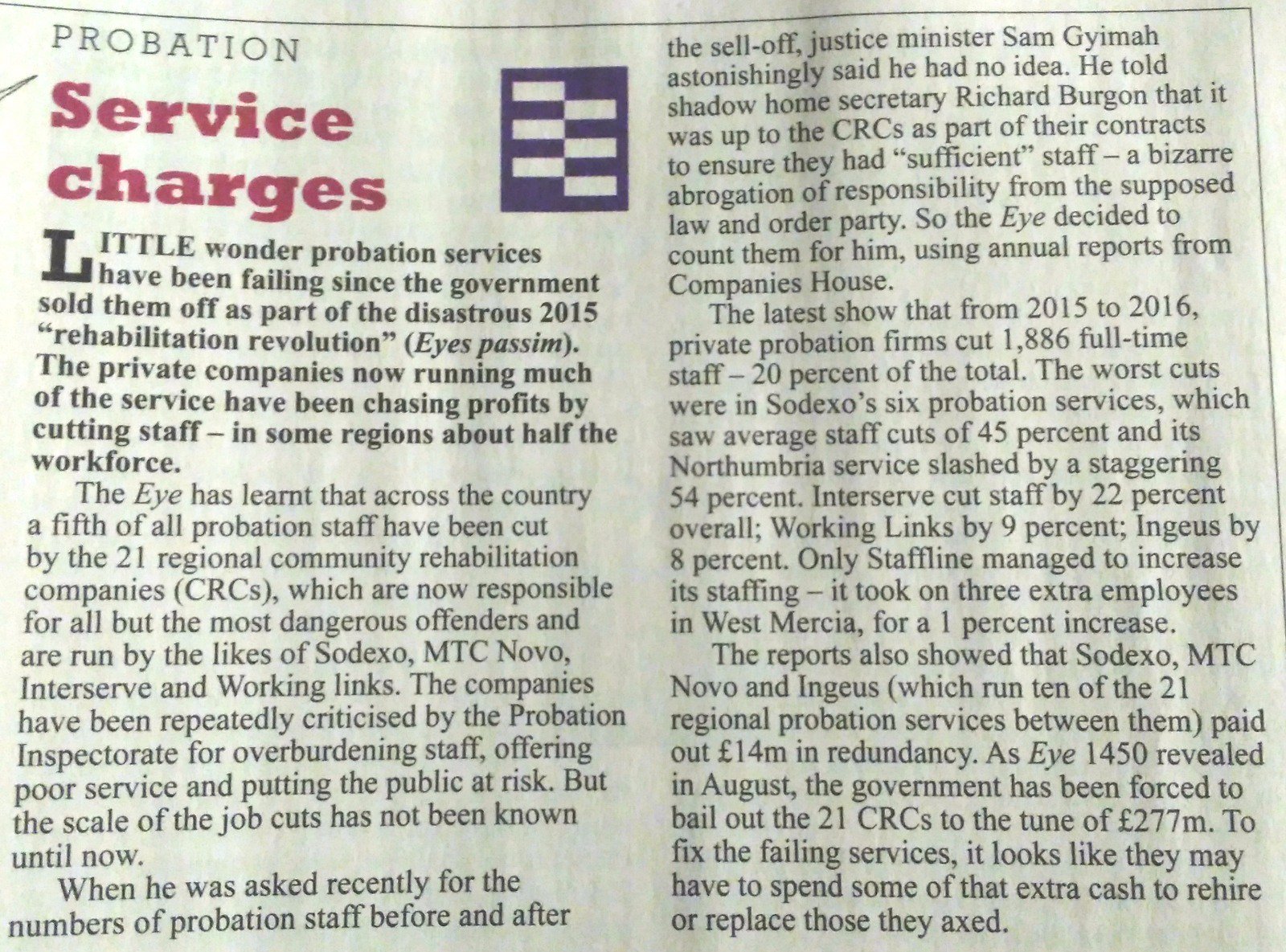
Finally, we can always rely on Private Eye to keep the TR omnishambles saga on the news agenda:-