Friday, 14 October 2022

Down to the Sea


Napo Conference 2022 Day One

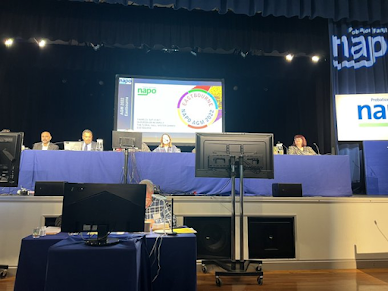
A damp misty afternoon in The Winter Gardens Eastbourne set the scene for Napo’s AGM. The event that is both in person and virtual felt like a much smaller more subdued affair than the last time it was held here. There were less people in the hall and the lighting on the top table was overly bright with a large screen positioned so that they were obscured but they could no doubt see the virtual participants.

The conference opened with the traditional roll call with the usual murmurs when Merseyside Branch were not present. With some branches only fielding a few attendees some of the cheers seemed a bit strained. Some members will remember conferences past when branches would proudly drape their banners around the hall and the roll call was met with loud cheers from the larger branches with London alone fielding ninety participants.

The departing Chair Katie Lomas gave a very lengthy and somewhat overly self congratulatory address that provoked a somewhat Marmite response from the faithful, many of whom had found something more interesting to look at on their phones. Katie’s super power is to speak without pause or hesitation for hours on end without giving way. Noticeably not everyone in the hall stood to applaud her, though several woke up at that point.

I imagine many could not help thinking that the appalling pay deal will be her lasting legacy and her comments about the unstinting support of the General Secretary felt odd and slightly disingenuous. Indeed Ian Lawrence seemed uncharacteristically subdued and uncomfortable in the glare of the lights that for an unapologetic narcissist and serial grandstander might count as somewhat odd behaviour. Perhaps he is worried that he is being gradually reduced to a sort of figurehead. Perhaps he will perk up when we get to motion number 12 that will be the ideal opportunity for members to express their confidence in him.

Then on to formal business as ever with the mild mannered and seemingly never changing Jeanne Peall giving the order of business. I sometimes wonder if they keep Jeanne cryogenically frozen between AGMs as she seems unchanged for as long as I have been attending AGMs. Perhaps she should be given some sort of long service award.

Appearing virtually mid trial from Leicester Crown Court, conference were treated to an eloquent address from the former chair of the Criminal Bar Association Jo Sidhu KC. The down at hand made Locke shoe barristers have settled for a £40m bung but they went on strike and perhaps serve as an example to probation service employees as the lawyers have only been on strike twice and united are proving a force to be reckoned with. There is also the matter of a build up of court cases potentially bringing the entire system to a juddering halt at a politically interesting and sensitive time.

Liz Saville Roberts appeared after conference were treated to Shadow Justice Minister Lord Ponsonby welcoming the @CommonsJustice IPP sentences report and its call for greater probation resourcing.

Liz spoke at length about the importance of the Justice Unions Parliamentary Group that is a surprisingly politically diverse group. Reading between the lines LSR appeared to be saying that they need more evidence from Napo to score points in Parliament and when this happens it has an impact. I think Napo employ someone full time to do this but correct me if I am wrong. I for one have always thought that in the past Napo has been at its best when it makes friends with politicians from different political affiliations through the group as this is how you exert influence and speak truth to power. 

Napo is not tied to a particular political party although as a trade union we might reasonably assume that they are ideologically inclined towards Labour. If they were to box clever however they might discover some MPs in other parties might be receptive to sensible suggestions and spread the word. A well placed question or a timely report can do wonders. I cannot fail to observe that in recent years Napo has become less relevant and it would have been good to hear from the new justice secretary or from Labours shadow justice team about their plans for probation. Failing that Napo could have bagged Rory Stewart who always seems to have something interesting to say and who is apparently available with time on his hands.

Some readers will remember the protest London Branch led at the last conference regarding voting both virtually and regarding remote devices in the hall. This was highlighted after a vote regarding a pretty clear cut motion in support of inclusion and diversity and anti discriminatory practice. Some of their suggestions made then have been adopted but a member from Essex Chris Pearson was moved to comment that people seemed to be pressing all the the wrong buttons as uncontroversial motions with no speakers against still had as many as 14% of members recorded as voting against. Perhaps a test should have been conducted.

Motion 17 Hands off Our Pay saw the return of Napo stalwart Keith Stockeld to the podium. Though no one would perhaps disagree with the sentiment of this somewhat rambling to be reckoned with motion. Its main thrust was to oppose the imposition of a regional pay structure. That battle has it seems already been won so technically Keith should have either withdrawn the motion or tabled an amendment. Ho hum. It was carried anyway so officers and officials can tick any action following the motion immediately as completed.

Motion 26 by Napo Cymru to value experienced staff with an interesting amendment saw veteran Napo activists Su McConnel and David Raho take the podium to propose and speak in support of the motion. Su spoke from the heart about the retention of experienced staff and the need for employers to take urgent action to address the issue. David reminded members that experienced staff were the backbone and lifeblood of the service and made clear that something had to be done to stop the departure of those who often function as the stable core in probation offices. Incredible then that 14% voted against valuing experienced staff. What the …….? Just as things looked to be finally warming up, it was the end and off to fringe meetings.

A Reader

Thursday, 13 October 2022

Too Difficult To Handle

We've discussed the disgraceful IPP situation many times on here and now we have yet another report, this time from the Centre for Crime and Justice Studies. Of course it all makes perfect sense in charting a way forward in sorting the situation, but I suspect it sadly falls into that political category of 'too difficult to handle' and joins that other thorny matter of drugs. Our polarised and toxic political environment, controlled as it is by the right-wing tabloid press, sadly means no common sense can be heard on either topic due to it being inevitably categorised as 'soft on criminals and/or drugs'. 

A perfect example of the situation is provided by Cruella Braverman the other day flying the kite of designating cannabis as a Class A drug. Complete bollocks as an idea of course, but absolutely typical of a politician 'on the make' aiming for supportive headlines in the likes of the Daily Mail. Happily she is highly likely to disappear without trace at the next General Election, such is the state of the developing Tory party implosion. However, I suspect there is zero chance of any incoming Labour government going public in support of either drug or IPP reform. Report announcement here:-    

Imprisonment for Public Protection: Psychic Pain Redoubled

A timely assessment of the profound psychological toll of the Imprisonment for Public Protection sentence and what needs to be done.


Imprisonment for Public Protection (IPP) has memorably been described by a former Supreme Court Judge, Lord Brown, as “the greatest single stain on our criminal justice system”.

The present report explores some of the main reasons for that assessment. It is a compilation and review of the available evidence about the psychological impacts of the sentence, covering:
  • Pre-existing conditions affecting many subjected to the IPP sentence
  • Feelings of uncertainty and helplessness the sentence provokes
  • The psychological obstacle course those subject to the IPP sentence are expected to negotiate
  • The long-term effects of the sentence
  • The persistence of anxiety, even following release and resettlement
The distressing experiences of prisoners under IPP, the report argues, demand urgent action to abolish the sentence once and for all. They also demand action to guarantee that there is no repetition of the IPP sentence. All forms of preventive and indefinite detention carry the same risks, and proper safeguards must be firmly established.

The whole history of IPP should be the subject of concerted political, legal and psychological inquiry, so that its systematic flaws can be determined. In its place there should be a coherent alternative framework that will inform future criminal justice legislation and can be incorporated in an overarching constitutional law.

Recommendations include:
  • The release, without delay, of prisoners on IPP sentences who have served time beyond the tariff set by the court.
  • The setting of a clear, determinate, release date for all other IPP sentenced prisoners, either through judicial or executive decision-making.
  • Mental health assessments and safeguarding measures should be part of the planning and support arrangements for release.
  • A programme of close and immediate support for released IPP prisoners to enable them to adjust satisfactorily to freedom.
  • The offer of adequate and prompt state reparations to IPP prisoners, on the basis of failures to provide programmes or meet known mental health needs, and unjustified time in confinement.
  • The creation of an overarching legislative Code, influenced by provisions in the Human Rights Act, against which any future proposals for legislation on indefinite detention should be tested.

Wednesday, 12 October 2022

HMI Plea Falls on Deaf Ears

Even before we get to the subject of todays blog post - an extraordinarily blunt statement from HMI Justin Russell demanding more prison staff - I feel compelled to mention the fact that the government of Liz Truss must surely be close to falling. It's pretty clear every aspect of her policies, bar removal of the National Insurance increase, are about to fail. The BBC is reporting Tory MP's are talking to Labour about defeating a return to fracking; the pound is plunging and Bank of England will not carry on with its support beyond Friday; impending benefit cuts have no chance of getting through Parliament and Labour have just been put on a war footing with a General Election expected. The Economist does not mince its words:-

 There is no way for her to go back to the way things were before

Liz truss is already a historical figure. However long she now lasts in office, she is set to be remembered as the prime minister whose grip on power was the shortest in British political history. Ms Truss entered Downing Street on September 6th. She blew up her own government with a package of unfunded tax cuts and energy-price guarantees on September 23rd. Take away the ten days of mourning after the death of the queen, and she had seven days in control. That is the shelf-life of a lettuce. 

--oo00oo-- 

So, with inflation rapidly rising, mortgage interest rates set to soar, widespread industrial action taking place or impending and extensive public spending cuts expected, it's hard to avoid the conclusion that we are rapidly descending into potential chaos with very little hope of a positive response to well-argued pleas such as this from yesterday:-  

Chief Inspector's blog: short-staffing in prisons must be tackled

HMP/YOI Woodhill near Milton Keynes and HMP Swaleside on the Isle of Sheppey are similar-sized men’s prisons that are part of the long-term, high-secure estate. Both house prisoners mainly from London and the South East who are often serving long sentences. Both jails have recently been in the headlines: Woodhill has been forced to close temporarily its high security separation centre, where prisoners are moved to prevent them radicalising other inmates. Swaleside, meanwhile, experienced serious, concerted indiscipline requiring the intervention of specialist tornado teams to restore order.

In the last 18 months we have conducted full inspections of both prisons and, more recently, followed up with shorter independent reviews of progress. Both establishments were, and continued to be, seriously short-staffed.

So serious was the situation at Woodhill, that we considered making just one overarching recommendation – get enough officers.

This situation was not new. Reports going back many years describe a similar picture at the jail. In 2014, we said that the amount of time prisoners were spending out of their cells ‘was very limited and reduced by staff shortages’. Likewise, in 2018, we described the staffing situation as ‘underpinning nearly all the concerns raised in this report’.

Perhaps unsurprisingly, when we returned to Woodhill in April for our interim review, staff shortages continued to inhibit progress despite significant effort from the leadership team.

The lack of staff at Swaleside had also severely affected prison life. In our report in 2021, our first key concern was that: ‘Only around three-quarters of prison officers were available and there was a severe shortage of workshop instructors, programme delivery facilitators, health care staff, probation officers, operational support grades and caterers.’

When we returned last month for an interim review of progress, we found that the staffing situation was even worse, and the prison was still running a heavily restricted regime. Some staff and prisoners told us they felt unsafe, and levels of prisoner-on-prisoner violence had increased.

As at Woodhill, the problem of recruitment and retention was not new. The 2014 inspection report said of the offender management unit: ‘acute staff shortages had completely undermined this crucial function’ while in 2019 we said the unit was ‘chronically understaffed’.

Both prisons hold men who are serving long sentences, some of whom were in prison long before the pandemic struck. In many cases they have spent far more time in jail than the staff who are looking after them. They have also experienced past prison regimes that were less constricted with more time out of cell and better opportunities to work or attend education. Sentence plans, that set out what the prisoner needs to do to progress to less secure jails, often demand that they attend an accredited programme designed to reduce their level of risk, but shortages of staff to deliver this work mean that prisoners feel stuck and a key incentive for good behaviour is lost.

The risk for both prisons is that, as staffing levels fall, violence increases as prisoners become more frustrated. This can mean more officers leave because they feel unsafe, further adding to the difficulties at the jail.

The situation at Woodhill and Swaleside is particularly acute, with long-term, often high-risk prisoners becoming increasingly disgruntled. But we see similar difficulties with staffing in most prisons in the South East of England, where prisons have to compete with local businesses able to offer higher wages or greater flexibility, and there is competition from other prisons for staff. Jails in more remote parts of the country also struggle. Swaleside, of course, suffers from both factors.

Questions must be asked about the recruitment process, given that so many officers leave so quickly. Governors say that they can often tell very quickly which new recruits do not have the capabilities to be successful and some appear to have no idea what the job will entail. This suggests that not enough filtering is done by the prison service during the recruitment process. It also seems bizarre to me, as a former headteacher, that governors have no say over the officers who come to work in their prison and the first time they meet their new recruits is when they walk through the door on day one. The work of a prison officer is highly skilled, difficult, and at times dangerous. It also varies greatly between different prisons. Given the importance to governors of having the right team in place, this practice seems archaic.

Prison staff tell me that new recruits are getting younger. While, previously, many joined in their mid-twenties after working elsewhere – often in the forces – some new staff members have only recently left school. Prison leaders have begun to recognise that, although many of these recruits have the potential to become outstanding officers, they need more support than in the past. There is some promising work in jails such as Featherstone to put in place more comprehensive mentoring for new officers, with the aim of reducing the high numbers who currently quit within their first year.

Existing, experienced staff also need appropriate support. The prison service seems to suffer from high levels of staff sickness, with some jails particularly affected. On my visits I have been surprised by how little input officers receive, compared with their contemporaries in secure mental health settings who get weekly clinical supervision. Of course, prison officers need to be resilient, but I have been encouraged to see examples where more thought has gone into the effect that dealing with violence and aggression has on staff. In the segregation unit at Thameside, officers were given regular opportunities to talk with members of the psychology team, which they found invaluable, particularly after they had dealt with a serious incident.

Other prisons are trying out new ways of increasing and maintaining the workforce. For example, at Onley, another jail with some serious recruitment issues, leaders are piloting the recruitment of more part-time workers and considering ways to make the working pattern more amenable to family life. At Portland, the prison is putting officers who live near each other onto the same shift so they can save money by sharing a car to work.

There have also been pay rises for officers, which at some grades have been quite considerable. It is too early to see the effect, but it should at least help to stem the flow of resignations and maintain a reasonably healthy pipeline of trainees.

Drastic measures in prisons as chronically understaffed as Swaleside and Woodhill could involve temporarily reducing prisoner numbers, but that would mean housing inmates further away from home and puts pressure on other, already stretched prisons.

It seems clear that successful prisons that are running well have fewer issues with retaining their best staff. The behaviour of prisoners also has a direct effect on the morale of officers, so making sure that there is a more open and productive daily regime with genuine opportunities to learn and work will help to make prisons happier and safer.

I do not pretend that there is an easy solution here. The scale of the task is huge. But situations as dire as those in Swaleside and Woodhill simply cannot be allowed to continue.

Charlie Taylor, HM Chief Inspector of Prisons

Read the reports:

HMP/YOI Woodhill

HMP Swaleside

Tuesday, 11 October 2022

Plight of the Long-term Prisoner

Right from the beginning of my career in the Probation Service and working in a Field Team, meant that a significant proportion of the the caseload were serving custodial sentences and a few were serving life. Regular contact through visits and letter was quite normal right from first remand or sentence, as was being part of the sentence planning process. I've always felt it was a vital part of the job and good practice for all prisoners serving 12 months or more to have community contact maintained and actively supported by a field PO.

It doesn't surprise me at all that a recent report from the Prison Reform Trust on the plight of long-term prisoners paints an extremely bleak picture and despite some optimism for OMiC, I can't help but feel this is a situation created largely by the absence of former practice.    

Prison system failing to prepare long term prisoners for release

Prisoners serving long sentences are spending years in jail unsure about what they can do to prepare—and ultimately demonstrate their readiness—for release, a new report by the Prison Reform Trust reveals.

Making Progress?, is the first consultation report of the Prison Reform Trust’s Building Futures programme. It follows collaboration with people from around 30 prisons, who have all served—or will serve—a continuous period of at least ten years in custody.

The consultation found that prisoners were confused and disillusioned by the apparently simple proposition that they are required to reduce ‘risk’. Whilst talk of risk pervades prison life and affects many aspects of prisoners’ experiences, this catch-all term masks important details—risk of what, from what, to whom, in what circumstances?

Demonstrating reduced risk is of particular importance to those whose release ultimately depends upon approval by the Parole Board—and if recent proposals become law—the Secretary of State for Justice.

The report suggests that this confusion stems from a mismatch between what prisons appear to expect from prisoners—broadly, compliance with the rules—and what those in probation and the Parole Board are looking for prisoners to demonstrate to secure their own development and eventual release.

Participants told us that this was leading to them spending years of “nothing time” in prison. Years, often in the middle part of their sentence, where the sentence felt purposeless and stagnant.
“Progress? Which part? Serving a life sentence longer than I have lived—is that normal? It felt as if the prison estate did not even know what to do with us. The reality is lifers at the beginning of our sentences were just warehoused like livestock…sadly many lifers, myself included, saw progression as somewhat of a myth” A life sentenced prisoner, quoted in the report
Another highlighted that their sentence length was acting as a barrier to progression:
“Offending behaviour programmes are prioritised by earliest release date. Which means I have little to no prospect of progressing through my sentence plan or the prison system.”
For others it was their age:
“A minority (but still a substantial number) of long-term prisoners are aware that they are unlikely to live until the end of their sentence. Being rehabilitated to re-enter society is for them (myself included) a false goal.”
The report recommends that HM Prison and Probation Service should develop a long-term prisoner policy framework. It should equip staff working with long-term prisoners to assess risk; communicate this effectively with prisoners and other criminal justice professionals; and give explicit guidance and direction on what kinds of behaviour may demonstrate lowered and elevated risk in future assessments.

It also recommends earlier involvement with the Parole Board in reviewing progress. This would allow any potential roadblocks to release to be identified and a plan to be developed which outlines the steps prisoners can take. With so many years in custody to work with, the system should be aiming for far more prisoners to be ready and safe for release when the period set for punishment expires.

Executive Summary 

This report presents the findings of a prisoner consultation carried out by Prison Reform Trust’s Building Futures programme. Initial scoping work on the programme revealed that sentence progression was a major concern of people serving long sentences. For some time, worries about progression have formed a significant part of the caseload of our Advice and Information service. We carried out the consultation remotely and via a series of roundtable events. Around 100 responses were received to the consultation, which asked prisoners to reflect on four questions relating to their progression. 

Section 2 of the report describes the structure of the different kinds of long sentences being served by consultation respondents. It also unpacks two key terms in the consultation responses that follow. 

The first is ‘risk’. Prisons assess and manage a large variety of risks and the term is used in many ways. For clarity’s sake, we therefore take some time in section 2.2 to unpack the term ‘risk’: what different forms it takes, what we mean by it in the report, and some of the reasons prisoners appear to become confused or disillusioned by the apparently simple proposition that they are required to reduce it. 

The second key term is ‘progression’. Prisoners who responded to the consultation tended to understand ‘progression’ to mean something more broad than ‘risk reduction’ and a gradual reclassification into lower-security conditions as they neared the date of their release. Sections 2.3 and 2.4 question whether ‘risk reduction’ alone can provide a coherent basis for thinking about ‘progression’, given that many sentences are now decades long, meaning that offence-related rehabilitative work may be completed many years before risk can be adequately tested in the community. We suggest that what ideas of ‘progression’ will engage prisoners will depend on factors beyond risk, including the age they are at conviction, and the length of their sentences. This, we suggest, points to the need for an individualised, personalised approach to ‘progression’, sensitive to the individual circumstances of the person whose sentence is being planned. 

Section 3 sets out the findings of the consultation. Section 3.2 shows how many long-term prisoners felt confused and uncertain about how they were meant to progress or to make positive, productive use of their time. Many believed that compliance and the completion of offending behaviour programmes (OBPs) were the only expectations coming to them from the prison, and some pointed out that mere compliance offered very little to motivate or challenge them over the long term. Their evaluations of OBPs were mixed, but there was a consensus that only in rare cases was participation in them enough to secure a progressive move, leading to the perception that the sentence plan left many ‘stagnant’ years in the sentence. Respondents also described problems where information used in risk assessment could appear inaccurate, irrelevant or out-of-date. We suggest that for many, there is a mismatch between what prisons appear to expect from them (broadly, compliance), and what will secure their own development.

This led to challenges that some respondents called ‘nothing time’: the years, often in the middle part of the sentence, where the sentence felt purposeless and stagnant. Section 3.3 presents responses from those who described how they had tried to give these years purpose and meaning, for example by pursuing their own plans and objectives. Educational opportunities were of major interest to many in this group, but all kinds of prison work and other activities were described as worthwhile. Many thought that achievements in these areas went under-recognised by prisons. Respondents also suggested it was difficult to access the right opportunities, and difficult to have their efforts taken seriously and recorded by the prison. Some said taking responsibility for their own personal development required initiative, persistence and determination, and often also strong reading and writing skills to put their case to the prison. These are not possessed by all prisoners. 

Section 3.4 discusses respondents’ views on casework and on how their relationships with staff affected their progression. These views were mixed. There was positive feedback on recent changes in policy, especially relating to the introduction of the Offender Management in Custody (OMiC) policy framework. In particular, the introduction of the keyworker role was positively received by those in prisons where keywork was operational. However, respondents also expressed the view that the Prison Offender Managers (POMs) and Community Offender Managers (COMs) relationships were distant and remote, and that these did not always take account of information that the respondent saw as relevant to their personal development. In fact, respondents noted that officers on the wings, whom they saw and interacted with daily, should be more directly involved in recording information relevant to progression, as they are most likely to notice positive changes in behaviour. 

Finally, in section 4, we set out the recommendations arising from this consultation which draw on contributions from prisoners to set out ways of improving the routes to progression for long-sentenced prisoners.

Monday, 10 October 2022

Yes Another Million!

It's traditional round here to flag up the fact that another milestone will be reached at some point today when the counter records the eight-millionth 'hit' to this blog. It normally results in a certain sense of satisfaction that, despite everything, a small self-publishing enterprise with global reach and made possible by the magic of the world-wide web, still seems to have relevance and utility. 

In the very early days I used to offer a bottle of something to anyone that supplies a screen shot of the magic figure and one person managed this trick not once, but twice and such dedication was indeed rewarded with a bottle each time, and thoroughly celebrated with lengthy sessions in an appropriate pub. The offer remains, but is I suspect a difficult trick to pull off. 

Whilst it's hugely satisfying to see the nasty Tory party continuing to implode under the chaotic leadership of Liz Truss and thus signalling a Labour victory at the next General Election, we have not marshalled some effective arguments for probation's return to independence and divorce from the strangle-hold of civil service command and control. We must surely look to all Criminal Justice bodies and agencies for support, together with evidence from academe. 

Of course Professor Rob Canton recently confirmed his belief that 'advise, assist and befriend' remains relevant and probably is still the best way to protect the public. Lets hope that his recent appointment as the first Patron of the Probation Institute will signal a spirited campaign for the heart and soul of our beleaguered profession in advance of a change of government. Of course it's a tall order, not least because we stand on the threshold of massive public spending cuts and politicians of all shades are aware of there not being votes in anything that sounds 'soft' on criminals.  

It's probably worth reminding ourselves that in the Republic of Ireland, probation still operates under the old Probation of Offenders Act of 1907 and hence 'advise, assist and befriend' remains a keystone of current modern practice. It should also be noted that probation staff have recently benefitted from a significantly better pay settlement of 6.5% as reported here in the Irish Times.  

I note that over on the 'secret' Facebook group there is much ill-tempered discussion of the recent acceptance of the HMPPS pay deal and no doubt this will form part of the lively debate at the forthcoming Napo AGM in Eastbourne later this week. As always, I remain supportive of Napo and am very happy to publish Conference thoughts and reflections from members anonymously if they are minded to share them to a wider audience. I hope it's a success.             

Sunday, 9 October 2022

Governors Fire Warning Shot

Clearly the Prison Governors Association feel they know what's coming, so what chance has probation got for the future? 

6 October 2022 

Dear Lord Chancellor, 

The Prison Governors’ Association (PGA) welcomes you to your new role as Lord Chancellor and Secretary of State for Justice. Your portfolio is demanding, and we wish you well as you navigate the complexities and competing priorities of your new role. A measure of your success undoubtedly sits in the hands of our members, who fill some of the most senior roles both in prisons and headquarters. Your success, and legacy as Lord Chancellor will, above all else, be gauged by public critique of our prisons. It is our members you must enable to deliver the aspirations of Government, and not see our service as a cash cow in an economic crisis.

Although the PGA feels compelled to write to you spelling out our concerns for the future of the Prison Service, we are committed to working collaboratively to get the best possible outcomes across HMPPS, and it is appropriate to state that your CEO, DG and senior operational leaders in HMPPS retain our support and confidence. Whilst we have seen frequent and significant changes within ministerial teams across many Governments over several years, it is our members who have remained a constant within HMPPS. They are the experts: they are the best in their field, and we ask that you do not demand they make financial savings to an already impoverished agency. 

It is likely that you will be asking your department heads to identify and make significant savings to help reduce the financial burden our country is under. This is nothing new to HMPPS: recent history has shown what a disastrous impact the austerity years had on the agency and its ability to provide the most basic of services. Our prison system was decimated by catastrophic cuts without the corresponding reduction in prison population. We lost a generation of improvements in decency and safety; our prisons were cited as being the most violent place to work across Europe. 

The loss of thousands of years of prison officer experience through redundancy, followed by a much-reduced pay and reward package, caused untold damage to the staffing position and ability to maintain safe regimes. All of this was to support a fiscal ideology and did nothing to safeguard those who lived, worked, or expected protection from those in custody. 

The level of disinvestment and efficiencies demanded by Government during the austerity period resulted in near total breakdown of the prison system. Scrutiny, both from external and internal bodies, has described a prison system that was broken and on its knees. Government austerity measures have resulted in untold harm and damage being caused to those within the prison system, either working or living in it. The PGA will not stand by quietly and let this happen again. 

We are still seeing the impact of austerity in our Service. We have a pay system which was designed to drive out cost. Fair and Sustainable (F&S) saw the reduction of prison officer pay to unfair and unsustainable levels. Recent attempts by the Prison Service Pay Review Body to remedy some of the recruitment and retention issues caused by this out-of-date pay system were rejected by Government. This unwillingness to invest in our people is one reason our Service is in such a perilous position. 

HMPPS were placed in the invidious position of implementing Government cuts or face the prospect of widespread or wholesale privatisation. Our most senior leaders were asked to make decisions no-one should be expected to make. We saw an increase in demand on prison capacity, at the same time the levels of investment in capital maintenance were at near non-existent levels. We saw the system wide dissection of prison maintenance, which placed the day-to-day upkeep out to the market with devastating effect. The lack of investment over many years in the crumbling prison estate was exposed in report after report from external scrutiny bodies; long term and sustained investment in the prison estate is still required and must not be put at risk or threatened by cuts. 

The benchmarking process to deliver the cuts left prisons dangerously understaffed, allowing organised crime gangs and more bullish prisoners to fill and control the void where larger numbers of experienced staff used to be. The results of this change in the cultural dynamic led to dramatic increases in suicide, self-harm and violence as evidenced by the Ministry of Justice’s own statisticians and a workforce who entered their workplace fearful for their health and safety. 

It is important to state that this austerity was imposed on a prison system which was hitherto functioning well. Safety was improving and decency was underpinning the delivery of its core function. The impact of the savage cuts was immediate and devastating: so deep were these cuts that recovery to pre austerity levels of safety a decade later has not been achieved. Covid may have played a part, but the main blocker to recovery is inadequate resources for the job required. 

Rolling forward to right now and we are seeing further decline in our more challenging prisons. The recruitment and retention issue remains at crisis point with leavers outstripping joiners. Some prisons are running at 50% non-effectives in their staffing profiles. Regimes are impoverished, resulting in prisoners becoming frustrated and angry at constant lock up and unpredictable daily routines. Staff bear the brunt of this with violence and disorder against them; is it any wonder our attrition rate is too high in such a working environment? The mental health and wellbeing of all grades of staff in these prisons has reached an unacceptable level.

The PGA is becoming increasingly worried at the country’s financial picture and what it means for prisons. Media coverage and commentators over recent weeks are following a line that the new Government will enforce “iron discipline” over public spending to restore its battered fiscal credibility. This has been confirmed by the Prime Minister in her keynote speech to the Conservative Party Conference this week. They also report that the mood music from Whitehall is that a further period of austerity is in the offing. It is imperative that we state loud and clear to you that we already have a prison system which in many areas has not recovered from previous austerity and is still broken. To expect efficiencies against this backdrop is a recipe for disaster and we are totally opposed to it. History has shown in graphic detail what happens if you don’t invest properly in prisons. We have seen first-hand both the personal and professional impact working in a broken system has on our members, let alone the lost opportunities to help reduce reoffending and protect the public. 

The removal of someone’s liberty is the greatest sanction a civilised society can place on one of its citizens, there is no greater sanction. To protect the public and have any hope of rehabilitating those who are locked up costs a significant amount of money. Our prisons are overcrowded, and the overall population too high. If the cost of imprisonment on this scale is not affordable to Government, we ask you to take swift action to reduce the demand placed on prison spaces. This needs to be bold and see a significant reduction at a time when we are not able to recruit and retain prison officers in the required numbers. 

For as long as we can recall, HMPPS has had efficiency savings at the forefront of its own budget strategy, and as such we believe there is no more to be taken out. There needs to be public acceptance from Government that if prisons are to be places which are safe and support rehabilitation then HMPPS must see increases in resources and not be subject to arbitrary budget cuts. If this is something Government will not accept, they will carry the risk of prisons becoming warehouses for those society do not wish to see. This is not something we want or accept. 

Therefore, we ask that you take urgent action to address the current crisis in our prisons by focusing on the following: 
  • A public commitment to maintain funding of HMPPS to deliver all recent White Paper objectives. 
  • A public commitment to accept future Prison Service Pay Review Body recommendations. 
  • Take action to deliver an immediate and sustained reduction in the overall prison population.
Yours sincerely, 

Prison Governors’ Association National Executive Committee

Andrea Albutt President 
Mitch Albutt National Officer 
Carl Davies National Officer 

cc. Amy Rees, Director General Chief Executive Officer, HMPPS 
Phil Copple, Director General of Operations, HMPPS 
Francis Stuart, Head of Employee Relations, HMPPS 
Dawn Orchard, Senior HR Liaison Manager, ER, HMPPS

Friday, 7 October 2022

Some Reassurance?

Readers might well remember that back in early August there was quite a bit of alarm surrounding the so-called 'One HMPPS' plan being a smokescreen for basically subsuming probation completely within HM Prison Service. The blogpost 'Probation to Disappear' can be found here. Russell Webster was also concerned and wrote about it here and made an approach to Jim Barton for his response. I notice he has responded and Russell Webster has published the following:- 

One HMPPS

Last month I wrote about the MoJ’s new leadership model for HMPPS and what I could glean about the new ONE HMPPS model, questioning whether it was in fact a merger of the prison and probation services and whether probation would lose its identity as a result. I reached out to Jim Barton, the HMPPS official in charge of the programme, to see if he would be interested in replying and sharing more information about the programme plans. He was kind enough to find the time to reply. Below is his guest post on the aims of the One HMPPS programme.

--oo00oo--

As the Senior Responsible Owner for the One HMPPS programme, I was keen to respond to Russell’s article and welcome the opportunity to share our early thinking and overarching priorities for this work.

History


Firstly I just want to clarify that both the Prison Service and the Probation Service already sit together along with the Youth Custody Service within the HMPPS executive agency and have done now for several years. Across the agency, we are all there to achieve the same things – to protect the public, reduce reoffending and change lives. One HMPPS does not therefore represent a ‘merger’ or changes in that regard. Instead, we want to build on what we already have and bring prisons and probation closer together to achieve better outcomes for victims, communities and offenders.

It has indeed been a challenging few years across the Probation Service and HMPPS as a whole responding to COVID, implementing major reforms and dealing with frontline staffing shortages. We also know the autumn is likely to present new challenges as it will for all government departments. We therefore want to ensure stability whilst also preparing for what may be ahead and ultimately make sure we have the very best model to deliver our core services with a greater focus on the frontline.

The One HMPPS programme

We have launched the One HMPPS programme with the aim of refocusing the agency on our core operational business making sure our Probation and Prison frontline staff have the right support to be able to deliver the very best services. We are in the very early stages of design but we are exploring how closer regional working and a greater focus on the frontline can help us to achieve this. In doing so, we absolutely commit to not only keeping but truly maximising the distinct professional identities of both the Probation Service and the Prison Service. We are one team but we all have different roles to play within this and that will not change.

Our Probation and Prison senior leaders already work closely together across a range of local partnership arrangements and they know and understand their offender groups and the issues which impact on their communities. We want to consider how we can empower them further and strengthen our joint impact regionally through devolved decision making and by building and delivering through stronger relationships with our stakeholders.

A range of models

To do this, we are looking at a range of models including our current arrangements in Wales where we have the HMPPS in Wales structure and considering how we could build upon this to provide greater autonomy to the regions to allow them to innovate and to build upon local networks to best meet the needs of their local cohorts. We are also taking the learning from previous models which have sought to do this. We are speaking to our front line staff and our senior leaders to get their thoughts as we want to make sure our future model works for them and enables them to deliver their important roles each day to the best of their abilities.

Conclusion

To summarise, the Probation Service is absolutely here to stay as a distinct professional organisation in its own right continuing to work closely with the Prison Service to deliver the sentences of the courts. What we want to do is make sure that the structure that wraps around it, is the most effective and efficient model it can be and helps our staff deliver their important roles. It is early days but we will ensure whatever we do, it will be with the very minimal change or disruption to the front line as they are our priority in all of this. Indeed, we want this to be a positive experience for them, putting them rightly at the heart of everything we do so that in turn they can deliver the very best services for victims, communities and offenders.

Jim Barton


Thursday, 6 October 2022

Guest Blog 87

Probation as Abuser

I am a senior probation officer and have been in the service for over fifteen years. Of course, I'd be happy to own the things I'm about to say, I believe them and I can evidence them, but I'd never get permission to publish these views and if I identified myself without permission, I'd be in breach of the civil service code and subject to disciplinary action. 

It's worth pointing out that a dedicated set of public sector workers have been silenced and reduced to anonymous blogging. This itself, is the first act of institutional abuse I'd like to mention. It's hardly the behaviour of a confident organisation that's not afraid of healthy debate, more the type of censorship that might be seen in a repressive regime. 

Some time ago senior management were pushing an agenda of "professionalisation", but that's a hard circle to square with a staff group that is unable to publicly comment on their work. Truly probation staff are the "hidden heroes", hidden in plain sight and forbidden to speak.

With a few years in the job I've seen some things. From TPOs to PQiPs, from new labour to coalition, from Grayling to Gove, from NPS Mk1 to NPS Mk2, I've watched and lived it all like many who read this blog. It's entirely subjective of course but I've never seen the service in such a bad state. The staff shortages, the chaos, the weariness of colleagues is at breaking point. I know of offices with huge lists of entirely unallocated cases. A panicky email has been sent out asking for staff who might be willing to go and live in a hotel to prop up London probation. 

Why any PDU head in a remote area would approve the loss of a member of their own staff to prop up the capital is beyond me. While London is clearly in utter crisis other PDUs are teetering on the brink. Weary SPOs tell me they've been "in red" on the prioritisation matrix for months. What's the cause? Well far from being the great panacea that was promised, reunification has not brought relief to the system. 

At times of change, people change and many have voted for the door. Helped perhaps by Brexit labour shortages, they've left for the many, many jobs that now look much more attractive both financially and emotionally. Lidl pay £12 per hour and there's no domestic abuse or sex offending, well not much. The remaining staff are increasingly shell shocked and off sick. Absence rates are through the roof further tipping the service into crisis. 

Any staff that have the ability or the wherewithal are applying for jobs elsewhere in the business to get away from sentence management. That said, those PDU heads are wise to this and are simply refusing to release staff when they get new jobs! What's the answer? An army of PQiPS. Hundreds of them, in some offices I'm told there are more PQiPS than POs. This is great news, but who will train them? The stressed-out experienced staff are too busy managing the dangerous cases, there's a shortage of PTA's. 

It's like Putin's great mobilisation, an army of conscripts with no officers to train them and no ability to fight. PQiPs are leaving (deserting?) before they even qualify. They look at their weary miserable colleagues, they look at the lack of support and the huge responsibility, they look at the SPO apologetically asking them to take another high-risk case with remote oversight and it's not painting an attractive picture of their future.

Of course, the senior management response to a service in crisis is to double down. Having submitted the probation service to repeated catastrophic re-organisations the time is clearly right for further ill-conceived tinkering. Despite many failed attempts to get prisons and probation to work seamlessly (end to end offender management anyone?) they're going to have another go. We will become "One HMPPS". It's a sick joke. It's almost as if change is the only thing they can do, despite little evidence of benefit and considerable proof of harm.

Change in probation has been the one constant in my time and the pace has accelerated. The expectation that staff will absorb more change is, in my view, abusive. Is it a coincidence that the service has a largely female workforce? Certainly, probation pay has been neglected conspicuously over the years. The message for some years now has been absorb more work, absorb more change and get paid less. 

The only counterweight they have to this is tin pot reward and recognition schemes doling out consumerist shopping vouchers or "wellbeing" programmes that have to be set up and run by staff themselves. Messages like "take five to connect with colleagues" circulate alongside emails to allocate more cases. Numbers cease to make sense with 120% being the new 100% on the workload management tool. 

It's abusive nonsense and don't ever be fooled, they don't care. I'm not saying they're evil, I'm not saying they're not kind to dogs and small children, but if you think they care about frontline staff other than as bare resource to be burned up and exploited then I think you're a bit misguided to put it politely. They know what would make things better, they know that lower workloads, less change, higher pay would improve morale and wellbeing (and probably outcomes for probationers) but ask yourself, have they ever done any of those things in the last ten years? No, they haven't, and no amount of moaning on the people's survey will ever shift that dial so don't even bother.

Lets put our senior management through the lens of OASys. What would be the crime? Hard to look past some form of domestic abuse. Repeatedly punching the face of someone you claim to love. Like many an abuser you've controlled the ability of your victim to interact with the outside world, controlling their freedom of speech. 

The constant change, the threats about performance, interspersed with daft awards and occasional cake (please bake your own), what is this but a form of gas lighting, leaving staff constantly dazed and confused. The restriction of finances, both resourcing and salary wise. The constant accrual of new victims, looking at you PQiPs. It all adds up. But you know what's the worst? The absolute worst is taking advantage of someone's love, someone's passion, someone's vocation and betraying that so they let you treat them so badly. That's proper abuse that is.

There's a new Lidl opening up the road. Might have a look.


Anon

Monday, 3 October 2022

Price of Everything and Value of Nothing

Jim,

Are you aware of an ongoing project to remove the band four staff from the delivery of sex offender programmes? There is currently a consultation ongoing and a job evaluation which is being done with the clear aim of down grading this work due to cost implications.

They want band 3 staff to deliver Domestic Abuse and Sex Offender programmes. Of course, this work used to be all done by band 4 staff (PO), it was only a cost cutting TR exercise that saw programmes work split with DA going to the CRC who immediately down graded the staff needed. However, CRC practice on DA was not generally well regarded as we know. HMIP found very patchy practice when they looked at BBR work in the report linked below.

You'd have thought that taking practices embedded in the totally discredited TR clusterfuckery and extending them to a further risky group of politically sensitive offenders might not be the best idea?

The excellent Probation Journal article by Renehan documents the impact of the Domestic Abuse work on largely female band 3 CRC staff. When I read this personally what I took was that the abuse of these staff by the organisation mirrored the abuse that the course was supposed to address. They were not adequately trained and supported to do this work. Again, doesn't seem the best footing on which to extend these staff into working with another group of POPs who's offending may bring a even greater degree of complexity and emotional labour.

In prisons Sex Offender programmes are delivered by a mix of "unqualified" prison officers alongside forensic psychologists I think, but then prison SO programmes have been found not be very effective so again, perhaps not the best model.

Ultimately, this is a cost cutting exercise and cutting costs while not cutting quality is always fool's gold. 

--oo00oo--

Domestic abuse: the work undertaken by Community Rehabilitation Companies (CRCs)

Foreword

An estimated two million people experienced domestic abuse last year. A good proportion of people in receipt of probation services are domestic abusers, and domestic abuse constitutes a sizeable proportion of the work of Community Rehabilitation Companies (CRCs). In this inspection we set out to assess how well CRCs are working to reduce domestic abuse and protect victims. Overall, we found CRCs nowhere near effective enough in this critical area of work, and yet good work here could make so much difference to the families and individuals concerned, and to society as a whole. 

Yes, we found pockets of good practice, as we have come to expect, and we saw examples of good public protection partnership work as well. But overall the work was characterised by a lack of awareness and applied expertise. It is not an exaggeration to say that many individuals were drifting through their supervision period without being challenged or supported to change their predilection for domestic violence, and that simply won’t do. 

Those left unchallenged and unassisted pose a particular threat to others, most especially those close to them. Too often we were left wondering how safe victims and children were, especially when practitioners failed to act on new information indicating that they could be in danger. Practitioners often underestimated the level of harm victims and children were exposed to. Some practice was of grave concern to us. 

In the cases we looked at, we found that very little meaningful work had been completed in custody. In the community, domestic abusers were not making enough progress, and many had completed little work to help them improve their relationships and behaviour. While a range of domestic abuse interventions were being offered, I am not assured that these were all evidence-based, evaluated or delivered effectively. Too few individuals were either starting or completing Building Better Relationships, the only accredited domestic abuse programme that the court can impose as part of a community sentence. 

Many practitioners had unmanageable workloads. Inexperienced staff were managing complex issues with little training or management oversight. Some were too busy to do a thorough job, while others simply didn’t have the knowledge needed to do a good job. Some CRCs had introduced new structures, policies and case management tools but, generally, CRCs should be taking a more strategic and determined approach. In my view, they should be making sure that practitioners know the current evidence base and that they are equipped to supervise domestic abusers well in all respects. That is not happening: there is insufficient focus on domestic abuse. 

There is a lack of clear and specific contractual obligations and incentives for CRCs to actively manage domestic abuse. The Ministry of Justice has the opportunity to consider this, as and when it recasts contracts. 

Our recommendations are focused on what we see to be the big priorities. There is enough in this report to help CRCs identify what needs to be done and where things are working well. I encourage them to build on the pockets of good practice identified here and to give domestic abuse the priority and attention it deserves.

Dame Glenys Stacey 
HM Chief Inspector of Probation
September 2018

--oo00oo--

Facilitators of probation-based domestic violence perpetrator programmes: ‘Who’s in the room?’

Abstract

The role that probation practitioners play in the desistance process has begun to receive much needed attention. Yet, the experiences of facilitators of probation-based, domestic violence perpetrator programmes have long been neglected. This article explores the experiences and wellbeing of eight facilitators from one cohort of the Building Better Relationships (BBR) programme in England. Drawing upon five-months’ observations and in-depth interviews, I demonstrate how working with domestically violent men with insufficient knowledge, experience, or support, exacerbated within the context of Transforming Rehabilitation reforms, impacted significantly on facilitator well-being, professional identities, and practice. Practice implications are discussed.

Discussion

The thematic inspection of domestic abuse work within CRCs offered a rare glimpse into the BBR programme. However, it was limited in scope given it did not seek to identify who exactly is ‘in the room’ (Burke, 2014). Understanding the capacities of group facilitators who undertake such work, and the effects on them, is crucial not only for desirable outcomes but for the well-being of those who are tasked with facilitating change in others. Unfortunately, to date, facilitators of DVPPs have been forgotten in between the debate of programme fetishism and desistance focused supervision with probation practitioners (Durnescu, 2012).

I have highlighted that facilitators were not enabled to work in ways that were commensurate with their own personal and professional values for many reasons: there was a lack of adequate training which focused on delivering (some) exercises from a manual and ‘lumped’ together amongst other accredited programme training; the video equipment which was used to record group sessions and monitor practice had not worked for over 2 years and so practice development was not in force; supervision was not supportive; facilitators felt de-valued due to a lack of pecuniary incentives, professional development, and promotional opportunities; and the emotional demands of the job was overlooked even though this affected how they felt and worked. This was further complicated in those cases where facilitators had their own personal encounters with trauma which had both positive and negative effects on them and in how this shaped their practice. What is important to note here is that some facilitators felt they had to leave their own trauma at the door, or face professional judgement or risk losing their jobs.

While many of the facilitators were able to humanise the traumatising but traumatised men with whom they worked, the lack of time, low confidence, and investment in them as valued professionals had impacted on their wellbeing and their professional identities, experiences that were interdependent and mutually reinforcing. Even while the Transforming Rehabilitation agenda of the Coalition Government of 2013 sought to de-professionalise part of probation services, the facilitators in this study, like many other probation practitioners in CRCs (Tidmarsh, 2020a), were still invested in the discourses of professionalism in which they endeavoured to deliver a service that valued the clients with whom they worked. But calls to ensure they were response-abled were met with solutions that diluted the standard of service they had strived to provide. Supervision was not adequate to deal with the emotional demands of the job, vicarious trauma, or the psychological impact of re-living their own traumas. The lack of due care towards facilitators resulted in them feeling devalued, exhausted, desensitised and disincentivised to do their job which was executed with a mixture of enthusiasm and dread. Almost 12 months on, five facilitators were either on long term sick leave or had left.

Nicole Renehan
June 2021

Sunday, 2 October 2022

A Beacon of Independence

In the tightly-controlled MoJ/HMPPS civil service bureaucratic world there is a beacon of light that continues to shine brightly and that is the remaining independent Approved Premises sector. They had a bit of a struggle to remain independent and viable during the dark days of TR and subsequent turmoil and I suspect further choppy waters lie ahead with talk of 'competitive tendering'. Happily, the sector has been fortunate in recruiting Andrew Bridges, former CPO and HMI, to offer support and guidance. Here he is writing in the latest edition of Probation Quarterly:-   

Approved Premises: the mid-2022 'State of Play'

In 2001, in England & Wales, Probation Hostels were redesignated Approved Premises (APs), and have undergone, and are still undergoing, major changes. These small institutions, accommodating usually 20-30 residents in the community, were mainly used to house individuals either serving a community sentence or on pre-trial bail. For some twenty years now, their residents have instead been almost exclusively individuals on release from prison – often following a long and/ or indeterminate sentence.

In mid-2022, about 100 APs are directly managed by HMPPS. An additional 14 APs are commissioned by HMPPS but managed by separate independent organisations, some of which are small historic charities whilst others are specialist accommodation providers.

HMPPS now requires all APs to accommodate only individuals that are “high-risk” and/or with complex needs. Both sectors of APs are therefore now better staffed and equipped compared with a few years ago, and cameras and monitoring devices are very evident. 

HMPPS has recently formally adopted a wider Accommodation Strategy nationwide, within which APs are the “Tier 1” provision, for the highest risk cases. It is seeking to expand this provision, while at the same time develop Tiers 2 and 3, for accommodating other individuals that are being released from prison.

What are the main current issues for the APs, in mid-2022? 
• COVID19 pandemic: All APs are now recovering from the hugely challenging effects of the pandemic. APs kept going when almost all of the rest of the probation ‘system’ was either shut down or ‘homebased’. 
• Expansion: HMPPS’s projections forecast a rise in demand for AP places, and the main route to increasing the number of beds by ‘200 in two years’ is to commission more independent APs, especially in London and the SE where demand should be highest. 
• Occupancy: At the time of writing, APs – especially the female ones – are not filling up with residents in the way that projections suggested that they should. The issues around this are complex, and might prove temporary. 
• A regrading within HMPPS’s own APs: A recent big step was the regrading of a whole sector of AP staff from Band 2 to Band 3 status and pay, to provide some recognition of the nature of this work. 
• New contracts for the independent APs: The contractual relationship with HMPPS is about to go through another major change, laying the ground for competitive tendering. 
• Referrals, especially in the female estate: Given that APs are NOT prisons, there are questions around which residents can or cannot be managed in an AP. Some of the most difficult cases to resolve are female cases, where much of the problem can be that the self-destructive behaviour of some female residents is so relentless, and so destructive to other residents as well as to herself, that she ends up having to be recalled, which means the cycle has to start all over again. Although the independent sector is only just over 12% of the total AP provision, independent APs have over 50% of the provision in the female estate. This is, thus, a very live issue for IAPs who face wider costs and challenges such as not having Crown Immunity, and so have to buy property and liability insurance in the commercial market. 
• Terrorist cases: Individuals imprisoned for terrorism offences are often required to live at an AP on first release, and while most residents are required to move on after just 12 weeks, new provisions mean that terrorism cases will be required to stay for a full year before moving on.
In both sectors of the AP world, life is currently not dull!

Andrew Bridges 
Strategic Director National Approved Premises Association (NAPA)