Wednesday, 23 May 2018

General Secretary Election 7

Mike Rolfe's Facebook message posted on Monday:-

To all my colleagues, family and friends,

I write this post to confirm that I am a candidate in the forthcoming election for the General Secretary of Napo, the Trade union and Professional Association that represents the Probation and Family Courts staff.

I have left posting this message until I was 100% sure that this was likely to be happening, however the news has been broken by other sources last week before I was able to make this Facebook post from a definitive position. I apologise if you had heard rumours about this without my confirmation but I wanted to be certain that I had passed each stage of the process to ensure that I would be entered into the final election ballot.

This is an exciting opportunity for me to try and secure a role that will allow me to combine and continue to use in excess of 10 years Trade Union representation experience with nearly 15 years working within the Criminal Justice sector representing Napo members at the highest level.

I realise that this will require me to take a leap into an area where I will need to learn a great deal in a short period of time but also that there will be some disappointment that I am not standing for any current POA vacancies.

I want my colleagues both within the Prison Service and POA to be fully rest assured that if successful and I leave for this new role that you will always have my unwavering support for all of the struggles that we continue to face together. I will always seek to influence and support the causes that have been dear to my heart and I know that our sister Union Napo will continue to speak out in support of our combined struggles regardless of the outcome of this election.

You will see an increase in activity via my social media accounts shortly and I thank you in advance for having continued to place your faith in me. I hope whatever I do in future that I can continue to be a positive voice of reason and for much needed change within the criminal justice sector.

Many thanks

Mike Rolfe


--oo00oo--

With London Napo branch having got the bit between their teeth on Friday by refusing to endorse either candidate and demanding further information, it occurs to me that possibly many members have questions they'd like answers to before being tempted to make any endorsements at up-coming branch meetings. So why not either send them to me via my contact details on the profile page, or alternatively post them here to be combined in a special future blog post?

It seems ridiculous, but I understand the statements from each candidate had to be read out at the London meeting on Friday, so can I remind readers that both can be consulted here as I published them over a week ago.

This is going to be a tough fight with the incumbent being assiduous with his campaigning, even straying from his prepared text at the trainees conference on Monday I understand. Somewhat confusingly, it would appear from the above that the challenger has barely started. I think it behoves Napo members to be equally assiduous in relation to the selection process for what will inevitably be a make-or-break appointment for the union's very survival. Get your questions in now!  

Tuesday, 22 May 2018

General Secretary Election 6

I notice Ian Lawrence was out and about in Leicester yesterday for the Probation Institute's first trainee's conference and he made a speech:-

Probation Institute Trainee Conference Monday 21st May 2018 

Firstly, many thanks to the Co-Hosts in the form of the NPS and the Probation Institute for this opportunity and can I say how appreciative I am of the important work carried out by the Institute in what are incredibly testing times for anyone delivering Probation services in a Criminal Justice System that itself is beset by a number of major challenges. 

As Helen Schofield said earlier I am currently the General Secretary of Napo an elected 5 year term position for which I am approaching another election shortly, so I am rather hoping that this is not the first and last time that I have the pleasure of addressing this conference.

My duties range between being the senior elected employee within Napo with responsibility for our members in Probation and the Family Court Service, typically my work involves high level interface with Government Ministers and the senior leadership of the Official Opposition and senior NPS and MoJ departmental heads.

I am also the lead spokesperson for Napo in our regular contact with TV and media and I also have a negotiating role with the three CRC Contracts in Wales and the South West which keeps me well in touch with the types of issues being faced by our members. 

Can I also wish you all the best with your studies as you approach qualification and hope that you have acquired vital knowledge and experience during your time within either the NPS or a CRC. 

I will have a bit to say about Napo in a few minutes and why I hope you may consider joining us, and Tania Bassett our Press and Parliamentary lead is also here to answer any questions that you may have. 

So where next for Probation? 

I make no apologies for saying that you have committed to an especially challenging career path but one that performs a vital public service in assisting clients and safeguarding our communities. 

Having listened to Sonia Crozier explain that the NPS has been awarded an excellence rating, reminds me of the situation prior to the part privatisation of Probation under Chris Grayling’s Transforming Rehabilitation (TR) for short, when probation was the holder of Gold standard awards prior to establishment of the NPS and CRCs. 

I am grateful to Sonia Crosier for outlining the history behind TR and whilst Tania and I of course knew the answer to the earlier Quiz question about not being able to pilot a Revolution we couldn't quite bring ourselves to utter the answer. 

I wanted to spend a few minutes focusing on three specific issues which I hope will be of interest to you.

The Post TR landscape 

Well, whether or not TR is the much vaunted revolution that Mr Grayling said it would be, and you will gather that I could use a variety of adjectives to describe it from our perspective, there are a litany of problems facing staff wherever they work. 

Within the NPS there are still problems over staff shortages despite the excellent efforts by Sonia and colleagues to encourage recruitment, and there are pay and pension administration problems, difficulties over Market Forces payments and the outsourcing of AP waking night cover arrangements. I also echo concerns over the OMIC project and the need to better support victims of crime. 

And we need a less bureaucratic management structure in HMPPS and an improved interface between the NPS Divisions and the recognised Trade Unions. 

There is also a desperate need for Probation pay reform and we await the Ministerial nod for negotiations to get underway soon, which means ending gender discrimination, decent pay rises for all and quicker movement up the pay scales. This must also apply to our members in Cafcass and PBNI. 

We also need to return to genuine collective bargaining across the NPS and CRCs so that we have common standards of employment across the two arms of the service which will bring stability and certainty for staff and more scope for movement of staff across both parts of the service. 

But while Napo’s stated position is that we want to see Probation back in public ownership we will, as I said in the Oral evidence that I gave to the Justice Select Committee in March, work with all politicians for a community focused, desistance driven probation model, one which ultimately I want to see set free from the still Prison-centric HMPPS. 

We must also strengthen the Professional aspects of your work and that’s why Napo along with the Probation Institute are campaigning for a Licence to Practice across probation and prisons. 

All these issues will be important as we start the run in to the serious consideration of what happens to the CRC Contracts and how we will need to learn the harsh lessons of the TR Experiment. 

Look, let me be clear, I have always been opposed to the privatisation of public services, but I have gone on record before and will again, in saying that not all of the post-TR difficulties are the fault of the CRC Owners.

It was not their fault that the CRC contracts were insufficiently structured from the outset, it was not their fault that TR shut the door on meaningful engagement with third sector providers and they're not to blame for a flawed PbR model. 

Of course there are a few things some of them and this government are to blame for. But today my message is that of seeing how we can work with NPS and CRC employers to ensure that where service improvements are needed we can try and work together, but that this ought to be similarly matched by some CRCs engaging positively with the trade unions on the issues I have touched upon today. And by them recognising the imperative to deliver safe operational models, understand that people must come before profit, and treat their hard working staff with dignity and respect.

So what might the future might look like? 

I mentioned the objective of freeing Probation from HMPPS control but in Napo’s view we need to campaign for a publicly owned model that embraces the concept of Community Justice. 

A model that builds on the key principle that its governance structures must be founded and delivered by people who understand the diverse needs of their communities: probation, police, the NHS (especially in the fields of mental health and drug and substance abuse), the judiciary, regional and Metro Mayors, PCCs diversity groups and those organisations in the third sector who are desperate to make a meaningful contribution, but need the resources to do so. 

Localism was the bedrock of the pre-TR Probation Service and it should be the cornerstone of a new future which encompasses the proud traditions of your profession, one which engenders trust from our communities and does right by the clients it seeks to assist and redirect into making a meaningful contribution to society.

It’s a big ask, but I wish you all the very best in helping to achieve that transition. 

Finally, what is Napo and why be a member? 

We are, as the title says both a trade union and professional association for Probation and Cafcass staff. Membership of Napo brings with it access to the Probation Journal and our recently relaunched and if I may say excellent Napo Magazine and regular personalised mail outs on the issues that matter to you and it means that the union will seek to help you with issues relating to your employment and professional development. You will also have access to legal support depending on the circumstances, and through Napo Extra you can also access a range of lifestyle discounts and financial advice. 

More information and application forms are easily accessible on the Napo website.

Ian Lawrence

Monday, 21 May 2018

Politicians - The Problem and Solution

It's clear to all that something has to be done about our burgeoning prison crisis and I noticed this contribution to the Political Quarterly blog that succinctly covers how we got to where we are. Politicians caused the problem and now they have to fix it:-  

Total prison reform will take political bravery, but it's our only option

It is often said that there are no votes in prisons. This, I think, is largely true. Crime and justice has not been a prominent issue during recent elections, but that does not mean that prisons are not political.

Overtly political decisions are made about how people are expected to behave, the rules that they should abide by and what happens when they don’t. Prison is now regarded as the central column of the criminal justice system and not the ultimate sanction available to courts. But surely prison should be a scarce resource?

Soaring incarceration rates in Britain

More than 25 years ago I started working in penal reform when the dark days of the Strangeways riots were seemingly behind us. There was muted optimism following the publication of the Woolf report heralding a more humane, decent and effective prison system.

But the optimism I felt at the time was short lived. The use of prison as a sanction has been on an upward trajectory since the beginning of the twentieth century, yet since the mid-1990s since it has more than doubled with 83,216 men, women and children in prison in mid-April 2018. We have more people in prison than any other state in Western Europe, with an incarceration rate twice as high as Germany.

In the early 1990s, the Home Secretary Michael Howard’s ‘prison works’ mantra was underpinned by Tony Blair, Labour’s shadow, whose rhetoric of ‘tough on crime, tough on the causes of crime’ has become famous. This is the point at which prison numbers begin to steeply climb.

The political rhetoric and the concomitant use of prison has been shown to mirror public outcry over high profile crimes, not least the murder of James Bulger. I fear that though they cannot be ignored, such events have been co-opted by the political classes to steer the nation on a punitive path that may actually be counterproductive.

New criminal offences

Successive governments have relied on the criminal justice system to deal with a whole panoply of issues. Criminal justice legislation – and increased criminalisation – has until recently has been a regular feature of the parliamentary timetable.

In the Howard League’s evidence to the Justice Select Committee’s Inquiry into the Prison Population 2022 we suggest that between May 2010 and May 2014, 1076 new criminal offences were created in England and Wales, approximately two-thirds of which carry possible custodial penalties.

There has also been an increase in the creation of Acts of Parliament which are law-and-order related. According to our estimates, a mere 11 law-and-order Acts were passed between 1980 and 1989, with another 11 passed between 1990 and 1999. 31 such Acts were then passed between 2000 and 2009, and so far since 2010 there have been 26.

Longer sentences

However, by far the biggest impact is due to the fact that sentences have become longer. Over the past ten years, average sentence lengths, imposed by sentencers, have increased by 24 per cent across the board. For certain offence types the rise in sentence lengths is particularly notable. For example: over the past ten years, average prison sentences for fraud offences have increased by 54 per cent; average prison sentences for miscellaneous crimes against society have increased by 45 per cent; average prison sentences for criminal damage and arson have increased by 118 per cent; and average prison sentences for robbery increased by 51 per cent.

There is an over-representation of young men in from BAME backgrounds in prison, and a preponderance of poor health including high levels of mental health needs and addiction.

A further contributing factor is the use of recall (when an offender has been released on licence or parole and they breach a condition of their release). Since 1995 the number of people in prison due to recall has increased by approximately 4,000 per cent, from about 150 people on any given day in June 1995 to 6,186 people on 30 September 2017.

This statistic is indicative of the greater number of people who now spend a period on licence since the last government’s transforming rehabilitation reforms whereby short sentence prisoners are now liable to a period on licence. But this is only part of the picture as research has shown that recall occurs not because a person has reoffended, but following an administrative breach for instance being late for an appointment or any behaviour that worries an offender manager.

Should prison incapacitate or rehabilitate?

In these circumstances can we rely on prisons not just to incapacitate but to rehabilitate people? The evidence of the recent past makes this assumption at best questionable. The Chief Inspector of Prisons, Peter Clarke, characterised prisons as being as in crisis and chaotic - indeed in recent months he has condemned the leadership at Liverpool prison and nationally, for its “abject failure” to provide a safe, decent and purposeful regime. While at Nottingham prison he triggered, for the first time, the Urgent Notification Protocol because the prison was “fundamentally unsafe.”

The Prisons Inspectorate is just one voice in an ever-louder chorus from Independent Monitoring Boards, charities and academics about the state of prisons. Prisons are dirty and decrepit. And they are full. The most severely overcrowded are Leeds, Wandsworth and Durham prisons each holding around 50 per cent more prisoners than they should safely hold.

Recent research by the Howard League showers that the number of officers fell by as much as 40 per cent when the prison budgets shrank. This means that there are fewer staff to unlock doors, take prisoners to work, education, training or exercise - so they have nothing to do, little purposeful activity and so it is not surprising that tensions will rise.

And violence does appear endemic. Incidents of assault and self-injury are at their highest levels since current recording practices began in 1978. If there is no purposeful activity, prisoners may well look to other ways to make the time pass more quickly; it comes as no surprise that there is evidence of increasing drug use in prison.

The public is not being well served by prisons. A crude measure of effectiveness is reoffending rates with 44 per cent of adults being reconvicted within one year of release. For those serving sentences of less than 12 months this increases to 59 per cent. The National Audit Office estimates that reoffending by all recent ex-prisoners costs the economy between £9.5 and £13 billion annually.

Reduce the number of people in prisons

We cannot build our way out of this mess. Building more jails only causes problems to grow; it does not solve them. The most sensible way to tackle the problem is to reduce the number of people in prison instead. Why is it that other western European democracies do not lock up as many of their citizens? I do not see their communities characterised by endemic crime. And it is not just in Europe, in the US some 35 states cut their prison rates between 2008 and 2016 and reduced their crime rates.

This does not mean that we condone crime. It means we need to think differently and find solutions elsewhere. In Scotland, for instance, the focus is on investment in community sentences. And some of the best solutions are to be found in welfare and social policies like Surestart schemes and public health approaches to knife violence.

If prison has such poor outcomes, surely it is time to take a different approach? The public – whatever that amorphous word means – want to feel safe, so there needs to be clear political leadership rather than the current Justice Secretary merry-go-round.

We need the kind of political leadership that supports people to be active citizens, and diverts them away from the criminal justice system. Politicians need to be brave and look away from prison as the answer.

Anita Dockley is Research Director at the Howard League for Penal Reform

Sunday, 20 May 2018

Prison Conditions and Suicides Linked

Last week saw publication of the full report by HM Chief Inspector of Prisons into conditions at HMP Nottingham and the issuing of an 'urgent notification' to the Secretary of State. One wonders how Michael Spurr at HMPPS keeps his job, let alone earns a bonus. This from the press release:-

Michael Spurr, Chief Executive of Her Majesty’s Prison & Probation Service, said:

“We published an immediate response to the Chief Inspector’s concerns on 14 February and have today published a comprehensive plan setting out the practical actions we are taking to improve conditions at HMP Nottingham. Drug testing has been increased, specialist staff are working with vulnerable prisoners and safety is the absolute priority for the Governor and staff every day. We have strengthened management arrangements, are providing external support and will monitor progress closely over the coming months.”

This from the Guardian:-

Prisons inspector condemns 'appalling' suicide rate at Nottingham jail

The chief inspector of prisons in England and Wales has expressed fears that inmates at HMP Nottingham are killing themselves because they cannot face conditions in the “dangerous, disrespectful, drug-ridden jail”.

In what the prisons inspectorate (HMIP) calls one of its most disturbing reports in recent years, Peter Clarke reveals he invoked for the first time a new “urgent notification” process during the inspection of HMP Nottingham in January, which calls on the justice secretary to publish an emergency action plan.

Clarke discovered there had been eight apparent self-inflicted deaths between inspections in February 2016 and January this year, and a ninth in the weeks after the most recent visit, part of what he called an “appalling and tragic” picture of suicide and self-harm in Nottingham. “The record of failure, as set out in this report, cannot be allowed to continue,” he said.

“For too long prisoners have been held in a dangerous, disrespectful, drug-ridden jail. My fear, which may prove to be unfounded, is that some could face it no longer and took their own lives.” The prisons minister, Rory Stewart, visited the prison after the urgent notification was issued and an improvement plan has been implemented.

HMP Nottingham is a category B prison that can hold about 1,000 men and young adult men. Between inspections, HMIP found eight prisoners had taken their own lives, with four of these deaths occurring over a four-week period during the autumn of 2017. Levels of self-harm were deemed by inspectors to be far too high with 344 occurrences recorded in the six months leading up to the inspection.

Reported violence had not reduced since the previous inspection and remained high, inspectors said. There had been 103 assaults against staff in the preceding six months, 198 incidents in which prisoners had climbed on to the safety netting between landings and 305 incidents involving prisoners under the influence of drugs. Combined, this led to “an atmosphere of tension and unpredictability around the prison”, the report said.

There had been nearly 500 uses of force by prison officers in the six months before the inspection, the report added. During the inspection, 40% of inmates told inspectors they felt unsafe on their first night, 67% said that they had felt unsafe at some point during their term in Nottingham and 35% said they felt unsafe at the moment they were asked.

More than half of prisoners said drugs were easily available and 15% indicated they had acquired a drug problem since entering the prison. During drugs tests, nearly 33% tested positive when new psychoactive substances (NPS) were included. 


The inspectorate found that the “inexperience of many staff” was behind some of the problems with about half of wing-based workers in their first year of service. The urgent notification protocol was triggered on 17 January to raise significant concerns regarding the treatment and conditions for prisoners in Nottingham.

At the same time, the acting prisons and probation ombudsman, Elizabeth Moody, who investigates deaths and complaints in prisons, raised similar concerns with the Ministry of Justice. She said: “The chief inspector is right to highlight the apparent inability of the prison to learn lessons and I agree that until it can demonstrate progress in this critical area the risk of future deaths will remain high.”

Stewart said:

“Through the new urgent notification process, we have quickly and decisively begun to address the very grave issues at HMP Nottingham. I personally visited HMP Nottingham immediately after the urgent notification process was triggered to see the conditions on the ground and to talk through the improvement plan. As the chief inspector recognises, there have already been a number of improvements – including increased staff support, new violence and drug reduction strategies, and specialist staff to tackle substance abuse. We remain absolutely committed to turning HMP Nottingham around.”

--oo00oo--

Rory Stewart looks like someone who might actually do something and was interviewed by Jon Snow on Ch4 News:-

Prisons Minister Rory Stewart: ‘I will be judged on whether I can demonstrate I can turn round a prison like Nottingham’


Saturday, 19 May 2018

General Secretary Election 5

News comes in from a reader that yesterday's London Napo Branch meeting was not only quorate, but came to the unanimous conclusion that a lot more information was required before any candidate for General Secretary could be endorsed. I understand a motion to the NEC demanding the opportunity to question both candidates by rank and file members, possibly online or in person, will be forthcoming. 

Apparently some members are strongly of the opinion that the incumbent has a significant advantage over the other candidate and despite some enthusiastic support for the challenger, not enough is known about them. There would appear to be quite a head of steam building in some quarters to demand an extension to the selection process in order to ensure proper scrutiny takes place for what will be a 5 year term of office. 

This interesting development not only serves to highlight that some members are not at all happy with a shoe-horn-in of the incumbent for another term, but that a change of leadership and fresh ideas is required. They are also dissatisfied with the whole process. On Facebook there has recently been some lively discussion regarding the perennial complaint of a lack of information from Napo HQ and some fairly lame responses that tend to highlight an unwillingness or inability of the union to acknowledge the world of social media and effective direct communication in an online world:-
"An advert went out on our website and press, your NEC rep should have reported back to branch members that it was happening as it was discussed at length at last NEC. Ian has been mentioning it regularly since last AGM when he announced he would be re-standing. Branches have been informed this week, get in touch with you local branch officers to find out how they are dealing with it as each branch is different."
What's clear from the Facebook exchanges is that post-TR and the split, many branches are barely functioning effectively with officer posts unfilled, inquorate meetings and even suspended according to one contributor! It surely serves to highlight the gulf between what's actually happening on the ground and the theory as espoused by HQ. 

Of course there was a time when all members got a regular emailed newsletter from the Joint Chairs, but this seems to have been dispensed with in favour of the General Secretary's blog. I suspect many members would expect regular direct communication from those charged with the direction of the union, as well as the General Secretary. But this only serves to highlight the dysfunctionality of accountability within the union that has been discussed here on many occasions.

It is the NEC that both employs and holds the General Secretary to account and thus has a vital role in the selection process. Over the years many union members have been astonished to learn how often this group has been inquorate, a situation that not only disables effective oversight and direction of the union and General Secretary, but effectively disenfranchises the membership, particularly those members who's NEC rep fails to turn up for any reason. 

More than ever, it's clearly of vital importance that individual members make sure that their Branch NEC rep will not only be turning up on June 5th, but that they are absolutely clear as to the mandated wishes of the Branch regarding the General Secretary election process and indeed whether either candidate meets the selection criteria. As employers, this group has the power and authority to decide as it sees fit and appropriate, taking full account of members wishes and what is felt to be in the best interest of the union. 

Such is the nature of any group that holds power over the direction of an organisation, there are bound to be factions, groupings, cliques and vested interests at play and so it's vital that ordinary members make their views known over the coming weeks, both at Branch meetings and by personally seeking out their NEC reps prior to the June 5th meeting. Failure to do so could mean the very future of the union is put in further jeopardy.

Friday, 18 May 2018

CRC Winners and Losers

April 26th saw the MoJ publish the reoffending rates relating to CRCs and 11 out of 21 of them hit PbR targets. It looks like the MoJ are going to have to find another way of cooking the books in order to bail them out:-

Final and Interim Proven Reoffending statistics for the Community Rehabilitation Companies and the National Probation Service


1. Introduction 

This publication provides the final results for the third offender cohort, April to June 2016. Final results for October to December 2015 and January to March 2016 were published in October 2017 and January 2018 respectively. The results are based on a one-year proven reoffending measure for adult offenders being managed in the community in England and Wales by Community Rehabilitation Companies (CRCs) under Payment by Results (PbR) arrangements, and by the National Probation Service (NPS). This is the measure against which CRCs will be assessed for the PbR element of the Transforming Rehabilitation reforms. 

The following two reoffending measures will be used to assess CRC and NPS performance:
  • the binary rate (proportion of offenders who reoffend) 
  • the frequency rate (the average number of reoffences per reoffender) 
The performance of each CRC in reducing reoffending, on both the binary and frequency measures, will be assessed against the baseline year 20112 . Furthermore, the binary rate for each CRC is subject to adjustment for changes in the case mix of offenders being supervised, using the Offender Group Reconviction Scale (OGRS), version 4/G3, to allow performance to be assessed against the baseline. 

In addition to the final results, the publication also includes interim proven reoffending statistics for the July to September 2016, October to December 2016, January to March 2017 and April to June 2017 offender cohorts. The Ministry of Justice (MoJ) included proposals in its July 2015 consultation, to provide early insights into CRC and NPS performance in reducing reoffending. These have been produced since October 2016 and are based on a reoffending-to-date measure. 

This bulletin was developed in response to the consultation and will provide final results and interim proven reoffending statistics for the following offender cohorts: 
  • PbR eligible offenders managed by CRCs 
  • Offenders managed by the NPS who meet the same eligibility criteria as those in the CRC PbR cohorts 
It is important to note that, while interim results provide useful and timely information, they will only give a broad indication of progress and, therefore, care should be taken when interpreting them. The measure against which CRCs will be assessed for PbR will be based on the final results, compared against a 2011 baseline. 

Final results for the July to September 2016, October to December 2016, January to March 2017 and April to June 2017 CRC offender cohorts will be published in July 2018, October 2018, January 2019 and April 2019 respectively. 


2. Final reoffending rates for CRC and NPS – April to June 2016 quarterly cohort 

Final results for the October to December 2015 offender cohort and the January to March 2016 offender cohort were published in October 2017 and January 2018 respectively. This publication contains the third set of final results, for the April to June 2016 quarterly offender cohort. They are based on a cohort of offenders being managed in the community under Payment by Results arrangements by CRCs following probation reforms. All offenders have been subject to the full one-year follow-up period and the additional six-month waiting period as detailed in the guide to proven reoffending statistics. Comparisons of performance between different CRCs and previous cohorts can now be made by comparing the adjusted binary rates. 

Key results: 

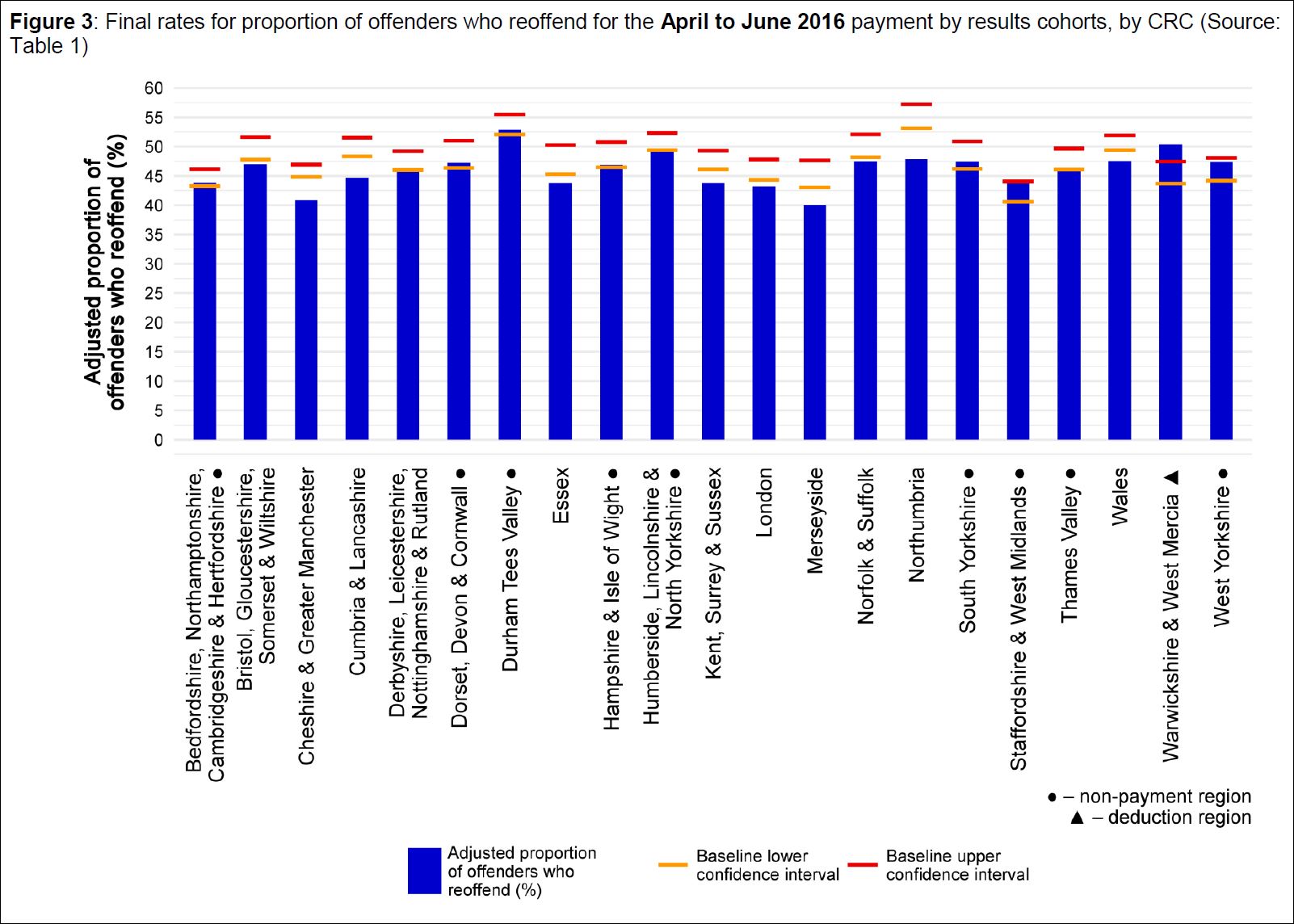
1. There have been statistically significant reductions in the adjusted binary reoffending rate for 11 of the 21 CRCs in the April to June 2016 cohort when compared to the 2011 baseline reoffending rates. 

2. For one CRC, Warwickshire & West Mercia, there has been a statistically significant increase in the binary reoffending rate. 

Main limitations: 

1. We cannot say which CRCs are meeting their frequency targets from a single quarterly cohort, as frequency targets are based on annual cohorts. The next annual cohort will be the 2016/17 annual cohort, due to be published in January 2019. It will include eligible offenders that began their probation between April 2016 and March 2017. 

2. This is the second publication to feature interim results for all the quarterly cohorts that will make up the 2016/17 annual cohort but it is too early to assess the progress of CRCs against their frequency targets. 

3. It remains the case that comparisons cannot be made between CRCs and NPS due to the difference in the nature of offenders being managed. 

Comparison to previous final results: 

The final results for April to June 2016 are the third set of final results to be published. Figure 1 compares this most recent set of final results to the previous sets of final results. 

1. Five CRCs have been in the non-payment region in all three final cohorts; seven have been in the payment region in all three final cohorts. 

2. Warwickshire & West Mercia CRC are in the deduction region for a second time after the October to December 2015 cohort. 

3. South Yorkshire CRC were in the deduction region in October to December 2015 but moved into the non-payment region for the January to March 2016 and April to June 2016 cohorts.

3. Interim results 

The interim results provide a broad indication of progress. They should be more reliable for earlier cohorts, where the follow-up and waiting periods are closer to having fully elapsed. The figures presented in the tables should be interpreted with caution for two main reasons:

1. They are interim estimates which are based on provisional data and a reoffending-to-date measure, rather than a measure with defined follow-up and waiting periods. 

2. The binary results have not been adjusted for the mix of offenders in the cohort. Before performance is assessed against the 2011 baseline, the final set of binary results for each cohort will be adjusted for changes in the case mix of offenders being supervised using the OGRS4/G. 

Furthermore, the number of offenders identified in the measurable cohort may still change and, hence, change the characteristics of the cohort. This could impact both the binary rate and the frequency rate. It, therefore, remains the case that no conclusions can be drawn until final results are published. 

Key results: 

1. With the exception of the Bedfordshire, Northamptonshire, Cambridgeshire & Hertfordshire October to December 2016 quarterly offender cohort, the average OGRS4/G scores for all four offender cohorts show all CRCs are managing offenders that are less likely to reoffend compared to the baseline year of 2011. It should, therefore, be expected that the OGRS adjusted binary rates will be higher than the unadjusted binary rates for most CRCs. 

2. No CRC in any cohort is currently in the deduction region based on their current interim figures, although it is possible this will change when the binary reoffending rates are OGRS adjusted. 

3. South Yorkshire; Staffordshire & West Midlands and Warwickshire & West Mercia CRCs are currently in the non-payment region based on their respective unadjusted binary rates for the July to September 2016 offender cohort. 

4. Bedfordshire, Northamptonshire, Cambridgeshire & Hertfordshire; Durham Tees Valley; South Yorkshire; Staffordshire & West Midlands and West Yorkshire CRCs are currently in the nonpayment region based on their respective unadjusted binary rates for the October to December 2016 offender cohort.

Thursday, 17 May 2018

Dodgy Contracting?

Whilst we have been necessarily distracted by the Napo General Secretary selection process, we have our regular contributor 'Getafix to thank for unearthing the following from the somewhat niche Spend Matters UK/Europe website:-   

Are Top UK Civil Servants Breaking The (Procurement) Law? Yes, According to PACAC Committee Evidence

Yes, following the UK parliament’s Public Administration and Constitutional Affairs Committee hearing on public sector outsourcing post the Carillion collapse, we’re going for the “clickbait” headlines to try and entice you to read what can sound like fairly dry reports of MPs grilling senior civil servants.

And actually, buried amongst the two hours of material, (you can watch it here), there were some rather striking nuggets. We’ll have several reports on the hearing, but let’s start today with perhaps the most interesting.

The victims for the Committee were David Lidington, the new “Minister for Procurement”, clearly a bright guy but has no background in anything commercial, little clue what he’s talking about, having to read from his notes when asked a tricky question such as “what are the benefits of outsourcing”? (I wondered once or twice whether his brief was based on the submission I sent the Committee, as some of his comments seemed very similar to my words!)

John Manzoni, the Civil Service CEO, has learnt how to speak convincingly when needed without really saying anything, a la Sir Humphrey, although he was interesting at times. He also gets away with saying “we’re just working on that now” quite regularly despite the fact he’s been around for over four years now. Gareth Rhys Williams, the government’s Chief Commercial Officer, looked and sounded uncomfortable at first but warmed up pretty quickly.

Anyway, to the matter of the day. EU and UK procurement regulations are pretty prescriptive when it comes to changing major contracts post-award. There is an obvious reason for that. The initial competition can be compromised if terms are changed once the contract is in place. I give my brother-in-law the contract because his firm bids low, then I just increase the agreed prices by 20%. That sort of practice raises issue around fairness, transparency and even corruption – issues the EU is pretty keen to address through proper public procurement.

So it was a little surprising to hear this Committee discussion. Asked about contracts that are in difficulties, “we have re-priced in some case” says Manzoni. He then backs off somewhat and says “we have to be careful with regulations”. Really? Tell us more, do explain where you have broken the law! “Several I can think of where a re-pricing has taken place, where we have got it wrong”.

Rhys Williams then said that we get more detail from open book contracts, we can see how they are doing, and try to price in a fair way – “where vendors are losing money on individual contracts we need to work with them to re-price it or change the spec”.

But the EU and UK Regulations are clear on this. You can modify a contract if the “need for modification has been brought about by circumstances which a diligent contracting authority could not foresee”, AND the modification does not alter the overall nature of the contract, AND any increase in price is not higher than 50% of the value of the original contract or framework agreement. Even then, you must publish a notice in the OJEU to say you have modified the contract.

Another part of the directive says this. A modification is considered “substantial” if it “changes the economic balance of the contract or the framework agreement in favour of the contractor in a manner which was not provided for in the initial contract or framework agreement”.

So where does “re-negotiating the contract because the supplier isn’t making any money from it” stand in terms of the directives? It would appear to be breaking the rules – it certainly changes the economic balance, and the overall nature of the contract. And of course the key point is that the supplier won the competition on false pretences; I beat you to it by bidding a 5% lower price, but now the government has decided to pay me 10% more than my bid, or has relaxed the specification. So it may well be you deserved to win the contract in the first place.

We do understand where Rhys Williams and Manzoni are coming from on this. There are real dilemmas when suppliers get into “bad contracts” and it is often not in the buyer’s interest either to demand continuation on those terms. It has become a bigger problem in the last couple of years in the UK, as we have seen issues with Carillion, Capita, Interserve and more major suppliers struggling.

But re-negotiation takes us into a very tricky legal area. It might be hard for a disgruntled supplier to challenge such events – how would they even know? But it just needs one executive who has had such negotiations with Manzoni or Rhys Williams to jump from that firm to another, and then challenge, and this could get very messy.

--oo00oo--

At least one other contributor picked up on the possible significance of the Select Committee exchanges and of course we've just heard the third-time failed ECML Virgin/Stagecoach rail franchise has been terminated by Chris Grayling:- 

Getafix's reference might be more significant than first glance suggests:

"Asked about contracts that are in difficulties, “we have re-priced in some case” says [John] Manzoni. He then backs off somewhat and says “we have to be careful with regulations”. Really? Tell us more, do explain where you have broken the law! “Several I can think of where a re-pricing has taken place, where we have got it wrong”.

Rhys Williams then said that we get more detail from open book contracts, we can see how they are doing, and try to price in a fair way – “where vendors are losing money on individual contracts we need to work with them to re-price it or change the spec”.

But the EU and UK Regulations are clear on this. You can modify a contract if the “need for modification has been brought about by circumstances which a diligent contracting authority could not foresee”, AND the modification does not alter the overall nature of the contract, AND any increase in price is not higher than 50% of the value of the original contract or framework agreement. Even then, you must publish a notice in the OJEU to say you have modified the contract.

Another part of the directive says this. A modification is considered “substantial” if it “changes the economic balance of the contract or the framework agreement in favour of the contractor in a manner which was not provided for in the initial contract or framework agreement”.

So where does “re-negotiating the contract because the supplier isn’t making any money from it” stand in terms of the directives? It would appear to be breaking the rules – it certainly changes the economic balance, and the overall nature of the contract. And of course the key point is that the supplier won the competition on false pretences; I beat you to it by bidding a 5% lower price, but now the government has decided to pay me 10% more than my bid, or has relaxed the specification. So it may well be you deserved to win the contract in the first place."

I hope the failed CRC bidders & charities saw the committee transcript & are angry, that civil servants who amended CRC contracts are shitting their pants & that scrutiny by any relevant authority of the whole CRC process unearths how unfair & cosy Grayling made it for his favoured chums.

Wednesday, 16 May 2018

General Secretary Election 4

I think it might be helpful if we summarise what's been learnt since Friday regarding the selection of the next Napo General Secretary:-

1. According to a comment seen on Facebook by Katie Lomas, there's been no change in National Officer roles as indicated on the circular - "must be a typo".

2. The two candidates will be interviewed by the NEC at their next meeting on 5th June.

3. Branches have been encouraged to hold meetings to discuss the merits of either candidate and return any nominations by 4th June. 

4. The Job Specification and Person Specification were both revised in March 2018.

--oo00oo--

My take on things are as follows:-

1. Neither candidate measures up to the revised specifications.

2. The post should be re-advertised. 

3. Turn up at Branch meetings and make NEC reps aware of your views well before June 4th.  

Tuesday, 15 May 2018

General Secretary Election - Person Specification

Here is the Person Specification, revised in March 2018, in order to assist in the discussion as to whether either candidate for Napo General Secretary actually measures up:-

General Secretary 

In short-listing and assessing the suitability of potential candidates for election as Napo General Secretary the panel will have due regard to all of the following essential criteria. The successful candidate will need to: 

1. Demonstrate significant relevant experience of leading within an organisation at a senior level, preferably within a union or not for profit context where there is a requirement to recognise democratic accountabilities upon elected leaders. This is likely to include demonstrating relevant experience of providing leadership, support and oversight to large and small committees of volunteers, generating positive accountable outcomes. 

2. Demonstrate the importance of building and maintaining trust across an organisation, including by delivering what they promise; being empathetic and supportive of team members; always leading by example; and encouraging empowering staff and elected officers to be leaders across Napo. 

3. Be able to work under considerable pressure, including managing competing demands and to tight deadlines, whilst always conducting themselves in a way that epitomises the aims and values of the organisation. 

4. Demonstrate, with relevant examples, understanding and experience of what is necessary to successfully manage a team of staff and support elected officers as well as leading and supporting member volunteers. 

5. Demonstrate an understanding of what the highest standards of corporate leadership means for the General Secretary role in Napo; what challenges could be presented in this context and how they have/or would respond. 

6. Demonstrate, with relevant examples, experience of developing corporate policies for an organisation including those policies aimed at changing the policies and actions of external organisations (e.g. employers, politicians, strategic partners). 

7. Demonstrate, with relevant examples, experience of ensuring the work of their organisation both champions equality and diversity and challenges all forms of oppression and discrimination.

8. Be an excellent communicator – demonstrating a capacity to communicate effectively and appropriately to different internal and external audiences, both verbally and in writing. This should include an understanding of the strategic importance and challenges of communicating using information technology. 

9. Be an experienced public speaker, including in a representative capacity to internal and external audiences, preferably including senior government officials and/or Ministers and/other senior union/partner organisation leaders. This will also demonstrate an ability to make good use of both spoken and written news media. 

10. Demonstrate a strong working understanding and knowledge of the pressures and challenges encountered by Napo members across all aspects of their operating environments - including different elements of the probation service, the Family Court Service, Courts more generally, and prisons. This will particularly include an understanding of the professional issues, challenges and obligations on Napo members as accountable public sector professionals; and the systems and frameworks necessary to support and sustain a strong sense of professionalism across this workforce. This will enable to General Secretary to act as a credible professional champion for all aspects of Napo’s membership.

11. Have a strong working understanding of the UK’s political systems, including how different elements of these could and/or do impact upon different elements of Napo’s membership. Demonstrate an understanding of how this knowledge can be utilised to support better outcomes for Napo members – including relevant examples of how their own political engagement has generate positive outcomes for others that they have represented. 

12. Have a strong working understanding of UK employment law, as well as ACAS principles in relation to discipline and grievance procedures; and demonstrate, with relevant examples, successfully using these to deliver positive outcomes for workers. Alongside this they should have a working understanding of how the law impacts on trade unions; alongside a complimentary understanding of the role of regulation in protecting and developing workers’ rights. 

13. Demonstrate a strong understanding of what is involved with providing accountable leadership in collective negotiations through all stages of the process up to and including a successful outcome. In particular, this should include an understanding of the difference between strategy and tactics; the importance of maintaining trust from all sides during negotiations; what constitutes excellent communication skills in a negotiating context; and what is required to ensure accountable leadership, especially in an organisation like Napo. We would expect this will include specific reference to their successful track record of negotiating positive collective outcomes for workers and/or groups in their current and/or previous roles. 

14. Demonstrate a high level of literacy and numeracy and, in particular, a capacity to understand, interpret and use data typically relevant in individual and collective negotiations for Napo members – for example pay data or other relevant staffing data. This will also extend to a working understanding of budgets and transparent accounting in an organisation. 

15. Demonstrate an understanding of Napo’s legal and moral obligations in regard to managing sensitive personal information across an organisation like Napo. 

16. Be a natural and convincing champion for Napo remaining a strong and independent collective voice for the probation and family court services, explaining to different audiences what this will likely mean for Napo members and how Napo organises and sets priorities. This must include recognising the importance of Napo’s status as a professional association as well as a union; and demonstrate an understanding of what this means for members; and why this impacts on how Napo organises, sets priorities and acts. 

17. Demonstrate, using examples, a long standing record of activity and commitment within the trade union and/or Labour movement, preferably including activities closely aligned to Napo’s values – for example, as reflected in our partnership with affiliates organisations. In doing this they must also recognise and explain the importance of Napo being independent of any political parties and not being seen as overtly partisan. 

18. Demonstrate a strong commitment to their own personal and professional development.

Additional desirable experience and qualities: 
  • Given the General Secretary’s leadership role in promoting the Edridge Fund, some demonstrable experience of working with and/or as a Trustee of a charity and/or voluntary organisation outside of trade unions and the Labour movement. 
  • Membership of a professional body and /or relevant professional qualifications to demonstrate an understanding of the requirements of professional status. 
  • Experience of being involved in successfully concluding difficult grievances and or disciplinary matters as an employer. 
  • Experience of successfully managing complaints against employees in their role as a line manager and/or employer.

General Secretary Election - Job Description

In order to assist in the discussion regarding election of the next Napo General Secretary, here is the latest Job Description, revised in March 2018 apparently:-

General Secretary 

The post-holder is the senior elected employee in Napo. The General Secretary is elected for a 5 year term. The post is line managed by the National Chair and is directly accountable to Napo’s National Executive Committee. 

Leading the Union 
  • The post-holder provides strategic leadership and ensures strategic alignment across all areas of Napo’s activity and outputs. The post-holder leads the Napo senior staff group and will attend Officers and Officials meetings as a voting member and will attend NEC and AGM to present reports on behalf of the staff group. 
  • They are expected to role model Napo’s values and principles at all times, in relation to all aspects of the work and conduct. This includes role modelling inclusive and non-discriminatory behaviours and actively championing equality of opportunity, including in negotiations with employers when operating as a manager and leader on behalf of the elected group of employers within Napo. 
  • The General Secretary may also be asked to take on the responsibilities of National Officials in relation to one or more local branches, on a permanent basis and/or as cover. This recognises the advantage of first hand front-line experience at local level in aiding understanding in National Negotiations. This would include all of the responsibilities regarding coaching local representatives, developing a local Branch plan, promoting recruitment of new members, etc. 
  • The General Secretary should be seen as a leader for members and potential members of Napo and is therefore responsible for producing high quality written and on-line communications for Napo members either directly or via delegation. This will include use of social media and other methods to disseminate messages to members and potential members. 
  • The General Secretary will also actively champion and support the professional and personal development of Napo employees, elected Officers, Representatives and other activists, including by fully supporting positive internal performance management and development. 
  • The post-holder will role model a commitment to personal professional and personal development, as an organisational leader and professional champion for the probation and family court services. In particular, this will include developing, maintaining and articulating an understanding of professional practice expectations on Napo members to enable effective representation of Probation and Family Court services externally. 
  • The post-holder also has lead accountability and responsibility for all day to day Napo output and activity, including ensuring strategic alignment and appropriate consistency between different negotiating aims and policies - culminating in presenting the Annual Report to the Annual General Meeting, and incorporating presenting relevant reports to each NEC meeting (delegated in exceptional circumstances). This will incorporate: 
Production of the Annual Report 

Production and then implementation of the Napo operational plan, informed by the decisions of the Annual General Meeting, NEC strategies and decisions made by democratic processes. 

Ensuring resources and support are available so that members’ can access representation and support in line with the Napo Membership Contract* or any other agreement about levels of service. 

Accountability for the oversight of Napo’s overall financial affairs, in consultation with the Finance Officer and the elected Vice Chair (Finance). Responsible for signing the accounts. 

The General Secretary also acts as Official Returning Officer for all Napo’s National elections and ballots. Administrative aspects of these functions can be delegated appropriately dependent on workloads and other work pressures. 

Fulfilling legal responsibilities as Napo’s legally recognised Data Protection Officer. o Responsibility for ensuring that appropriate advice (including legal advice) is available to Napo staff, elected Officers and members on matters relating to: pay and conditions of service, employment law, trade union law (including constitutional and procedural matters), family court legislation and practice, probation legislation and practice, social policy legislation. 
  • The General Secretary oversees and co-ordinates all of Napo’s externally provided services to members, supported by the Finance Official, Elected Officer Group, HR & Office Manager, Assistant General Secretary, and others as appropriate. This will include: 
Reviewing contract performance and Napo Extra content, informed by member feedback and demand 
Ensuring providers can adequately support Representatives in communicating support available to members, to maximise the benefits to Napo. 
Assessing and addressing complaints relating to Napo Extra and wider member benefits. 
The post holder will be expected to work with relevant Napo staff to explore and where possible maximise revenue opportunities for Napo via sponsorship or advertising. 
  • The General Secretary has lead responsibility for ensuring Napo’s employment practices are appropriate, fair and in keeping with Napo principles and priorities (delegating activity where appropriate). In this regard they will work closely with the relevant Napo staff and the employers group to ensure that they are in possession of high quality advice and data and that arrangements are in place for the effective management, organisation and administration of Napo's staff, including Health and Safety and welfare, appointments and training. 
  • Accordingly, they will investigate, assess and present recommendations to the elected Officer Group relating to formal complaints about employees of Napo - supported and informed as appropriately by relevant line managers. All investigations and complaints will be managed in accordance with Napo’s values, rules and processes. 
  • Where the General Secretary receives complaints against Napo members and/or Representatives, they will assess grounds for a formal investigation and liaise with members of the elected Officer Group and NEC, in accordance with Napo rules. This will include making available advice on Napo processes and the Constitution. 
  • The General Secretary will be responsible for ensuring all complaints are dealt with in an effective, fair and timely manner, where the outcomes can be judged against Napo’s values, aims and principles. 
Influencing externally 
  • The General Secretary is Napo’s principle National Spokesperson. They have lead responsibility (with scope for appropriate delegation) for presenting Napo policies, principles and priorities to others. This will include face to face and written contact with all levels of Government, Ministers and Senior Leaders, the opposition and Parliamentarians. The post holder may be required to present written and/or oral evidence to Parliamentary select committees on behalf of members. This will also include the media; TUC and other affiliates; GFTU; allied pressure groups, charities and organisations supportive of Napo aims and values (and/or to whom Napo have affiliated) employers, or interested stakeholders/parties. Additionally the General Secretary will represent the interests of members at relevant external conferences and events such as the Trade Union Congress. 
  • To ensure accountability in this regard, the post-holder will actively support, have oversight of, and (where necessary to support delegated lead Link Officers and Officials) directly participate in relevant negotiations with all employers; and within relevant Napo Committees. The post holder will hold the AGS and Officials to account for their performance in achieving Napo priorities in negotiations with the employers. 
  • The General Secretary has lead responsibility for liaising with the Trustees of the Edridge Fund. They are expected to actively promote the fund and seek to encourage member and staff support and participation in the Funds’ work and activities. 
  • The General Secretary, in particular will be expected to be the lead for Napo on all matters relating to professional issues for Napo members. This will involve working closely with Elected Officers and Napo’s committees, especially its Professional Committees and Negotiation Committees to mainstream professional issues into our campaigning aims and priorities. They can also expect to lead initiatives identified in the Napo operational plan and by AGM to develop employer policies and practice around professional practice issues. They are also expected to champion professional issues in wider Napo communications. 
As with all Napo employees the General Secretary will also: 
  • Manage their time so as to adequately meet all aspects of the job. 
  • Support their own professional development. 
  • Participate positively in Napo events (e.g. NEC meetings, AGM, Professional Conferences, etc.) and Napo team meetings. 
  • Occasionally work unsocial hours or away from home overnight in the course of their Napo work. 
The General Secretary will be the line-manager for the Assistant General Secretary, Finance Official, the HR & Office Manager and the Administrator to the General Secretary. 

Notes: *The Napo Members’ Contract is an initiative that we anticipate implementing in 2018, following consultation.