Sunday, 12 January 2020

Pick of the Week 56

The biggest reason for the lack of diverse representation is the change to the qualifying route under PQiP. Recruitment is organised nationally, most of those who get on PQiP have criminology and/or psychology degrees courses which attract a disproportionate number of white young females as opposed to other groups. We need a new training route which can be accessed by other staff already working in probation (PSOs, admin) - it has become incredibly hard for existing staff to get on the training, yet we have more diverse staff especially at lower grades already in the service with valuable experience. 

Targeted recruitment campaigns, advertise in publications and websites which attract male, black and disabled viewers, outreach activity, have a presence at community events,  look at how other organisations improved diversity and follow similar strategies. All of these options are possible (even under civil service control) but we really need to address this imbalance. I think it is actually a form of indirect discrimination not to have a training route which recognises educational disadvantage faced by black people, the barriers to getting a degree are much greater if you are black or poor. We can be more representative of the communities we serve but it takes recognition and analysis of the problem first, then a strategy to address it.

*****
JB nails it viz-'probation is dead' with that simple exchange. NPS & those who perpetuate it are completely happy with the current situation, albeit they add the odd caveat here & there, e.g. "I haven’t got the figures to hand but we have got a way to go." But then they say "We’ve been working on it for as long as I’ve being involved with trainees in 2005."

Perhaps the 'awkward question' should be... Q: So you clearly haven't got it right yet, even though you've been involved in that aspect for 15 years? So why the fuck are you still in the job? Either someone should have booted you out or you should have walked years ago. Perhaps YOU are the problem?

*****
I'm no fan of NPS senior management but even I think you're all being unreasonable here. AC acknowledged that a lack of gender diversity was an issue and asked for suggestions on how that could be tackled. JB mentioned things like research, innovation, salary erosion, etc, which whilst all important issues, don't seem to be directly linked to a lack of gender diversity. Unless you're all suggesting that women are attracted to professions where research isn't carried out, where there is little innovations and where salaries have declined?

*****
It would help if AC actually appeared to have some direction or knowledge and researched base for the feminised recruitment process. If men are wanted but do not apply for roles perhaps they realise they are not actually wanted. The structure of this women dominated profession says it all to would-be applicants.

*****
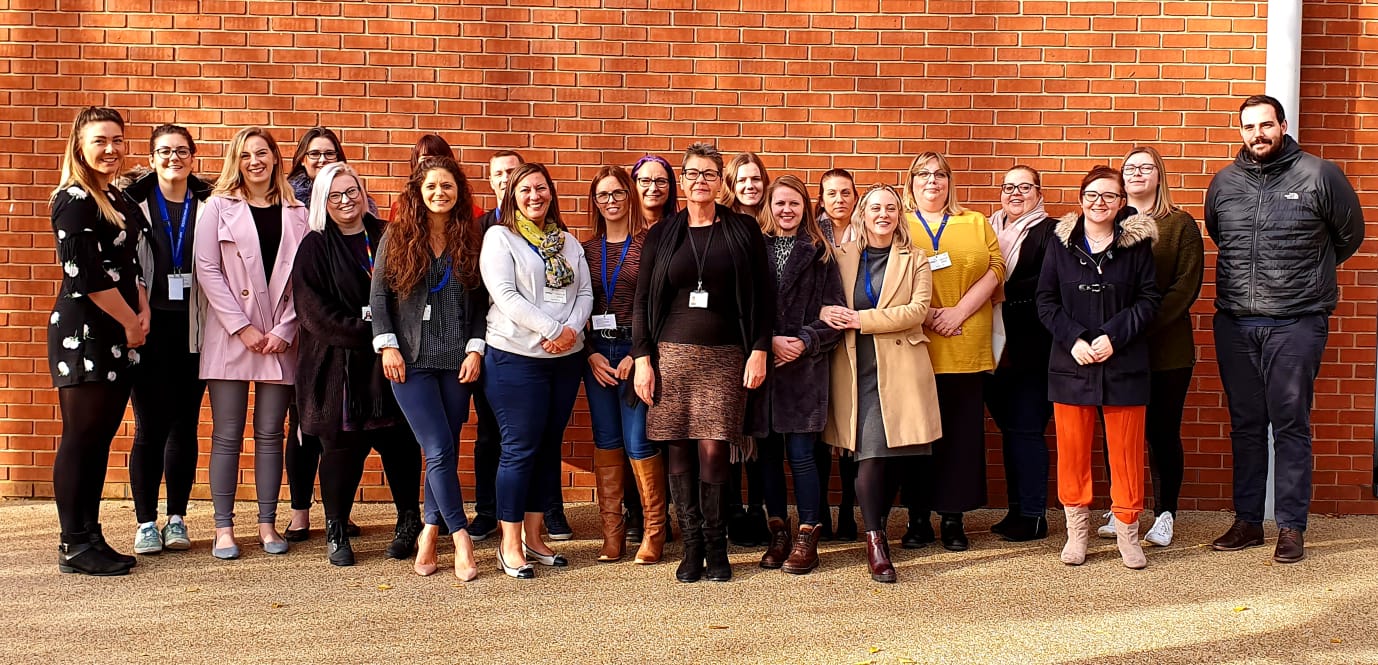
The image says it all. Amongst the abundance of females, the first apparent male is hiding at the back and the second is billy-no-mates with daylight between him and the rest of the group. It’s a surprise this did not compute to Angela Cossins, Deputy Director National Probation Service South West, South Central, but the gender minority worker is not featured on diversity training.

All Senior Management, including Angela Cossins, know very well what the recruitment issues are. Some of the bigger issues are; The main wage earners in most households are still men – probation jobs simply don’t pay enough and there are many other justice and graduate jobs that pay better.

Except for negative media, not much is known about probation, and both it’s roles and progression opportunities are limited - it needs to raise awareness of the roles in the profession. There are no government-set targets to ensure that sufficient funds are allocated to recruitment drives, including to recruit more men. With a female dominated workforce, male role models in the sector are limited but essential to recruit more young men and males into probation.

There are other potential issues too which require research; Males are more likely than females to be ineligible to apply due to previous convictions. This may be more of an issue in the NPS due to vetting. Probation previously tended to attract administrative staff who wanted to train as probation officers - usually female. Probation training programmes now tend to attract graduates - predominantly those with criminology degrees. Similar to care professions, is it possible the more female dominated probation is the more difficult it will be to recruit males?

*****
But don't despair - "We’ve been working on it for as long as I’ve being involved with trainees in 2005."

*****
Clearly probation still tends “to attract mainly female and mainly white graduates in their twenties (NOMS 2013)”. So we have a white and ethnic diversity of male hardened criminals aged 18-100 years old that will continue to be mostly supervised by young white girls who know more about hair and nails, university and living with mum and dad, rather than having any real life skills, experience and common sense. This problem has been building since 1993 and the article about suggests it is intentional. As probation senior management bury their heads in the sand (or smile and carry on as it is dominated by now middle-aged white women who have helped create the problem), it is unlikely probation recruiters will acknowledge they’ve got it very wrong.

*****
Those bloody women hey! Surely we can agree a more diverse workforce would be a positive thing without having to degrade female staff! Your misogyny is showing.

*****
Most probation officers I’ve seen either look like grungy teenage girls or Essex girls readying for a night out, and do not really have much of a clue what they are doing. When people on probation say “my probation officer knows nothing about me and cannot help me”, they are right? Are male offenders asked whether they want to work with women probation workers.

*****
As a middle aged, middle class, white female who has been in probation since the mid 80s I can assure the collective this problem has been building a long time; especially in London. The main structural problem is the very poor pay; looks good whilst you are footloose and fancy free but you cannot build a professional life style on the public sector pay scale. Historically this has meant the men have left to take better paying work. Due to dreadful property prices this has been a bigger problem for longer in London than anywhere else, but other parts of the country are now experiencing the same problem. Just do something about our dreadful pay!

*****
There is a notable shift in culture following what above is described as a change to a ‘feminised’ Service. The number of conversations I have had trying to convince colleagues that they should take an interest in male issues such as mental health and the appalling male suicide rate which is often linked to separation and family matters. There’s little interest with a common retort that the ‘patricarchy’ in fact privileges all men so they shouldn’t complain. If you have no interest in the needs of over 90% of your client base perhaps this isn’t the right job for you.

*****
For the past decade the whole CJS has suffered from shambolic Conservative policies and ideology. Their coalition with the Lib Dems was really in name only. The Conservatives have been at the helm since 2010. They've opted for a DIY approach, ignoring professional knowledge, advice and research, and allowed a string of incompetent Ministers to make whatever unqualified decisions they feel like. It's now all a total mess with no aspect of the CJS fit for purpose and costing far more to achieve far less.

I personally see no way back anymore, it's to broken. It's all going to have to be torn down, and a 'newbuild' is required. As much as the previous decade is to be lamented so too is the next decade to be very concerned about. No doubt our 'special' relationship with the USA will see a lot of CJ imports coming across the pond post Brexit, but America's CJS is in a worse state then ours. It's hard to work out whether to be shocked by the last decade or frightened by what's to come.

*****
The complete demise of the Probation profession is but one example of the ease with which the nameless, faceless powers that-be can manipulate & engineer whatever outcome they want, regardless. It shows how readily & easily those who are offered a taste of honey will sell themselves out for a slightly bigger pot of honey.

*****
I have just read the revisionist nonsense from Napo & it leaves me irritated, uninspired & concerned. "On May 16th 2019, a date which must surely feature forever in the annuals [sic] of Napo history; we saw a remarkable U-turn in the form of an announcement that 80% of the roles associated with OM work would be transferred to the NPS from the private sector along with the staff undertaking these functions, once the termination of CRC contracts had taken place."

What about the date when Napo silently but firmly held the privateers' cutlass while hundreds of Probation staff were made to walk the plank into professional oblivion? The date when Napo signed off on TR, transferring thousands of staff to the private sector on the most flimsy of terms & conditions in the knowledge it would lead to inevitable & PRE-PLANNED job losses. Oh, and of course there's TR2...

*****
How could we never forget the Napo signing of our demise. That the transfer measures in 2015 that should have secured members pensions, terms and conditions would be so instrumentally sold off later by an ignorant narcissistic Trade Union leader purposefully failing to ensure members had legal representation when agreeing the measures at the time and thereafter to protect them. The demise of Working Links was the work of Dino. Napo's achievements are the demise of their members terms and conditions, employment status and pensions.

*****
It's absolute nonsense for NAPO to claim the credit for any of this. They did nothing.

*****
Is that entirely fair ? They attend meetings or some I am told. They have produced some reports although not very good or useful. They are amateurishly gaming around the membership and employers pretending they know what they are doing but when all is considered Napo is only potentially effective if their combined abilities and talents in the leadership is able. When examined more closely the standard of reporting their self indulged in crowd gravy train wanna bees and their inept response to anything important we must start to realise Napo are just not relevant anymore are they?

*****
It is the performance of the private companies and inability to make Probation work from the hemorrhaging effects of TR that has led to the contracts terminating and transferring to NPS. It's hysterical to think Napo believes it was their work. Government had no time for Napo, that was very clear when they walked away from national collective bargaining in the knowledge Napo would never take that fight on.

*****
"In intensive and complex negotiations around the transfer of Offender Management work to NPS Wales and beyond." Spell it out. What are you talking about Complex? Rocket science is it? This is a short hand report to keep readers off the detail of Napo doing nothing.

*****
Methinks Napo's paid "elite" live in the same distorted, Stalinesque universe as Trump where the 'truth' is whatever you say it is in press releases, blogs or on twitter.

"our impressive campaign which has exposed the folly of the Transforming Rehabilitation disaster"
"Gauke & Stewart sent some important signals that they wanted to do some serious business with Napo"
"Ministerial top cover had been approved for senior MOJ/HMPPS leaders to engage in exploratory discussions with the unions"
"a date which must surely feature forever in the annuals of Napo history"
"a significant victory"
"the most remarkable media engagement that this union and professional association has ever seen in our history"

*****
Napo is in intensive care, on a life support machine. The disease is within and can only be cut out by removing the current leadership who can only claim apocalyptic disaster for its members.

*****
"Attacks on staff, false allegations, inappropriate and failing disciplinary procedures. Sickness absences and Grievances at record highs in my 36 years service. Staff leaving in volume and dissatisfaction across the board. Favouritism, nepotism and cronyism the centre of the Working Links way and those enablers... We disagreed within the union internal national ranks many times as their weak and short sighted agents wanted to form inappropriate agreements. This included most other union officials. I have been complained about from all sides and many times over from them... It is a tough role and at one point I had to take my own national union to the Certifications Officer for their gross incompetence... In my view we are now travelling a different journey and at the least a renewed direction. The General Election outcome will have sealed the future contractual plans for TR2 and a further split for interventions."

As ever Dino provides a warts-&-all account of events which is far more palatable than rainbows & unicorns.

*****
Dino is an amazing rep and been working hard for many never giving up on issues our branch could not have done a fraction without his leadership.

*****
Dino has been an amazing unyielding force in achieving the best for his members. His resilience has seen off the most unbelievable and undeserving nasty attacks not just from the employer but from Lomas, Lawrence, Rogers and the rest of the leadership team of 2018/19. They should feel ashamed as should others for attacking their own colleagues in the workplace for self rewards.

*****
A warts-&-all account I think that should read WARS with what is said in this report. It was once said this branch was led by a controversial character. Courting trouble perhaps? However, their accomplishments in the SW branch has remained the go to place for information strategy and can do approaches than those of the can't do or won't do brigade. Not heard the SW saying the best that can be achieved as an excuse for failing. 

Controversial perhaps but they do appear to achieve in that branch. They have not let up in the years of TR. I did a search and this blog is prolific with vitriolic reports and assertion of their trade union position. That has to be a good thing when you read the awful account of the several Murders. Those SFOs happening while the known failing Working Links exposé by that chair has been on-going. These tragedies and failings of the privatised management of services are clearly to blame and this branch had the foresight it seems to have registered their formal dispute. 

It is clear no one in authority was prepared to heed the NAPO branch chairs warnings. It might also be a record in running a dispute for the years Working links tried to hold onto government funding. It would have been a phenomenal fight against TR had this confidence or tenacity with the strategic outlook. Had that been deployed nationally to all branches what might have been?

*****

What an astonishingly hard working and resilient NAPO SW Branch Chair! Perhaps National Officials should take a leaf out of his book. I am proud to have witnessed the incessant work rate and the torture endured by this shining light for the rights of SW NAPO employees. Despicably attacked by the hierarchy of NAPO (alleged colleagues) who were then to their cost found wanting by the Certification Officer. Despised and alienated by the Working Links Company who then collapsed into administration. Countless representations for NPS and CRC members amid unprecedented grievances, disciplinaries, overwork, sickness absences.

Tirelessly travelling across all corners of the south to support the needs of members.
Instrumental in now repairing the damage caused by the incompetent previous contract holder and its unable and wanting senior management (some still present) to provide a forward thinking and innovative system to support and protect the needs of the employees in TR2. To you Dino Peros and the SW Exec Branch which you have led with passion and integrity, I hold you in high esteem for what you have achieved and for the advice and information you give.

*****
You'd really like to hope that the family of the victim and the officer are all being appropriately supported! Reading the evidence by the officer made me realise I made the right decision to resign as I had many sleepless nights worrying about what I might have missed that day and if I would be walking into an SFO the following - I constantly felt we were not effectively managing risk with ridiculously high case loads and ridiculous unproductive models/targets that we were expected to meet regardless of extremely low staffing levels. I hope the officers' strategic management team and office level management take responsibility as we've seen far too many case managers (PSO/ PO) thrown under buses to save the skins of those who have been complicit in TR/TR2.

*****
These are the observations of a worker in crisis:

“Some days I wouldn’t leave my chair all day. One week I was seeing 15 to 20 people all day. Sometimes I worked until 12 at night. It was very difficult to keep a tab on things. Sometimes I didn’t have time to sit down or even have lunch..."

And now we have the comments of a very modern manager:

"Her caseload of around 60 offenders was appropriate for her level of experience... [she] required support and confidence building... I was aware from the data there was enough items outstanding to be concerned and tools were put in place to help officers... in my view she was well supported".


Can somebody please help me out here & clarify who had what role? Everybody seems to be a 'probation officer'. Is that right?

*****
Does it matter. The buck belongs and stops with the complacent Chief Officer team who supported the failings of the Working Links programme for case management. They allowed the abusive unmanageable cases. The lack of training, failure to support, recognise and do anything about work pressures. They take a salary, yet failed in all aspects of public safety and yet somehow absent from account. Wales senior management did this as they helped Working Links damage the service they must have known could only fail. Working Links need to be held to account. They know what they did and who they are.

*****
Totally agree. This Officer and many others are left out to dry when SFOs occur with Seniors shifting the blame and trying to come out looking like the efficient Manager only doing their job. The reality is the same stuff time and time again on this blog highlighting Officers being overworked, not enough staff and Seniors passing the buck. This profession needs 100's of more staff, but strip the qualifications needed to apply and get more people with life experience, critical thinkers and staff who know what life is like. 

These people are not stupid because they don't have relevant degrees it's the other way round. There are thousands of people out there who could wipe the floor with obnoxious staff who think they are better than others in this service. This poor Officer and all the Officers who go through SFOs have our sympathy, because no one else is going to support them in the CRC or NPS due to job worth's in Senior Management.

*****
My heart goes out to you Kathryn. It feels like you are the scapegoat and I would hope if I had been your manager I would not have said your caseload was 'appropriate' and would have supported you. As been said, the CRC culture has been to be over lenient with enforcement as money talks! I am not the first person to comment that you can't make money out of peoples misery! Of course those senior managers and politicians will not be held to account as to do so would fuel further debate on the CRC/NPS split. Yes, SFOs happen and individuals should not be singularly held to account for systemic failure. No other criminal justice organisation would expect an employee to manage 60 cases and get it right all the time. Best wishes and take care of yourself.

*****
I would not wish this so-called career on anyone in the current climate. The reality for many is to consistently work unpaid overtime to avoid poor performance by trying to meet the ridiculous workloads and targets. Staff being exempt from the values they spout in relation to diversity issues and safety issues. A lack of professional respect and experience not valued as you are just a disposable number to them. Huge impacts on your mental health, family relationships, quality of life with stress and burnout and constantly justifying your every move to protect yourself. Scapegoating and a culture of blame. The list goes on and yes you could leave if you don't like it, but quite frankly it should not be allowed to go on and this treatment and attitude leads to high staff turnover. I feel for that poor PSO as per usual blame is aimed at her rather than the organisation or business as they like to be called. It's shameful. Where is the duty of care to staff and acknowledgement that the workload and lack of proper training and support [are] huge factors.

*****
Oh how I agree with what you say.  As an experienced PO my practice is mainly focused on covering my back. This is not what I joined for and I have personally witnessed wonderful professional colleagues being thrown under the bus by managers. We have not had a consistent manager for the past year. I am actively seeking an out for sure and it makes me weep with frustration and despair for a job I am good at, those whom I try to help better their lives and the loss of a gold standard service. I am tired of attaining meaningless targets set by civil servants who have no clue and ineffectual management.

Saturday, 11 January 2020

Is Seetec Way the Future?

There was a significant announcement yesterday from Seetec:-

Seetec to become one of the UK’s largest employee-owned public services companies.

Seetec, a leading provider of skills, employment, justice and rehabilitation services, today becomes one of the largest employee-owned companies delivering public services in the UK and Ireland. The company has annual revenues of £150 million and will be the 9th largest employee-owned company in the UK by number of employees. A new employee council will be set up to manage and represent the interests of employees, which include frontline probation workers, employment coaches and trainers.

Seetec’s founder and 80 per cent shareholder, Peter Cooper, has sold 51 per cent of the company into an Employee Ownership Trust for the sole benefit of the company’s 2,500 employees. This complements and is in addition to, an existing employee benefit trust (EBT) established in 1990 which owns 18 per cent of the company, as well as a 1.5 per cent stake held by the company’s charity, Your Ambition.

Seetec supervises and supports nearly 30,000 low and medium risk offenders across the south of England and Wales for the UK Ministry of Justice. Through the Department for Work and Pensions’ Work and Health Programme, the company also provides intensive support to people who may be disadvantaged and struggling to get into work. In the Republic of Ireland, Seetec delivers the JobPath employment programme and has helped 30,000 people into work for the Department of Employment Affairs and Social Protection.

The company also provides apprenticeships and training on behalf of thousands of employers including market leaders in aviation, media and logistics as well as small and medium sized enterprises across Great Britain and Northern Ireland.

Peter Cooper retains a 29 per cent stake in the business and will step down from his role as executive chairman. He will continue to chair the main board as a non-executive director. John Baumback, the current managing director, will take over executive leadership of the company as group managing director from 1 April 2020.

Seetec Chairman, Peter Cooper, said:

“Seetec was founded to help people to take ownership and responsibility over their lives and so it is a logical step for Seetec’s employees to take on ownership of the business.

“Our founding ethos was to empower people and deliver social value, attributes that are hardwired into our culture. When 30 unemployed young people first came to a former primary school in Essex more than 35 years ago to learn computer programming skills from Seetec trainers, our simple aim was to help them to change their lives for the better by giving them the tools to shape their future.

“As I approach 36 years at the helm of the business, I have increasingly wrestled with how best to protect these values, ethos and roots in communities across the UK and Ireland. I have never been satisfied that a sale to outside investors would protect our record as a force for good, fearing that we would be subsumed into a corporate culture which is not sufficiently focused on doing the right thing for the people who use our services.

“It is Seetec’s employees who know the people they support best and understand instinctively what it takes to deliver life-changing services. The evidence also shows that employee owners can be more productive, engaged and innovative. Under this structure it is my hope that we can continue our legacy of growth as a private company and represent an alternative way, which creates profit for social value and rewards each other, comfortable in the knowledge that it is possible to do well by doing good.”

Seetec Group Managing Director, John Baumback, said:

“Employee ownership means that Seetec’s future is now in the hands of our people, certain in the knowledge that we cannot be sold to the highest bidder.

“As shareholders in our collective success, with new accountabilities and responsibilities, we have an opportunity to create value not just as employee-owners but for the communities and clients we serve. There is now an exciting future ahead as we establish a new dedicated employee council to manage and represent employees’ interests and shape the next chapter of the company’s future.”

President of the Employee Ownership Association (EOA), Sir Charlie Mayfield, said:

“I welcome Seetec’s move to employee ownership. Employee owned businesses are united by an ethos that puts people first, involving the workforce in key decision-making and realising the potential and commitment of their employees. They create profit with purpose, put people at the heart of the organisation and are characterised by high productivity, greater levels of innovation and higher resilience to economic turbulence. I wish Seetec every success as they join a growing number of employee owned organisations who collectively deliver better business for the UK economy."

Chief Executive of the Employee Ownership Association (EOA), Deb Oxley, said:

“We are delighted to congratulate Seetec on becoming employee owned and excited to welcome them as trustee members of the EOA. Seetec’s focus on people, purpose and its impacts on the communities it serves, positions it well to gain the most from employee ownership including securing its independence, empowering its employees to deliver impact and sustaining the business for the longer term.”

--oo00oo--

This from the FT yesterday:-
UK government services group Seetec becomes employee owned

Seetec, a provider of probation and state training services, has become one of the UK’s largest employee-owned companies, a transition that its founder said would allow it to pursue an “alternative way” of creating “profit for social value”. Company founder Peter Cooper announced on Friday that he had sold a 51 per cent share of the company to an employee ownership trust, which will run for the sole benefit of Seetec’s 2,500 workers. It makes the company — which runs education, training and work programmes for the Ministry of Justice and Department for Work and Pensions among others, and which had a turnover of £150m last year — the ninth largest employee-owned company in the UK. 


The move follows increased scrutiny of private provision of public services after a string of scandals including a chaotic part-privatisation of probation services revealed government money had been spent on inadequate projects. Seetec took over the running of probation services in south-west England and Wales when Working Links, another private provider, collapsed in February last year after inspectors found major failings in its work. All probation services are now in the process of being renationalised. 

Napo, the probation officers’ union, said Seetec had “chosen a progressive future” and showed “a real investment” in staff with the switch. “Whilst Napo still believe in a public probation service, our relationship with Seetec has developed over recent months and is now very positive,” it added. “We hope that other providers will follow suit as it now raises the bar for future contracts.” 

Mr Cooper, who made the sale as he steps away from the day-to-day running of the business, said it was a “logical step” and would prevent Seetec being “subsumed into a corporate culture” with a sale to outside investors. “Under this structure it is my hope that we can continue our legacy of growth as a private company and represent an alternative way, which creates profit for social value and rewards each other,” Mr Cooper said. 

Carys Roberts, chief economist at the Institute for Public Policy Research, a left-leaning think-thank, said employee ownership was “broadly a good thing” but “not a panacea” and would depend on the level of workers’ representation for its success. According to the White Rose Centre for Employee Ownership, there are 370 employee-owned businesses in the UK, and the sector grew 18.5 per cent in 2018, with companies including Riverford Organic and studio Aardman Animations recently adopting the structure.

Deb Oxley, chief executive of the Employee Ownership Association, said employee ownership allowed businesses to plan for the long term and have greater independence, which would be particularly beneficial in public service contracts. “Seetec’s focus on people, purpose and its impacts on the communities it serves, positions it well to gain the most from employee ownership, including securing its independence,” she said. 


As well as the 51 per cent of shares sold to an employee ownership trust, 18 per cent of Seetec will remain in an employee benefit trust for founding staff, and 1.5 per cent will be retained by the company’s charity. Mr Cooper will retain a stake of 29 per cent. Workers will be represented on an employee council and on the board of trustees.

Thursday, 9 January 2020

Harry Fletcher

From Facebook:-
Image may contain: one or more people

Sad news just in from Napo. Our thoughts and condolences go out to Harry's family, friends and colleagues.

It is with sadness that I have to inform you that Harry Fletcher, passed away on 8th January 2020 after suffering a heart attack over the Christmas holidays. The news came as a great shock. Harry was only 72.

Many of you will remember Harry well, as Assistant General Secretary of Napo for over 30 years until he left in 2013. With responsibility for media, parliamentary liaison and campaigning, Harry was extremely successful in making sure Napo had a high public profile and spearheaded many, many successful campaigns on behalf of the union. Over the years he was the ‘voice of Napo’ on TV, radio and in the papers.

I’m sure you will join with us here at Napo HQ in sending our condolences to Harry’s family at this difficult time.

Further details regarding funeral arrangements will be made available as soon as possible.

Meanwhile Kath Falcon has kindly offered to receive messages and tributes from colleagues of Harry which we will publish in Napo Magazine in the future. Please contact (kfalcon@napo.org.uk)

Regards
Ian Lawrence, General Secretary


--oo00oo--

A timely reminder of Harry's work. This from 2013 in the Guardian:-

Privatising probation makes no sense – and will put the public at risk

After months of speculation, the coalition has finally published its plans for privatising probation through outsourcing. Essentially, up to 70% of probation's core work will be put out to competitive tender. Companies likely to bid for the work include Serco, Sodexo and maybe even G4S. The voluntary sector has also been asked to play a part in the sale, but because the schemes are likely to be based on "payment by results", the vast majority are unlikely to be able to compete, as they have no spare capital to risk on such schemes.

The government has said that the public probation service will retain its work with high-risk offenders – approximately 50,000 of them – and also retain the responsibility for giving information in reports to the courts. It however didn't explain how this change will be organised either nationally, regionally or locally. It is at this stage uncertain who will be responsible for recalling individuals to prison for breaching probation orders.

The timing of the announcement is truly jaw-dropping. In 2011, the probation service in England and Wales was awarded the British Quality Foundation's gold medal. In giving the award it said: "They are on the right path to achieving and sustaining excellence and being the best providers of these essential services."

Last year, the probation service met or exceeded all of the Ministry of Justice's set targets. Figures show that victim feedback in 2011-12 was positive in 98% of cases; that 49% of offenders were in employment at the termination of their orders; that 89% had accommodation; and that 82% of orders or licences were successfully completed during the period. In terms of timeliness of court reports, the service was set a target of 90% – and was successful in 99% of cases. And as far as cutting reoffending goes, the actual rate was better than the national predicted rate. In all but five probation areas, three-quarters of orders or licences were successfully completed.

I therefore suspect that the true motivation behind the announcement is to drive down costs, as well as to affirm an ideological commitment to the private sector. In 2012, community service (or "unpaid work" as it is now known) was privatised to Serco in the London area. So far, staff cuts since the transfer are exceeding 20%. That is how the government will make its savings, and the companies their profit.

During the course of the last few weeks, the government has claimed that reoffending rates of people on probation are far too high and cite the example of short-term prisoners who constantly reoffend and find themselves back in prison. Last year, 70,000 prisoners received custodial sentences of 12 months or less, and two-thirds were back in custody within weeks of their release. Yet ironically, the probation service has no statutory responsibility for this group, nor does anybody else for that matter. It is therefore grossly unfair to accuse probation of not working by referring to these particular statistics.

The reoffending rates are actually quite good: 50% for a standard probation order, falling to 35% if the person completes an accredited programme. Given that offenders are complex beings and are 10 times more likely than the general population to have been excluded from school or taken into care, have on average two or more mental illnesses and the majority are addicted to drugs or alcohol and have literacy problems, it is not surprising that reoffending rates are significant.

The government's plans outlined this week are extraordinary thin on detail, and the timetable for delivery is far too hurried. The government has said nothing about what training operatives from Serco or G4S will receive. To date, there seems to be no mechanism for determining what happens if an offender moves from being low or medium to high risk. Crucially, there is also no mechanism to resolve any disputes about risk assessment between the private and public sector.

If this plan goes ahead, the provision of probation services will be fragmented. There will be communication issues between agencies, and any escalation of risk might be missed by the private companies. It is also difficult to see how the private sector will be able to negotiate protocols on sensitive data with the police, and public protection compromises seem inevitable.

The supervision of offenders is complex work. The government's solutions are simplistic, and do not take into account the difficult nature of the work, or the need for local structures and liaison with local agencies. Fragmentation will create silos, and silos will lead to mistakes. All in all, this puts the public at risk.

Harry Fletcher

Wednesday, 8 January 2020

So, Who'd Be a Probation Officer?

Once again it's that time of year when NPS senior management are keen to drum up new recruits for the training programme, especially men as the advert is full of them. Unfortunately the campaign coincides with desperately sad news emerging from the inquest into the Conner Marshall case. It's not so much a case of an opportunity to "Guide. Advise. Inspire." as Watch. Worry. Weep. This from the Guardian:- 

Probation officer supervising Conner Marshall killer was 'overwhelmed'

A probation services officer broke down in tears during an inquest as she described being “overwhelmed” by her workload in the months before a serial offender she was supervising murdered a teenager in an unprovoked attack. Kathryn Oakley said the Wales Community Rehabilitation Company (CRC) was chaotic and short-staffed at the time she was supervising David Braddon, who went on to kill 18-year-old Conner Marshall at a caravan park in south Wales.

Oakley said she “was thrown into the deep end” and was juggling 60 cases at the time. She was forced to stay in the office until midnight sometimes to try to catch up. Managers came and went frequently and oversight of her work by her seniors was often ad-hoc, Oakley told the inquest in Pontypridd. “It was a very difficult environment,” Oakley said. “Some days I wouldn’t leave my chair all day. One week I was seeing 15 to 20 people all day. Sometimes I worked until 12 at night. It was very difficult to keep a tab on things. Sometimes I didn’t have time to sit down or even have lunch. You’re talking about an impossible task.”

The inquest was told that Braddon, who was being supervised after being convicted of assaulting a police officer and drugs offences, missed a string of appointments and admitted that he was drinking and had come off medication that helped his mental health problems. A barrister for Marshall’s family, Kirsten Heaven, suggested to Oakley that she could have taken firmer action against Braddon. Oakley replied: “If I had more time I would have made more checks and had a more investigative approach.”

Braddon, who was 26, had been staying at the caravan park with his estranged partner and their children when a row erupted over an ex-boyfriend. He had taken a cocktail of drugs and alcohol and he armed himself with a kitchen knife, announcing that he was going to look for the ex-boyfriend and kill him.

Mistaking Marshall for the former boyfriend, Braddon launched a frenzied attack on him, striking the teenager with a pole and repeatedly punching him before stripping him naked to humiliate him. Braddon, of Caerphilly, south Wales, fled and was eventually arrested by police in Scotland. He pleaded guilty to murder and was sentenced to life with a 20-year minimum term.

Asked by Heaven if she had thought of whistleblowing about the situation at Wales CRC, Oakley said: “We were all in the same boat. We just got on with it. We tried to do the best we could in the environment.”

The Wales CRC was set up under the controversial 2013 probation reforms led by the former justice secretary Chris Grayling. Thirty-five probation trusts were dismantled and replaced with 21 CRCs to manage low- or medium-risk offenders, while the National Probation Service looked after those posing a higher risk.

Oakley said: “It was the government who decided to split the probation service. I can’t answer for what the government did to probation. It needs to be answered at a higher level.” In her witness statement for the inquest, Oakley said staff were encouraged by managers not to take action against offenders if they breached their licence conditions unless absolutely necessary because the CRC lost money if this happened.

In court Oakley said the “paid-by-results” issue was “rolled out” by the press and unions and added that officers were encouraged to engage offenders rather than enforce breaches. 

The inquest continues.

--oo00oo--

This from BBC Wales online:- 

Conner Marshall: Murderer's probation officer 'did her best'

A probation officer who had been monitoring a serial offender when he went on to murder a teenager told an inquest she did the best she could under the heavy workload.

Conner Marshall, 18, was beaten to death at Trecco Bay in Porthcawl in March 2015. Killer David Braddon, who was 26 at the time, pleaded guilty to murder and is serving a life sentence. Braddon was subject to two community orders at the time.

A Pontypridd inquest into Mr Marshall's death heard Braddon had repeatedly missed appointments to supervise his behaviour. During the hearing, probation officer Kathryn Oakley broke down and said she had been given an impossible job. The court heard she was new to the role and Braddon was her first case. She was employed by Wales Community Rehabilitation Company.

The barrister for the Marshall family, Kirsten Heaven, asked Ms Oakley if she told the probation service when Braddon, who was diagnosed with depression and anxiety, had stopped taking his antidepressant medication without talking to his GP. Ms Oakley said she had encouraged Braddon to speak to his doctor. She was then asked whether she would have handled the situation differently. Ms Oakley broke down and said: "In an ideal world I wish I had. But I did the best I could under the heavy workload.You're talking about an impossible task."

The inquest heard that Braddon had drug and alcohol issues. He had missed a treatment appointment and was still drinking. Ms Oakley said she was unaware of the missed appointment because she was on holiday in Mexico at the time. Ms Heaven asked her: "You were told he was drinking four cans a night and you were told alcohol led to an increased risk of harm. Why were alarm bells not ringing?"

Ms Oakley said she "was a bit concerned about that" but said because of the pressure of the workload it meant she did not investigate this further, which she would have normally done if she wasn't having to deal with 60 separate cases. Ms Oakley told the court she felt let down by her employer.

The inquest continues.

--oo00oo--

Our heart goes out to all those involved, especially the officer and we all earnestly hope she is being fully supported.

Tuesday, 7 January 2020

Napo at Work in the South West 28

Thanks as always to the reader for forwarding the following:-

December 2019

Branch Report 34


Dear Members,

This report, is my last, as 2019 draws into Christmas. It has been, as promised, a difficult four months since we reported the upheaval changes to rid us all of the Working Links model and what was done to destroy better working practices for the public, so that Working Links could redirect our resources and the finances in order to survive another day.

We have all understood this year the worst ever HMIP report on record. Followed by the sudden departure of a Chief Officer and the subsequent reorganisation of most staffing to help repair the damage caused by Working Links and their enablers. The roll out of the new framework going forwards into January is a now welcome and mainly agreed structure that has the support of the unions. The Case Management model has now for the first time in 5 years achieved an agreement on management action when staff report overwork situations. This did not see any progress on a weightings arrangement as the structure is set up on a special measures intention. It is acknowledged there are not enough staff for the work and the intense recruitment will address the issues as fast as suitable appropriate applicants can be found to fill roles.

In that process we have not established a full moratorium but the employers have agreed to relax all the formalities on staff related matters, where possible, to save time, reduce bureaucracy and engender support to staff in difficulties. This is at last a measured way forwards and it took the external Seetec Senior Management to realise to put the brake on and re direct the blind over excessive management.

With Seetec now firmly recognised and properly in control, the overview of the new model has taken apace under the guidance and hard work of the MoJ representative. NAPO and the sister unions have been working closely on the obvious flaws in the proposals and much of the initial concerns have been recorded and wherever possible addressed. For example case allocations has now been restored to the professional grade with appropriate procedures to ensure professional sign off. It restores some balances to workloads and removed the nonsense of the suggested percentage distributions in the hope of a flood of PO grades joining the CRC shortly. The redirections of face to face management is now assured. Telephones are back as a working tool. How Working Links thought the job could be done without them illustrates further gross negligence. 


Considerations are ongoing for the buy up of staff toil accrued, should staff want it and paid overtime arrangements where work demands are great. Also, where local arrangement demand a flexible approach to workload management, cluster working can be deployed, as may well also use of redirection of some staff in exceptional circumstances. These arrangements could not have happened without the sheer number of consultation negotiations that we have been engaged. The active inclusions of many staff across the levels and the commitment from Seetec senior authority to try and ensure this transition year starts to deliver assured services would not have been possible as we were. Thank you, to all those staff who joined the range of consultations and putting across the real and stark situations that we have all endured. Your efforts have worked and the next three months should see the changes required.

In CP we have also agreed a consistent regional model going forwards that has the backing of staff grades in those areas and CP teams. It resulted in the first collective agreement with the privatised arrangements. That put the ongoing 4 year dispute to an end. The benefits work for all sides - a consistent model and for some less working days, built in breaks, remuneration, harmonisation of many practices and some valuable experiences learned in the way to manage future agreements. Sadly, the pay consistency parity issue, was not settled immediately at this stage. However, better news on that shortly. Our thanks go out to all those staff who gave up some significant time to deliver the regionally ratified outcomes.

Seetec themselves have yet to announce PAY news and we have continued to campaign for proper pay and rewards. I can assure you at every stage in those talks we have maintained a consistent position. There is news on this front to be announced shortly so again look forward to the detail.

2020 looks to be exciting with the roll out a full programme of much needed and welcome training. Free of the computer based farce of Working Links and back to comprehensive developments featuring 1-1 and group delivery. This will start to rebuild the workforce as a cohesive team renewed competencies, confidently delivering the daily pressure of workloads. The planning is done and the announcements due out shortly. We all expect this to lift practice and put another country mile of distance from the gross incompetence of Working Links and their facilitators from which our members and staff have suffered.

In my view we are now travelling a different journey and at the least a renewed direction. The General Election outcome will have sealed the future contractual plans for TR2 and a further split for interventions. Seeing the returning journey for case management now established as the responsibility of the state and off to NPS in the extended likely date of summer 21.

When I took up the role of NAPO SSW chair it was clear to me and others the prospects of facing Working links, an already established dubious company was going to be fraught with danger. It was a challenge, presenting great personal risk. To formally disagree and be the spokesperson for the branch whatever it takes was always going to be incredibly hard. I set out on that understanding and to do the role as assertively and aggressively as possible should the need arise. I have had the skills and the support of some fantastic people in service and in the broader trade union movement. This branch SSW formed many complex strategies fighting off compulsory Redundancies and major policy changes to impact on terms and conditions. Attacks on staff, false allegations, inappropriate and failing disciplinary procedures. Sickness absences and Grievances at record highs in my 36 years service. Staff leaving in volume and dissatisfaction across the board. Favouritism, nepotism and cronyism the centre of the Working Links way and those enablers. 


We still have some distance to go to see these practices extinguished in full. For me we are a long way from the full on dictatorial although some senior management still attempt the same traits and recent tricks sadly. We have taken local political action in the form of a council led motion against Working Links performance, well before HMIP took any notice. They only had to ask us three years ago plus it is not like we have been silent on the issues. The branch contributed to the parliamentary inquiries, the audit accounts and many other sources. We have taken Joint Secretaries action followed the two years of ACAS talks to failure. We disagreed within the union internal national ranks many times as their weak and short sighted agents wanted to form inappropriate agreements. This included most other union officials. I have been complained about from all sides and many times over from them (so what!). It is a tough role and at one point I had to take my own national union to the Certifications Officer for their gross incompetence and my team resoundingly beat them. Thanks to Dave Rogan et al from the outset saw what a staged and nasty game they played out at the members significant expense. All while holding our local team together. No, it has not been an easy journey.

There have been many changes in the staffing reshuffles and reorganisation nothing short of some real professional and well managed Seetec HR interventions that have gone a long way to securing contractual compliance and staff protections. The changes are set and processes are agreed. We are moving directly away from the previous disasters and the joint unions have contributed with that new direction of change. With this in mind it took a new management to relieve us all of the impasse that had locked progress. We have forged new positive understandings. The future is set to amalgamation and a second TR2 by which we will be splintered further as the bulk of staff return to what is seen as the central activity of case management. It is clearer to me at least continuing in the role of Branch Chair now that the main fighting is over would go against my announcement in the branch AGM in June 2019 that it would be my last as the chair of the SSW branch. Everything we have done on behalf of our SSW members has been vindicated over this arduous 5 years. That is now assured given the agreements are in train to protect staff and work through to transition. In January the executive will look to see how we organise election processes.

In the meantime It is Christmas and the customary Chairs message is to enjoy your time off whatever you celebrate or not. To thank all of the SSW branch executive, those special members (secretary) in that team who have started a different direction as a result of the changes. Hoping all goes well as we all move into what effectively will become the last full year of the CRCs. Have a restful and enjoyable break.

Dino Peros 

Napo Branch Chair SSW

Monday, 6 January 2020

Latest From Napo 197

Here we have some thoughts on the year just ended from the Napo General Secretary:-  

Impressions from 2019 – another year of achievement

Even those people who boast of their preternatural ability to predict events well ahead of them happening, would surely have had some difficulty with their forecasting for 2019.


Napo entered this year in the hope that our impressive campaign, which has exposed the folly of the Transforming Rehabilitation disaster, might at last find some traction with Government Ministers who actually seemed to have a clue about the role and value of the Probation service. Our request for a drastic policy U-turn began to gain momentum after a pivotal meeting with then Ministers David Gauke and Rory Stewart in January. For it was they, unlike the useless incumbents who had previously filled their positions, who sent some important signals that they wanted to do some serious business with Napo as they looked for face saving solutions to the shambles they had inherited from Grayling’s woeful social experiment.

Granted we already knew of the plan to move Offender Management (OM) work from the Private Sector into the NPS Wales later in December this year, but until this point we had not seen any sign that anything other than a wholesale re-marketisation of Probation services was on offer.

Goodbye Working Links

Once it became clear that Ministerial top cover had been approved for senior MOJ/HMPPS leaders to engage in exploratory discussions with the unions, we proceeded to examine how we could arrive at a similar position in relation to OM work across England. As we have subsequently reported on numerous occasions and despite every effort, it was a step too far for the Government to agree to do all of the right thing and bring everything back in house.

Our approach to these negotiations was given a timely boost in February when the widely predicted demise of the Working Links Community Rehabilitation Company came to pass as they entered into Administration. This, following months of blatant lies by their diminishing band of hapless Directors, whose denial that there was any sort of operational problem that yet another taxpayer bail-out would not solve, was staggering even by their disgraceful standards.

Fortunately, the above Ministers denied Working Links that luxury; calling time on the contract of this most inept private provider whose corporate incompetence was to feature in a number of Serious Further Offence reviews (and which is very likely to be brutally exposed in at least one forthcoming Coroners Enquiry next year).

Whist the hard working CRC staff would not have shed any tears at their employer’s departure from the scene, the decision to invite SEETEC KSS CRC to fill the void was quite extraordinary. Coming as it did at a time of more uncertainty for employees and in the face of numerous logistical and operational challenges for unions and senior HMPPS management alike.

The media exposure around the Working Links debacle and the release of further reports by Chief Inspector of Probation Dame Glenys Stacey and her team, and our many friends in Parliament helped us to maintain pressure on Messrs. Gauke and Stewart that a major change in direction was required.

‘Unified Model’ announced

On May 16th 2019, a date which must surely feature forever in the annuals of Napo history; we saw a remarkable U-turn in the form of an announcement that 80% of the roles associated with OM work would be transferred to the NPS from the private sector along with the staff undertaking these functions, once the termination of CRC contracts had taken place.

As I said in my speech to Napo’s AGM in Cardiff, this was a significant victory in the sense that Napo with our limited resources, could have helped to secure such a climb-down over a high profile flagship Privatisation policy that had been engineered specifically to divide and conquer the profession and turn it forever into a commercial commodity.

That day also saw the most remarkable media engagement that this union and professional association has ever seen in our history, with over 30 national and local interviews taking place between Midnight 15th May and 7:00 pm Thursday 16th May. I was proud to be part of that, alongside National Chair Katie Lomas and Press and Parliamentary lead Tania Bassett with the support of the Napo Communications Team.

Negotiations still to be concluded

Since May, Napo has been engaged in intensive and complex negotiations around the transfer of Offender Management work to NPS Wales and beyond. This work has been focused on trying to secure a new Staff Transfer and Protections Agreement relevant to all of our members in the NPS and, if it does not prove possible to prevent new provider contracts for Interventions and Programme work, for our members who will work for new commercial enterprises.

We await news on some important unresolved issues and will be in touch with members again in the New Year.

Other highlights

These included the appointment of new Legal providers Morrish and major progress in the implementation of our new data base and the development of our Members Helpline. We also saw the successful transfer of Offender Management work into NPS wales from KSS CRC where our Napo Cymru reps have excelled themselves. We have seen the launch of a new and bespoke reps training programme which has helped bring new activists into our ranks, and following a highly productive session with our Family Courts Section we warmly welcome a new Co-Vice Chair in Nicola Ebong-Taylor.

We bade farewell to Dean Rogers our former Assistant General Secretary, with massive thanks for his contribution to Napo and its members over six years, especially the victory through the courts on the policy relating to pay in Lieu of Notice (PILON).

Membership has seen a promising increase as we launched our ‘big conversation’ initiative to get Napo out into more workplaces. We intend to do much more of this next year. Napo officials have also done a sterling job in our campaign to maintain pressure on CRC owners to move towards pay parity with the NPS; and while there is clearly more to be done here, I expect to be able to report a major breakthrough in negotiations with one of the CRC owners in early January which I hope will have a significant ripple effect elsewhere.

Our track record of defending members collectively and individually via our National Rep Panel and through numerous SFO reviews and Coroners Inquests is unparalleled, and we have built a high quality relationship with senior HMPPS leaders in marked contrast to that which has gone before and have materially strengthened or collective bargaining mechanisms.

We have secured automatic pay progression for NPS members in 2020 despite the delay in negotiating the Competency Based Framework and have taken some important steps towards Professional recognition in our engagement over a future Licence to Practice. Additionally, we have made some important progress on behalf of members in the areas of ViSOR and OMIC and have established new arrangements for taking forward issues for our members working in Approved Premises.

All of this still doesn’t give the full picture of all of our work this year, but it indicates why it is so important that staff belong to a trade union. In my considered view that should be Napo.

Finally, my best wishes to all of our members and your families for a restful Xmas holiday as we get ready for the major challenges ahead of us, and which I will talk about in my first Blog post of the new year.

The next five years

Once again, the UK is to be governed by a party that most voters rejected at the ballot box. The UK desperately needs Proportional Representation to level the playing field, so Parliament reflects the people and all votes count equally. Regardless of how you vote, a system which produces a ‘majority’ government most people didn’t vote for is just wrong.

Ian Lawrence, General Secretary

Sunday, 5 January 2020

Reflections on a Decade

All the festivities now being but a distant memory, life begins to get back to normal. Goodness knows what lies in store for any of us, but as a new decade gets under way, it's naturally time for reflection. First a heart-felt plea from a Napo Branch and an expansive piece from Rob Allen:- 

End of Decade Message

This decade began well for Probation – remember we were a leading world class provider of services. Unfortunately, under that Coalition, we quickly got hijacked/derailed in an unnecessary and unwanted carve up, by he who shall not be named & his bidders. The destruction worked well if that was the plan & probation has never, & may never, fully recover. But we are still here, doing as brilliant a job as our owners & leaders allow us, for minimal reward or thanks in bloody difficult conditions. 


Our CRC colleagues have suffered multiple redundancies having been reduced to the bone in staff & budgets. The NPS continues on a trajectory clearly driven and controlled by civil servants who know or care little about the work, our customers or its demands. You carry on & pick up the pieces, making the most of a bad lot.

So a new decade offers hope. For many colleagues things can only get better & maybe the changes ahead under the amalgamation of case management offers the chance for leaders to listen & front line staff to speak up. Now is your moment to contribute to how things ought to be. If we don’t, alien forces in distant planets will dream up a dastardly plan; resembling a probation solar system far, far away.

So the start of 2020 is an opportunity to try to influence our future, to make our voice heard & rather than “put up & make do” to ensure that we work together to shape a probation service we can once again be proud of.

The branch wishes all members & friends best wishes for 2020. We need more members to step up & make a difference. Please get active………

NAPO East Midlands Branch Exec.


--oo00oo--

A Year - and Decade - of Penal Policy

In a curious symmetry, penal policy in 2019 has mirrored the decade as a whole.

The year opened with then Prisons Minister Rory Stewart proposing to abolish short prison sentences, followed by his boss David Gauke giving perhaps the best ministerial speech on sentencing since Ken Clarke spoke at King’s College London just after the 2010 election.

While Clarke’s plans to reduce prison numbers went with him to the back benches in 2012, Gauke’s seem to have departed with him from the Conservative Party altogether. The new Prime Minister wants to toughen up what he sees as “our cock-eyed crook-coddling criminal justice system”. While Boris Johnson’s sights are set on longer periods in prison for the most serious sexual, violent and terrorist offenders, this could easily have the effect of raising the going rate for a much wider range of crimes.

Sentencing for serious offenders has become more severe over the decade with the custody rate for indictable offences rising from a quarter to a third and the average length of a jail term for all offences up from 13.8 to 17.4 months. But because of falling clear up rates and prosecutions, the prison population is slightly lower now than 10 years ago. Sentence inflation has occurred in spite of the guidelines produced by the Sentencing Council which marks ten years of operation next year and whose impact leaves much to be desired.

Johnson’s line has been hardened by November’s dreadful events at Fishmonger’s Hall which tragically cut short the lives of two inspiring young people involved in an initiative to open up educational opportunities for prisoners. A month earlier, former prisons boss Sir Martin Narey had controversially called for prisons to forget rehabilitation, and with the new government pledging a root-and-branch review of the parole system and talk of shifting responsibility for sentencing, prisons and probation back to the Home Office, the new decade looks set for a repressive turn.

It might have been different. But David Cameron’s hubristic promise of prison reform as a defining, progressive cause for his government disappeared with him and his lieutenant Michael Gove after the EU referendum. While Gove subsequently returned to the May government in other roles, his successors at Justice belatedly abandoned his lofty rhetoric about redemption and instead focussed much needed attention and funds on addressing the major operational crises created by reckless staff reductions and the increasing availability of drugs in prison. Promised new prison legislation has never materialised but controversial measures such as the introduction of incapacitant spray for prison staff are on their way.

Alongside, the probation service, sacrificed on the altar of privatisation by Chris Grayling in 2014, suffered a widely predicted decline in performance, charted in forensic detail by former Chief Inspector Glenys Stacey. In May this year, Gauke bowed to the inevitable by announcing the re-nationalisation of probation supervision.

The last years of this decade have thus been spent on urgent repairs to the largely self- inflicted damage wrought on criminal justice institutions. Had the numbers of people sentenced by the courts not fallen by more than 40% in the last ten years, prison and probation services would have collapsed.

Youth justice has fared a little better- if only because numbers in custody have continued to fall through the decade, with fewer than 800 under 18-year olds behind bars in October 2019 compared to more than 2,000 ten years ago. Black and minority ethnic over-representation among children locked up remains shockingly high and the fall in numbers has not led to better conditions or treatment for those who continue to go to custody.

Much criticised Coalition plans to build a very large Secure College were abandoned after the 2015 election and it would not be a huge surprise if a similar fate awaits the new Secure School due to be opened by Christian charity Oasis next year but already postponed until 2021. Many of the more radical proposals in Charlie Taylor’s 2016 Youth Justice Review were dispatched to the long grass but in the face of decades of experience, the belief in the need for yet another form of youth custody has proved enduring.


Rob Allen

Saturday, 4 January 2020

Dear Dominic Cummings,

I Want The Job

Oh boy, what a breath of fresh air mate! I know exactly what you mean, even though I hope you don't mind my saying you do ramble a bit - you'd definitely benefit from some old skool probation expertise in the precis department - we're experts at distilling shed loads of info into 2 pages of A4 in order to get what we want from magistrates. I know you like history and of course Churchill was famous for demanding solutions on one side of paper. Learning point - make it snappier next time, ok?

As one blogger to another, I think you and me could get on well. Ok, I'm not in the flush of youth, but I've definitely got attitude and experience at rattling cages - so we're on the same page. Probation is completely fucked - that other sociopath Grayling saw to that - and you know as well as I do there's no young Turks at the MoJ - they're all establishment drones nowadays and don't know their arse from their elbow - have you any idea how much their piss-poor contracting skills have cost us over the years? Learning point - dig out the figures.

Now we both know your boss is dead keen on sorting out crime and punishment because lets be honest here, it's just an embarrassment what's going on both sides of the prison walls. Obviously there's votes in getting it sorted, am I right? But it's going to take some serious thinking outside the box and preferably by weirdo's like an old probation officer. Have you any idea what a diverse bunch of awkward, independently-minded, innovative, creative, misfits and odd balls we used to be? Learning point - read the blog.  

Lets get to the point - I know how to fix things and am available for an immediate start. I hate bureaucracy and believe me, the Civil Service are the problem! Probation needs a no-blame divorce from HMPPS asap. Lets get it done by January 31st! While we're at it, lets get shot of those irritating, robbing bastards, the CRC privateers and bring it all back in-house. The clever bit is turning a reunified Probation Service into an independent, arms-length QUANGO, regionally-organised and locally accountable! Honest mate, just like magic, a thousand flowers will bloom, trust me. Learning point - it's all on the blog.

Obviously there are one or two details I've left out because I don't want to show my hand too early and before I get the job, but rest assured, as soon as the paperwork is done, I will reveal everything and I'm sure it will all work out just fine. 

Look forward to hearing from you and keep up the good work mate! 

Yours, etc     

Friday, 3 January 2020

Probation Diversity

Apart from negative publicity, have we all noticed how probation continues to slip quietly out of view and behind the ever-tightening grip of the bureaucrats now running NPS? Firmly in denial mode and now subject of direct government control, what possible hope can there be for the Service being able to address the many issues it faces, workforce diversity being but one of many? We've discussed this before, so it might be worthwhile reminding ourselves of this from September 2018 which was reproduced from the Probation Institute magazine:-

Where Are The Men?

As we continue to 'mark time' whilst the sham probation 'consultation' exercise is undertaken, we might as well take a look at another article from the latest PI magazine:-

Gender Matters in the PQiP

Paula Hamilton, Senior Lecturer at Sheffield Hallam University, explores some possible implications of the gender ratio in probation training.

As one of the three nationally contracted Higher Education providers, here at Sheffield Hallam University we are currently delivering the academic component of the Professional Qualification in Probation (PQiP) to the fourth cohort of learners from across the North East and North West divisions. One of the most notable, but perhaps less surprising, features of the first cohorts is the relative lack of diversity in terms of age, ethnicity and gender and the predominance of young, white, female learners. National data from Havas people/ HMPPS (2017) shows that for PQiP cohorts 1 to 3 (including 2A) between 78% and 82% of learners have been women – a pattern of gender distribution that is replicated in the North East and North West divisions.

The age and ethnic distribution of the future probation officer workforce are, of course, hugely significant issues given the widely accepted notion that the probation workforce should reflect the communities they work with. However, it is the feminisation of probation, which continues apace in terms of those recruited to the PQiP, that is arguably one of the most significant changes that has occurred in the organisation but one which has received relatively little attention. While it is not within the scope of this short piece to engage in an in-depth discussion of what is meant by ‘feminisation’, it should be noted that it is a contested term and refers to a potential difference of occupational culture, not just numerical female domination of an occupation.

From its inception until the early 1990’s the probation service was a male-dominated organisation. The ‘tipping point’ came in 1993 when for the first time there were more women than men probation officers. It has been noted that this shift from a masculinised to a feminised service came, paradoxically, at a time when the then Conservative government ideology and rhetoric had become increasingly punitive and indeed ‘macho’; exhorting the probation service to take ‘centre stage’ in the masculinised penal system or face its own demise, and explicitly encouraging ex-police and armed forces (male) personnel into the service as second career entrants via a direct entry, skills based only route.

Against this backdrop the Diploma in PS (Dip PS) was introduced in 1998. While cementing the break with social work education, the Dip PS resisted the technicist, skills-only version of the probation officer envisaged by the Conservatives, retaining training within a higher education framework through the integration of a work-based NVQ alongside academic assessment in a two year qualification. Despite the fact that the Dip PS involved a common undergraduate level for all entrants, it tended to attract mainly female and mainly white graduates in their twenties (NOMS 2013) with the gender ratio at this level in 2007 being 72.86% women to 27.14% men (Ministry of Justice 2007).

In 2010 the Dip PS was replaced by the Probation Qualifications Framework (PQF) in an effort to enable existing probation service officers (PSOs) to train without losing job security and employment benefits via a foundation degree to an honours degree alongside a fast track qualification – the Graduate Diploma – for existing and newly recruited staff with relevant degrees.

In 2016 the PQF was replaced by the Community Justice Learning framework, at the apex of which sits the PQiP. Although access to the PQiP itself is fairly straightforward for those graduates with a relevant degree – and in that respect is similar to the preceding PQF Graduate Diploma - the PQiP is underpinned by a flexible (and complex) matrix of distance learning qualifications that allow learners to ‘bridge’ their previous learning to make them eligible for the PQiP or provide ‘ladders’ for learners who have practice experience but little or no academic background.

Therefore since 2010 and the introduction of the PQF, the two main entry points for professional qualification have been progression from probation service officer grade or via a relevant undergraduate degree, both of which in themselves are female-dominated. As offender-facing work has been increasingly devolved to probation service officer grade, the number of PSOs has expanded and the gender balance is broadly the same as for main grade officers.

Meanwhile a gender gap in those going to British universities has also gained pace - in 2016 66,840 more women than men were on degree courses, compared with a gap of 34,035 in 2007 (The Guardian, 5th Jan 2016). More specifically the requirement to have a relevant degree to be eligible for the PQiP in essence means a criminology degree (in the main), itself a female-dominated subject area.

All of this raises three questions - why has the probation service become feminised, but perhaps more importantly, what are the implications of this and, if deemed desirable, what can be done to attract more men (as well as older people and those from minority ethnic backgrounds) into probation?

Some of the potential answers to these questions are explored more fully elsewhere (see for example Annison, 2013; Mawby and Worrall, 2011, 2013), but in terms of explaining how and why the service has become feminised, commentators have highlighted the broader trend of younger women seizing opportunities for work and education and seeing opportunities for professional development and a place for themselves in probation. Also discussed is the idea that due to repeated restructuring and reorganisation and changes to working practices, the ‘ideal (probation) worker’ (Acker, 2006) has been recast with women responding in terms of adaptability and in addressing competency requirements (Annison, 2013).

In terms of implications, authors have raised issues around the relationship between a feminised probation service and other male-dominated criminal justice agencies, and the difficulties some male officers may face in navigating the feminised environment (Mawby and Worrall, 2011). Significantly however, it has been suggested that the feminisation of probation has not, as might be stereotypically expected, meant a return to the service’s traditional social work roots, and furthermore that many women officers see the ‘symbolic mother’ role as inappropriate, instead seeing their role more as ‘symbolic victim’ in terms of confronting and holding offenders to account (Mawby and Worrall 2013:137).

This brings us to one of the less well explored areas – the implications of a feminised service for work with, overwhelmingly, male offenders. Mirroring most theories of crime causation, and ignoring the fact that crime is an overwhelmingly a male activity, aside from work with domestic violence perpetrators (and perhaps even less so these days even with this group), policy and practice tends not to explicitly recognise or engage with masculinities and masculine self-identity. My own research has suggested that this is a vital dimension of practice, and that the process of personal change for some men would seem to be predicated on a complex, emotionally charged, reworking of masculine identity which then allows them to move towards desistance.

While of course not suggesting that women cannot help men through this process, it would seem that having regular access to a male role model who displays alternative ways of being a man to the harmful masculinities associated with criminal and anti-social behaviour can be an extremely important element. Such practice that engages with men, masculinities and emotions could, in turn, also be seen as offering an opportunity to have a more transformative effect on the particular discourse of masculinity that is seen to still pervade the criminal justice and penal systems into which female officers seem to have been subsumed (Mawby and Worrall, 2011).

Finally in terms of attracting more men into the service – and a more diverse workforce overall, the recent relaxation of eligibility criteria for the PQiP from a relevant i.e. a criminology degree to any degree may go some way to achieve this but it is still too early to tell. However, it is likely that more radical action, including efforts to raise the media and public profile of the probation service in line with other male-dominated criminal justice agencies, along with continued efforts to maintain and promote the professional status of the probation officer will ultimately be what is needed.

Paula Hamilton

Thursday, 2 January 2020

Probation Under NPS Control

A recent Twitter exchange:- 

Image

AC December 2019 highlight. Congratulating our newly qualified Probation Officers, now working across the National Probation Service South West and South Central ...

JB Gender balance?

AC I know! And other issues of representation. I haven’t got the figures to hand but we have got a way to go. We’ve been working on it for as long as I’ve being involved with trainees in 2005. Any thoughts and ideas gratefully received...

JB Research, openness, flexibility, willingness to listen, discuss, debate and innovate. Community and volunteer involvement. Not possible as part of Prison and Civil Service command and control.

AC I’m sure you won’t be surprised when I say I disagree & that we are - although I do accept NPS has more to do to involve the communities we serve . However I’m not sure how improvement in any of these will address gender balance?

JB Civil Service control makes community involvement impossible. Volunteers? Job satisfaction, salary erosion, worsening terms & conditions, disability provision etc all play a part in hindering diverse work force profile. I'm sure research will enlighten.

AC Whether we agree or not, I’m still not sure why you think these issues are more important to men than women?

JB I don't recall saying that.

AC You commented about gender balance. I asked how we might attract more men.

JB Not sure why asking a question about gender balance raises a query regarding the gender of the person asking the question.

AC Sorry that’s not what I meant. You commented about lack of gender balance in photo I posted. I agreed & asked how we might attract more men. You replied with a list of things you say is wrong with Probation, none of which I think are the reasons we attract females but not males.

JB Blimey - if you think it has nothing to do with the list of things I suggested then I guess there's very little point in continuing a dialogue.

AC My only query was why you thought these issues are more important to men than women. And I disagree that dialogue has little point. How else do we develop. Should we only engage with people we agree with?

JB As a Probation Officer I've always felt it part of the job to ask awkward questions from a variety of standpoints and as a prelude to some open discussion. I'm sure gender balance is of concern to everyone, isn't it?

AC I value your questions and challenge & agree it’s an important part of what we do in Probation whatever role we have.