Monday, 12 February 2018

An Harmonious and Uplifting Song

                          NAPO Cymru Panel Discussion at the Welsh Assembly
L to R  Dean Rogers, Bernie Bowen Thompson, Lisa Robinson, Su McConnel, Anne Fox, Darren Mc Garvey 

“Listen to us, don’t have us at the table as a tick-box gesture.”

A strong consensus was emerging at the NAPO-hosted panel discussion at the Welsh Assembly on Wednesday, considering the question “How do you solve a problem like Probation”. The context of this event is the launch last year of the Commission on Justice in Wales, the first of their terms of reference being: “promoting better outcomes in terms of access to justice, reducing crime and promoting rehabilitation.”

NAPO Cymru invited a range of speakers with different backgrounds and perspectives on rehabilitation, from as far apart as Plymouth, London and Glasgow, and from the Third Sector, Academic Research, and Social Campaigning. The invited audience included Assembly members, members of the Wales Justice Commission, Welsh Government policy staff, County Councillors, and campaigners as well as Probation staff.

The event opened with words from Secretary to the Commission on Justice in Wales Andrew Felton, saying that the call for evidence would be announced in coming weeks, inviting submissions and that they “were not ruling anything out”. Nadine Marshall, who has campaigned for greater transparency in SFO processes for victims following the death of her son Conner, asked from the floor if individuals might submit evidence, and was encouraged to do so.

Dean Rogers NAPO Assistant Gen Secretary, said that TR and the privatisation of probation had been “an unmitigated disaster”. Looking forward, NAPO seeks to build a consensus approach with all stakeholders; an effective plan for the future of rehabilitation services should be built by listening and collaborating. He gave five “key tests”

  • Pragmatic collaborative approach, not driven by any ideology
  • Local service
  • Strong leadership able to withstand government pressures “stand up to Westminster”
  • Unified delivery of service
  • Not for profit: crucial role for 3rd sector
Writer, broadcaster and community activist Darren McGarvey gave a compelling social and health/trauma informed account of crime in the community and the pioneering work of the Scotland Violence Reduction Unit, a community engagement model that is leading the UK in violence reduction. The Scottish perspective is in stark contrast to England and Wales: “probation” is embedded in social services, and “probation officers” are Criminal Justice Social Workers. 

He remarked “you do the work with people, not to them”. He spoke about “class, the elephant in the room” commenting that the correlation between deprivation and crime is hardly controversial, going on to say this is as much a Public Health issue as a criminal justice one. Darren McGarvey also described the “bold and progressive” decision by Scottish Government to move away from short term prison sentences (under 3 months) in favour of community supervision.

During questions and answers, we heard about the investment by Welsh Government into a joined-up police and health approach to violent crime. Janine Roderick, Wales Policy Lead for health and policing, said “There has been significant investment in this. We have a great opportunity in Wales”

Anne Fox, CEO of Clinks, made the - devastating for many probation staff present- observation that “the 3rd Sector supports desistence, in an ethos of mentoring, befriending, and advising: that ethos is not the same in statutory organisations like the MoJ.” 3rd Sector organisations are particularly effective in supporting and working with particular groups, eg BAME, women. She spoke about the devastating effects of TR on her sector, with work and opportunity shrivelling: “TR has been awful…. The rate-card must go”. She envisioned a future probation service working collaboratively with the 3rd sector and had this advice for Probation:

  • Seize the opportunity of devolution (of justice)
  • Define the role: what the statutory duties and expectations of Probation are
  • Understand what people need to desist 
  • Don’t do it without the voluntary/third sector
Dr Jill Annison, Associate Professor at University of Plymouth, has been involved in training Probation Officers, as well as research and publishing in the field of Criminal Justice and Rehabilitation. “After so much fragmentation, I find it hard to describe what Probation as a concept represents now” she opened. The rhetoric of TR was that this was the only way to achieve change, (top down restructure): “the scope for grass roots progressive change was lost”. She described the importance of relationships with individual clients, requiring “critical, skilled, professional, well-trained staff”, who stuck with individuals through their “often sig-zag paths” to pro-social and healthy living: also the importance of collaborative relationships at a community organisational level : “Probation used to be, and should be, the glue that held local partnerships together.” 

A published author on the subject, she went on to comment that the issue of women in the CJS is “one of the most dispiriting aspects of TR”. For this group, there is a particular need for an holistic, sustained, joined-up approach, “time-limited interventions are not the answer”. Her advice for those looking to the future of Probation was “to look hard at the training and Continuous Professional Development” as this had been pushed aside in TR.

Bernie Bowen Thomson CEO of Safer Wales, was the last speaker. She reminded us that “Offenders are ultimately people within our communities” and called on the Justice Commission to look at

  • Women in the CJS
  • A gender-informed approach
  • You must not ignore the lives and environment 
  • Generational impact of CJS
She set her comments in the context of the Well-being and Future Generations Act Wales, “if we get it right for women in the criminal justice system, we get it right for future generations”. Echoing Darren McGarvey’s point, she talked about individuals and communities living in “toxic stress”. She spoke about confusion following TR, in particular in commissioning and funding. “What is required is needs-informed services, and this is not helped by competitive tendering”. 

She called on commissioners to listen, and to look for sustainable collaboration between statutory agencies and the 3rd Sector. Listening and collaboration should happen at all levels; local, regional and national. To Probation, she said, “We want to be there with you” and to the Commission she asked “Listen to us, don’t have us at the table as a tick-box gesture”.

Comments during Q&A sessions included

Probation Officer “Desistence is filtered out of current probation practice, by the structures and systems” …” Commercial Confidentiality shrouds any accountability of CRCs”… “the only accountability is to the budget sheet”.

“Most of the TR money was spent on the change, not on the work”.

Ian Lawrence, NAPO Gen Secretary: “There is climate of innovation in Wales, and appetite to do things right, courage to do them differently, to ask brave questions, and to listen to the answers. The lack of professional standards, and the diminished emphasis on, and investment in qualification and continuous training, is a growing issue. Establishing Professional standards, and a Licence to Practice, is a key NAPO issue. To work out what is to happen next, we must forge alliances.

Anne Fox “The contracts drive out experience… we have lost the sense that we are working with people. Take it (Probation) off the MoJ… The MoJ style of recruitment and selection: we are precluding people with convictions, people who don’t fit a particular mould, we should be pushing the envelope. Resist the building of a Women’s Prison in Wales, we have a wealth of, albeit badly underfunded, women’s centres.

Su McConnel, NAPO Cymru Communications Officer, said “It was so encouraging to see members of the Commission here today, listening to the authentic, varied voices of experience and expertise. It was remarkable how, given the invitation to set out their vision of a future probation service, these varied voices sang an harmonious and uplifting song. NAPO Cymru is very grateful to Jayne Bryant AM, who sponsored this event, and to all the contributors, from the panel and the floor.”

Sunday, 11 February 2018

Pick of the Week 42

Just prepare yourself for some harsh comments from those professionals who read this blog. I got them in bucket loads when I did a guest post last year. What got me most about it was the sheer refusal to recognise that my experiences of their "services" might be 100% genuine and the points I made therefore legitimate.

I had 5 probation officers on the outside so the revolving door of them isn't exactly unusual. What probation fails to realise by doing this is that it is so counterproductive to building up any kind of working relationship/trust etc which will definitely have a knock on effect. Then there's the worrying quality of those probation hires. Like prison officers, far too many of them should not be in the job because they are only there because they want to exercise power over people.

Being on licence is, in many ways, infinitely more difficult than being in prison. This is because you live in constant fear of being recalled even if you haven't actually done anything to warrant recall. I clearly remember my last PO threatening to recall me for allegedly breaching a licence condition that she'd actually written, but had completely misinterpreted what it actually said. In other words, I hadn't actually breached the condition, she was the one who tried to make it say something it didn't. One formal complaint to the head of the CRC later and she didn't try that one again.

The best our relationship got was a sort of armed truce. I thoroughly object to people holding me to account who then trample all over my legal rights and fail to do their job properly because that's just hypocritical. There are Probation Instructions, Data Protection etc all of which are useful tools to hold PO's to account so use them if they fail to provide the service they are legally obligated to.

It's also very lonely on licence because you have no idea who may turn on you or who probation may find unsuitable company for you to be hanging out with, so you just tend to avoid people. Unfortunately by the time you're off licence you've pretty much forgotten how to have a social life and the habits under which you live life while on licence stick for quite some time thereafter. And you will still feel your heart jump every time you hear a police siren even if you've done zero to warrant getting arrested. It's not fun.

You can be the most perfect human on the planet and some dipshit PO will still try to find a reason to recall you. I'm a firm believer in that there should be no recall unless you commit another crime and get charged. Any other recall seems to be covering the PO's back on the off chance you may or may not do something. Madness.

You also can't expect any help at all from probation. The lot in my area are beyond useless. They don't even refer people coming out of prison to the local homeless team any more. Everything is just a tick box exercise done over the phone these days. You have to seek out your own help from your local area. There are some charities and groups set up by ex offenders that can help point you to the right places in your area and provide support so seek them out. I wish you well whilst on licence and don't give up. It's tough and lonely but you can get through it.

*****
"dipshit PO" does sound a bit harsh so how about ''not all those that have made a mistake are thick, some, maybe many are going to be more intelligent than you, more articulate (like this chap) more qualified, higher IQ, have a degree, have a better degree, have a higher degree, have two or 3 degrees, maybe a PhD, so be more formally qualified and more intelligent than you will be or ever be with your crappy diploma or worthless social work degree'' or perhaps "dipshit PO" could be accurate after all for this fella. Not all POs are bad of course but I have yet to be impressed frankly. You need a certain higher level of social interpersonality skills.

*****
Good stuff that commands consideration & respect & my thanks go to the Guest, the poster & JB for giving the blogspace. Important views that must be heeded are aired today.

In my last role I requested the recall of numerous cases. On some occasions, after I initially felt it was appropriate due to a set of specific circumstances, the preparation of evidence for management & NOMS' staff made me reconsider & withdraw the request. On those occasions the laborious procedures & paperwork were, dare I say it, "useful". But I never found recall requests an 'easy' process in any respect. I had to justify removing someones liberty, returning them to a prison environment, unravelling a working relationship, undermining stability...

I'd like to think that all of my recall requests that resulted in a return to prison were appropriate, proportionate & necessary; even in the knowledge that three of the numerous people I requested recall for (over several years' in that role) never made it to re-release.

*****
Thanks for your interesting blog and insight into your experience. Unfortunately the problems in our society run deep and offenders are an easy group to blame for all our ills. As a PO I really struggle with the sometimes overwhelming barriers especially for those convicted of sex offences to be allowed to put the past behind and move on.

*****
Articulating these sympathies is one thing and the self statements feeling sorry for themselves. True there are some very odd PO staff who get things disastrously wrong and there are many different types of qualified entrants to the work. The CRCs are a waste of time and cannot be called probation and the multi officer experience is not uncommon. However, ask your selves what of the victims of your awful crime? Selfish personal gratifications aired no sympathy when whatever you were convicted for came to book. No repeal for the victims, no consideration of their needs and although these blogs trigger debate, you don't have a voice before the victims of your type of behaviour. You paid no regard and yet what do really expect?

*****
Writing a guest blog is courageous. Your thoughts and feelings are presented and you open yourself to critique which is an anxiety provoking place to be for many, including myself. I think there are a range of different perspectives which would challenge some aspects of what you have written. However, your perspective is valuable and it highlights many important issues. I applaud your effort. Don't let the boo boys and girls get you down but be open minded to comment. For me it highlights the importance of quality Probation (and Prison) services and thoughtful, well trained professionals who can engage successfully with people such as yourself and others. These are after all complex and emotive matters.

*****
A touch too much support for an offender in SOTP when no one has any clue on the detail of the offence. Sexual Violence Media material or the usual far worse stories. Need some balance here. All this liberal heart pouring without a clue on dangerousness level. Exactly the sort of thing that opens the profession up to critics.

*****
Returning to today's guest blog, it seems that there has been, and probably continues to be, widespread damage as a consequence of SOTP. It could be construed that today's Guest felt SOTP contributed to their feelings of despair: "Towards the end of my participation in SOTP... I reached a point where I felt the only good that could come of my life is through taking my life..." I don't know if that's what was meant, or if it was merely a coincidence of timescales?

However, while Probation has achieved many positives over the years in addressing offending behaviours, it has also - in my view - strayed well beyond the boundaries of its professional abilities when devising & delivering pseudo-therapeutic work. Once again I would lay these charges at the door of interfering career politicians and the ambitious hierarchy in NOMS, who were determined to quantify probation work in order to 'prove' this or that - OASys, SARA, RM2000, SOTP...

The SOTP delivered here has proven to be, at best, ineffectual and at worst, to exacerbate sexual offending. But the interventions of Lucy Faithfull, NSPCC and other specialist agencies have proved more effective. Rather than try to photocopy those interventions, why not leave it to the experts? Similarly with Personality Disorder issues; specialist agencies identifying, diagnosing & treating? Yes. Half-baked probation programmes delivered by people who have had one day's tutor-training from someone who's had one day's train-the trainer training? No. Such self-important amateur fiddling & experimentation is disrespectful, dangerous and has most likely contributed to making matters worse for everyone.

*****
Can I thanks the Guest Blogger for this piece. As someone who has recently left the NPS I recognised alot of what he has written. Being a Probation Officer is a curiously split role. On the one hand (most) Probation Officers come into the job wanting to help the clients towards happier and better lives. On the other hand we have the power to recall them based often on judgement calls which are often no more than very cautious but defensible positions for the MoJ and senior manager masters. To get it right takes wisdom, good judgement and a great deal of ethical practice, as well as an attitude that will occasionally stick two fingers up to the people who employ us.

I think people on licence have an understandable but maybe irrational fear of recall. Anyone serving a sentence in a local prison will see dozens returned on recall and fear the worst for their own releases. But as someone who has worked with those recall cases in a local prison, it was surprising how few were spuriously recalled. But if you are on a wing with them they will tell everyone there that they were recalled for no legitimate reason. "I was only ten minutes late for my curfew" is often, when you get the reports, actually something like "after assaulting a local student and jumping from his bedroom window I had to limp to the hostel and so was ten minutes late for curfew. I don't know why I was bleeding from my head, and just because I refused a drug test I don't why the staff thought I was being verbally aggressive and threatening. I'd only had ten pints and three lines." I must say, I liked virtually all the people I supervised, even those who were the most challenging.

*****
Well done for writing the guest blog, a valuable insight into how you feel about this stuff.
Unfortunately those that defend our UK CRCs don't seem to be able to have the ability to allow the other (the user) to see beyond the confines of their own rather limited views and capabilities. Sure other countries are way ahead in terms of humanity and Norway surely has to be the best. Sending people to hell holes is not in any way going to induce any kind of rehabilitation. Well done again.

*****
Now that NPS London have been empowered to process 3000 (thousand) un-enforced Community Payback Orders on behalf of MTCNovo who knows what that will lead to? This is of course London only. Will the rest of NPS in the regions follow? If so, one can only speculate as to the implications!

*****
Don't quite understand the 3,000 un-enforced MTC UPW orders comment, unless it is referring to the practice in London by PP's not to routinely extend stand alone UPW orders at time of breach, or production on warrant and breach and therefore making the orders unenforceable before the user could possibly be expected to compete.

The sentencing of working service users to long UPW orders without reference to their ability to be able to complete orders, the ridiculous number of closed projects, lack of supervisor cover, the appalling situation where users had absolutely no means of contacting their UPW officers (and even if they could they'd find they were "Ghosts"), PO's spending between 45 and 96 minutes trying to get through to a Control Centre on behalf of their service users- that's if they did not lose the will to live. Or simply the fact that MTC Novo have succeeded in surpassing even the asset stripping, staff sacking super dooper Serco in spectacularly stuffing up the Service.

*****

London traditionally never extended their operating periods for UPW, situation snowballed. Remember telling Helga Swidenbank more than a year ago that the Courts were losing confidence in UPW and OM's were embarrassed extending orders again and again. Oh and forgot another reason for the large numbers, Service users re-offending and Courts sentencing without report, without reference to an up to date MG16 and no Court Officer available.... here's another 60 hours UPW - even though they have 199/200 from 6 months back to do and have never received a warning letter, let alone had enforcement commenced. Or the short custodial sentences that mean they are unable to attend and have to pick up where they left off on release. No one notices because Delius profile number 3 has been set up. The split has meant that we are all working in the dark with no contact with the "other side".

*****
"The only way that I can make sense of, that stands a chance of working, is by establishing a professional rapport and relationship, engaging the individual motivationally, and then, based on thorough and ongoing assessment, collaborative work toward agreed goals. That means a one-to-one relationship with time to be meaningful."

The trouble is the current model sees the practitioner/service user relationship as completely irrelevant to the process. Most supervisees have numerous outside probation officers throughout their sentence and licence which makes it virtually impossible to establish trust and rapport and a good working relationship that just might enable the service user to turn their life around.

Add in the fact that you learn very quickly as a supervisee (under the current regime) to never, ever, ever tell your PO the truth about anything because that will simply get you recalled because of perceived risk, even when there isn't actually any actual raising of risk. And even if you do need help with something, you're never going to get it, so there's no point in even asking, so your situation can get a lot worse because there's zero help and support.

If Sweden can get things right (see Erwin James' latest piece in the Guardian about the Swedish system) and other countries can do a much better job than the UK can at less cost overall even if there may be greater cost up front, one has to wonder why UK politicians are so resistant to doing the right thing that will benefit society much more in both short and long term than the current disastrous mess.

*****
Because it's about the career of the politician, not for the good of society. Demonising those who commit offences is easy pickings for the ambitious MP; planning a long-term strategy that is efficacious & beneficial to society as a whole, e.g. Bevan's NHS, requires a visionary, not the kwikfix of a self-serving psychopath.

*****
In a similar vein, i.e. justice on a hiding to nothing as a result of rank stupidity by the NOMS' self-designated 'elite': Who can remember those days of yore when Probation Areas retained experienced criminal lawyers to prepare & prosecute breaches? This was in the dark ages? Then someone decided that was shit and had the bright idea of getting untrained probation staff to prepare & present their own breaches... and as if by magic the number of contested breaches was manifold, as the number of breaches determined 'not proved' escalated from 'very few' to 'quite a lot'.

Also, remember those pre-historic days when there were Probation Officers based in prisons and they prepared the Parole Reports, and even compiled the full Prison Dossier for submission to the Parole Board? Oh, and then someone thought that was shit as well, and had another bright idea: removing the prison-based POs and introducing warm & fluffy Oral Hearings where externally-based probation staff (qualified and unqualified) - often unable to have any previous contact other than via a pisspoor videolink - were pitted against battle-hardened defence barristers & expert witnesses in an adversarial setting with (more often than not) a Judge chairing the Oral Hearing.

Q: So who is more likely to be able to impress a Judge and win a legal argument in an Oral Hearing? NB: it often didn't help that the Prison Officer at the Oral Hearing simply wanted Prisoner 1234 to be released as they were causing hell on the wing. I don't know, those bloomin' dinosaurs and their old fashioned ways. Pah!!

*****
Crispin Blunt has just been interviewed on Sky news and said...He's spoken to some CRCs in preparation of the interview and been assured that caseloads are pretty much the same as they were prior to the split with probation staff managing caseloads of between 30 and 50. He doesn't recognise reports of probation officers having to manage caseloads of up to 200. Someones not telling the truth.

*****
To be fair to Crispy Runt, he spoke to the CRCs themselves and it is not surprising that they tried to polish that particular turd. They have been trying to do so since day one.

*****
As a PSO my case load is currently 84 which is unworkable.

*****
Victim issues - here's hoping someone at MoJ, Parole Board & office of Victims Commissioner reads this blog.

1. It is simply not appropriate to use probation staff - those who supervise caseloads, cover court duties or work within offices where perpetrators attend for supervision - to act as Victim Liaison Officers.
2. The VLO role should be independent under the gaze of the Victims Commissioner & located within local Police & Crime Commissioners' offices. This would release probation staff to undertake probation duties, and removes them from the risk of conflict of interest, intentional or unintentional bias, or accidental disclosure.
3. The Parole Board should be enabled to commission truly independent professional assessments, e.g. medical reports, psychological assessments. And independent should mean wholly independent, not someone in the employ of the HMPPS or associated with a particular Chambers or law firm.
4. The definition of an eligible 'victim' needs to be clarified.

*****
Please get your facts right before you give advice. To be clear, Victim liaison officers DO NOT see offenders, they have a separate database which is exclusive to VLO staff, they sit in field team offices to give advice and information to Offender Managers, there are no paper files and victim details are protected. VLOs need to access offender information and prison systems so absolutely need to remain in the National Probation Service employ.

*****

The VLO remit is professionally delivered under a national job description the same as PO or any other NPS post. The job is evaluated and graded. The job is specific and does not merge into other roles, the boundaries are not flexible. VLOs never supervise offenders. Conflict of interest is not possible. It is a demanding, professional role which is sometimes dismissed by the arrogant or uninformed. There is a piece of legislation called The Victims Charter and it clearly defines the role of the Victim Liaison Officer in the judicial process.

*****
Falconer refers to the 'relentlessly unfair incarceration under IPP', asserting that many of those safe to release are still in prison, but when an IPP is released, he attacks the Worboy's one as unsafe. I trust the Parole Board more than any politician to reach dispassionate release decisions, a power that once belonged to politicians. Falconer has enough legitimate targets to hit without undermining the Parole Board and jumping on a populist bandwagon about the release of a notorious prisoner.

*****
Yesterday after watching the 9am lead story on sky about probation I thought it would be pretty informative to the public. It was superceded by the justice committee and the Parole Board, Worboys and then Venables in the afternoon. The media, which is really the vehicle that informs public opinion decisions decides what's important. But shouldn't we be more open minded? More challenging of our own opinions? Realise that we are being fed vote winning dogma?

I think Nick Hardwick gave a really good performance yesterday. The worst cases are not always the cases that attract the media's attention. People go to university and dedicate their lives to a cause to serve society. Get your votes somewhere else politicians, preferably from areas that you know something about.

*****
I think you have hit the nail on the head. When I started in Probation, it was essentially left alone by politicians but Michael Howard approached it as would a Daily Mail reader and stared interfering with the approaches being taken. Then Boateng came on board with his Community Rehabilitation and Punishment Orders (CRAPOs - remember them? (actually they never existed)) and it was downhill from there. Since then, the HO, NOMS, MoJ, HMPPS have continued to fool around using ill-informed 'experts', dodgy research, amateurs and 'people who have hunches'. Of course, you are right in saying that the politicians can never admit that they are wrong even if it is blatantly obvious that this is the case. This can be opened up to include the NHS, Armed Forces, Housing etc etc. Add Brexit and Trump and I remain convinced that we are looking at the collapse of the West. In 100 years, the UK will be a tiny outpost of civilisation, much liked the Maldives.

*****
Like Carillon before their demise, Interserve have issued two profit warnings they however have been given till March by the banks to see if they will breach their covenants - I've got to say it's been very quiet on the Interserve need front! Some would say no news is good news however call me cynical! It will be interesting for those of us who are unfortunate enough to work within an Interserve owned CRC to see what further savings they are going to make as part of their "fit for growth" model. 

They are making massive changes to UPW, come April we will no longer have stand alone unpaid work officers in offices as all of this will be done remotely (I think 56 staff have been turned into 14) that will be based in one of intended performance service centres (Cunard in Liverpool) - not sure how this staff are going to cope with court appearances for contested breaches along with the massive amount of cases they will be dealing with - apparently this approach is going to improve unpaid work targets? 

Unpaid work staff are now expected to become generic case mangers, a few have been given "office manager " type roles (previously made redundant so they've changed the job title!). 4 unpaid work mangers are being reduced to 2 - what's next who knows watch this space - oh we also had an agreement with NPS that we take back to court all those orders with outstanding Unpaid work hours or those that were approaching 9/12 mths - they set aside specific cost for us - I think there was around 500 cases - unpaid work or should I say SL10 is a massive target as it means money!

*****
I feel for the inspectors. They have to walk a fine line between telling it as it is, appeasing the tabloids and ministers. Trouble is this leads to the situation being drastically watered down. Probation simply isn't fit for purpose at present which is doing everyone - supervisee, PO and the public a huge disservice. Everyone I know who has been on licence or is still on licence has had multiple probation officers over the course of their sentence and licence. There is no way anyone can build a good working relationship with a service user if they are here today and someone else is there tomorrow. Consistency and trust are key.

Supervising people by telephone, unless you're 100% sure that they aren't going to slip back into bad habits or as is clearly widespread as has been revealed recently - innocent of what they were imprisoned for so are extremely unlikely to commit a crime, is asking for trouble. At the very least the PO/supervisee relationship needs to be built on trust that both sides are going to behave themselves and abide by the law (and yes there are an awful lot of PO's playing fast and loose with their legal obligations under the law or who simply don't understand their legal obligations and can't be bothered to educate themselves on them. You can't seriously expect a supervisee to abide by the law if you're setting a bad example by not adhering to the law).

Instead of a sticking plaster which is probably what will happen, if anything, this is an excellent opportunity to redesign the service from the ground up to make it fit for purpose now and in the long run.

*****
The problem is that you last sentence was the rhetoric that surrounded TR. Look where that got us. For me, the problems are simple. An overemphasis on punishment not rehabilitation. An over reliance on IT and recording. Excessive caseloads and few opportunities to build relationships with offenders and to offer the practical and emotional assistance required. The value of Probation is and always has been the relationship between the practitioner and the offender. Until that relationship is put at the centre of the operating model, it will be all hot air.

*****
"in many CRCs, the case management itself is insufficient to enable good enforcement decisions. Instead, poor supervision is more likely to lead to reoffending and, for some, another round of imprisonment." This can only be read as "people are going to prison because of crap supervision by CRCs"? A powerful statement.

*****
"People on licence are more likely to be supervised by higher grade staff" - Really!! Not in my experience, it really doesn't work like that unless there is child protection. Those licence cases would sit with any member of staff regardless of experience - recalls have to be endorsed by a line manager and the manager above them. However, all of that said, you have to know when to go to a manager to discuss a potential recall and as most of us know, some case managers are being left inexperienced to handle high case loads.

*****
Privatising probation was only one part of Graylings Rehabilitation Revolution. He said it would work because it came in conjunction with engagement with the third sector, resettlement prisons, and TTG. None of that has happened, and without the whole package there is no Rehabilitation Revolution, and CRCs remain as the only part of a botched and broken ideologically driven system.

*****
Well, well what a surprise, pretty meaningless of course. I see this as tokenist fodder to make it look like there is some sort of monitoring going on when you and I know its not the case. The only outcome will be to waste more money on even more poor service. How the hell can you have a proper insight if you are not talking to the very people who use the service? Yeah lets ignore them that's a good idea. The very people who know whats going on.

If you come from the standpoint that everyone who has committed an offence must be totally untrustworthy and not to be believed at all under any circumstances, then you will learn sweet FA. Finding excuses to breach someone or winding them up until they break is NOT proper enforcement. 'Dame' Stacey needs to talk to the service users to find out what the real issues are, one of which is very poor, low quality POs in CRCs. They can cause quite a lot of damage with their mishandling and more contact with them only serves to allow them to cause even more. They are especially a waste of time (and space). Add into that very poor courses with very poor presenters where people are lumped in to make a larger invoice, spells tick boxing roller-coaster. Yep just keep on ignoring the service users, that's the solution!

*****
Why are the CRCs 'overstretched'? This judgement lets them off the hook. I don't recall thematics on probation pre-TR ever highlighting lack of resources – even during the austerity years - as being a fundamental issue – yet the first recommendation in the report tells the government to ensure that probation is sufficiently resourced. 

Did the CRCs overstretch themselves in cutting staff numbers and dispensing with many experienced practitioners? Are they overstretched because their operating models are not fit for purpose? 'Poor performance' is becoming synonymous with CRC operations. Two of the recommendations tell the NPS and CRCs to 'jointly develop' partnerships and services - this points to the necessity of integration. 

As any child will tell you, you cannot put Humpty Dumpty back together. A public-private partnership will never work in probation. As it seems doubtful that any government would ever trust the private sector to run the NPS, the only way out of this mess is to return the CRCs to public ownership. It's been tried before and whilst not always perfect, probation was one of the best performing public services that enjoyed the trust and confidence of the judiciary.

*****
"I don't want to pay for a service, I want to pay for results". When asked about the evidence base for the TR revolution, preferred to rely on "Common sense." Stated that the Private sector was best placed to shape the necessary changes to bring about the revolution. Claimed he had achieved what various Justice Ministers had been trying to achieve over the last 30 years, namely support for people on release from short term custodial sentences. Claimed the best of the public, private and voluntary sectors would revitalise through innovation, creativity and efficient use of taxpayers money the hitherto unacceptable and stale performance on rates of reoffending. The only box I am ticking, several years later, is that a revolution has been enacted.

*****
On the face if it, if the government, to celebrate the end of austerity, gave everyone in the UK a chocolate cream cake, it would be seen as a really great goodwill gesture. But for those with diabetes, gluten intolerance or nut allergies, it could be very harmful if not fatal. But that's exactly what they've done by bringing those sentenced to 12mths and under into probation supervision.

I'd like to ask those who shout about how great it is that 40,000 short term sentencees are now subject to supervision  do you really think it's done more good then harm? I suggest that those 40,000 are mostly problematic offenders and their offending behaviour is rooted in alcohol and drug addictions and mental health and social problems. With the best will in the world, probation services are not the agency best suited to deal with those problems. With redundancies, short staffing and a high dependency on agency staff in CRCs it's unlikely that offenders with particular offending patterns will be matched with the supervisor best suited to offer help and support.

Add to that the fear of sanction and recall is a barrier for people seeking help. Even if the offender knows recall is unlikely, the fact that it's possible creates a significant barrier. It also forms a barrier seeking help from other agencies because you can never be sure what, when or with who your information may be shared. For many of those 40,000 that the MoJ boast about 'bringing into the fold', they've just created a revolving door with no exit. The question is, does TR do more harm then good?

*****
This may seem an unusual question to ask as a long serving PO, but, what is the point of OASys? When OASys was first rolled out, we were instructed to write short but relevant notes in 1-13 sections, document a short yet clear risk management plan and a short sentence plan; a document being instructed to be shared with partnership agencies. Even managing a high case load, producing meaningful (as far as was possible) OASys did not prevent me from doing my job as an Offender Manager.

Roll forward to this week. Now, on average, completing a new ISP to meet the newly developed Quality Assurance Standards takes 10+ hours. A colleague said one recently took them over 12 hours. We both have many years service and know how to do an OASys. This is proving to be the norm not the exception.

Reviews to this new standard, Terminations to this new standard, all take our time away from seeing offenders (ex). Many OASys are being rolled back, rejected, no longer meeting this new super duper standard, with requests to do a better job again being the norm rather than the exception. No longer can we share them with partnership agencies. Just who the hell reads them? Add to the fact that each offender needs an ISP, numerous reviews, and a Termination review, all to meet this new Quality Assurance Standard, and it begs the question, what are Oasys about?

Sure, as Officers, we can spend all out days data inputting. But what about the offenders we supervise? How can it make sense that I have to allocate 10+ hours for an ISP, perhaps half that or more for a detailed review etc, and when you multiply these numbers by the 30-40 case loads, cases changing hands time and time again, then I and my colleagues have little or no time for anything else, let alone supporting, supervising and assisting those with are changed with managing.

Am I alone in questioning the validity of Oasys, or any computer task that means Officers have to spend 7.5 hours of an 8 hour day data inputting? How can we help offenders turn their lives around if we don't have time to spend with them? I do know this, 10 hours spent with an offender will have more results in helping that person turn their life around than the same amount of time spent on a computer. Anyone else agree with this, and if so, what can we do about it?

*****
Agree totally as it’s not good for anybody’s health to be sat at a computer for this length of time. Cut backs and procedures without adequate training ie learn as you go results in mistakes which could leave the public at risk. Frustrating times for service users and staff alike. Pro social modelling is hard to deliver when you are treated in such way. Transparency doesn’t exist. As an employer you have a duty of health and safety to your employees. You are not only letting the public and service user down but your staff who are hard dedicated workers who want to do a good job and help service users turn their life around.


*****
Not just PSS, also Community and Suspended sentences not being supervised for months on end by CRC. Pre TR the Mags used to scrutinise engagement with community penalties - not any more. Have they too been told they cannot hinder in court the commercial practice of CRCs?

*****
In London CRC all PSS are assessed as low risk and supervised by Penrose. A “light touch” we’re told to call it. http://www.penrose.org.uk Say no more!

*****
Are they serious! Assessing all PSS as low risk is a criminal act in itself! Ludicrous. Whoever made this decision needs to be hauled before the courts to explain their decision making process and risk management. Ok, some or many could be low risk but definitely not all. What about the DV cases..?

Saturday, 10 February 2018

The Myth of TTG and PSS

Post-sentence supervision 

We looked at a small sample of post-sentence supervision cases. Overall, the quality of case management and consequent enforcement decision-making in the sample of post-sentence supervision was poor. We found that CRCs were struggling to provide adequate services for the range of complex needs of this group of individuals. In particular, responsible officers struggled to find ways to engage with them. Enforcement had the effect of compounding rather than lessening the sense of a revolving door between prison and the community.

The above is from the latest HMI report into Enforcement and Recall and I wasn't surprised that it highlighted that one of the factors involved was the "limited opportunities to engage with service users who were reluctant to be supervised."

As we have become all-too-well aware, the government's continued response to the growing probation TR omnishambles is to endlessly restate the mantra that "48,000 short-term prisoners are now being supervised", whereas of course before they were not. This was repeated only recently by Crispin Blunt and it will be recalled was Graying's main cover story for forcing through TR in the first place. 

In this latest report we have yet more evidence of how this is not happening and is in fact a lie. In the new age of fake news and 'alternative facts', lets nail this now - TTG and Post Sentence Supervision is a complete myth; a pipe-dream; a lie; a cruel con; a waste of time and utterly counter-productive. Here's a summary of the case and evidence:-

1) "Service users are reluctant to be supervised". Quite a lot of them are in fact mightily pissed-off and the refrain 'I've done my time' was always going to be the view of many short-term prisoners, and especially if they clearly have no need for 'help' or supervision.

2) "poor supervision is more likely to lead to reoffending and, for some, another round of imprisonment." The CRCs aren't interested in this group, don't make enough money from them and are thus most loathe to fork out for expensive voluntary groups and mentors.

3) "On 31 March 2017, 6,554 of 85,513 prison inmates were in prison because they had been recalled. While the number of recalls is now starting to fall, the last quarter of 2016/2017 saw 5,347 offenders recalled to prison. Of these, 2,085 (39%) were individuals who had been under probation supervision having served a sentence of less than 12 months." Recalls for this group have increased dramatically, thus proving it's utterly counter-productive and a major factor in adding to the increasing prison crisis. 

4) “If Through the Gate services were removed tomorrow, in our view the impact on the resettlement of prisoners would be negligible.” Joint HMI report June 2017 and a situation confirmed by subsequent HMI reports, thus reducing the much-lauded TTG initiative to the status of urban myth.

5) "Offenders sentenced to less than 12 months also serve the second half in the community but are not actively supervised by Probation."  From the official MoJ 'sentences explained' website. At least it's an honest statement of the position and nails the myth about TTG and 'supervision' of the group "released with only £48 in their pocket."

When I joined I worked for something called the Probation and Aftercare Service - support and guidance for the under 12 month custody group was voluntary - on offer if required and requested. Now, how about that as a novel idea to try and help get us out of this bloody mess called TR and imposed upon us by a rabid, psychopathic ideologue?   

--oo00oo--

This from the Independent (not happy at all with terminology 'convicts'?):-

Private probation companies letting convicts commit more crime and allowing them to disappear, report finds

Private companies are failing to enforce the sentences handed down by courts, leaving convicts to commit more crime or simply disappear, a damning report has found. HM Inspectorate of Probation said firms commissioned in a 2014 overhaul of the service are “stretched beyond their capacity”.

Inspectors found that staff in community rehabilitation companies (CRCs) are not seeing the offenders they are supposed to supervise during community orders and suspended sentences often enough. They said the lack of proper engagement with convicts has led to poor decisions in managing violations, which can cause people to be sent back into overcrowded prisons.

In one case, a CRC officer made no contact with a 33-year-old pregnant woman due to be released on licence after being jailed for shoplifting. The person charged with meeting Lucia, a heroin and crack cocaine addict, was on long-term sick leave and no action was taken when she missed other appointments. CRC officers did not visit her home, even when a social worker reported Lucia was injecting heroin and taking other drugs, and she was eventually recalled to prison.

In another case, no plan was drawn up for a man given a suspended sentence for assault, and an appointment finally made after 10 weeks was cancelled because of staff sickness. The CRC eventually sent a letter to Michael’s address, but he no longer lived there. He then committed another attack on his former partner. He since claims to have left the country. In other incidents highlighted by the court, failures by CRCs allowed people to drop out of contact and disappear, including a homeless heroin addict with a “long history in the criminal justice system” who is now wanted for arrest.

In the 2016-17 financial year, almost 30,000 court orders were terminated through failure to comply, further offences being committed or other reasons. Convicts who were released but then recalled to prison for violations made up 6,554 out of 85,513 people imprisoned in England and Wales.

The report came less than two months after another assessment warned poor supervision by CRCs was putting the public at risk, with thousands of convicts monitored using phone calls. Inspectors concluded that the Government’s 2014 Transforming Rehabilitation programme had created a “two-tier” system that could worsen as loss-making CRCs cut 

staff and services.


Dame Glenys Stacey, HM Chief Inspector of Probation, warned that bad supervision leads to bad enforcement, as well as higher reoffending and returns to prison. “CRCs focused on contract compliance, but not seeing people often enough, or not engaging meaningfully with them, are inevitably behind the curve on enforcement,” she said. “Often, the level of disengagement or deterioration in the person’s behaviour were such that they could not be safely managed in the community. Recall was appropriate, even when the individual had committed a relatively minor further offence.” 

The report called on the Government to ensure probation services have the resources to supervise convicts with complex needs often including homelessness, substance misuse, poor health and limited employability. Inspectors said CRCs must effectively assess convicts in their charge and have purposeful face-to-face contact, while developing local partnerships. They found the National Probation Service (NPS), which remained under government control when the service was split four years ago, was still performing well.

The 21 CRCs provide probation services to low- and medium-risk offenders, while the NPS handle those deemed to be a high risk. Supervision covers around 268,000 offenders who are subject to community orders, suspended sentences and licence conditions, who may be put on rehabilitation programmes or electronically tagged. The number of people supervised has increased by a quarter since the Offender Rehabilitation Act 2014 extended monitoring to all adults sentenced to more than one day in prison.

Officers are required to judge convicts’ compliance and decide what to do if they violate orders, carefully balancing their prospects of rehabilitation with the need to protect the public.

The Howard League for Penal Reform said the number of people being recalled to prison had “spiralled out of control” following the part-privatisation of probation in England and Wales. Campaigners said the change had increased pressure on a prison system already struggling with overcrowding, a lack of resources and record levels of violence and self-harm.

Chief executive Frances Crook said: 

“This is the latest in a long line of critical inspection reports that show how private probation companies, which have already been propped up with extra taxpayers’ money, continue to fail the public. The Howard League is calling for contractors to be held to account. When a privatised probation service fails, people get hurt. It is time for the Government to end this dangerous experiment and recreate a single, successful, probation service using the best from the system we used to have.”
The Ministry of Justice said the report showed probation providers were recalling offenders to prison where necessary to keep the public protected. “We also welcome the inspectorate’s conclusion that the NPS, who supervise higher-risk offenders, are doing a good job to enforce sentences,” a spokesperson added.

“However, it is clear that CRCs must make improvements in this area, and we have already taken action – setting up an enforcement working group to bring providers together and drive forward necessary improvements. We will continue to monitor CRCs’ performance and will work closely to ensure they meet the high standards of probation services we expect.”

Friday, 9 February 2018

Stretched Beyond Their Capacity

It's Friday - time for another report from Dame Glenys Stacey on how the privatised CRCs are doing on another aspect of their work. Here is the press release that accompanies todays release of a report on the thematic inspection of Enforcement and Recall:- 

Overstretched private probation companies struggling with poor enforcement of community sentences, inspectors find

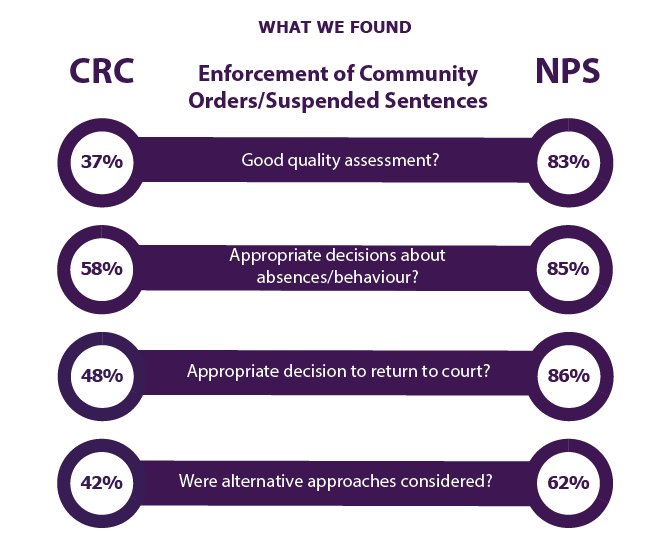
The enforcement by private probation companies of community-based court sentences has been assessed as poor in a report by HM Inspectorate of Probation. Inspectors found that staff in Community Rehabilitation Companies (CRCs) did not see offenders often enough while under supervision on two of the most commonly used non-custodial sentences – community orders and suspended sentence orders.

This lack of meaningful engagement led to poor decisions in managing breaches of the orders. Though the proportion of community-sentences completed or ended early through good progress has been gradually rising, it was still the case that in 2016-17 a total of almost 30,000 court orders were terminated through failure to comply, further offences or other reasons.

Dame Glenys Stacey, HM Chief Inspector of Probation, has previously raised concerns about remote and infrequent supervision of offenders by CRC staff, sometimes only by phone, which risks breaking the face-to-face relationships which are vital to successful probation work.

In the new report – Enforcement and Recall – Dame Glenys said: “Once again, we found CRCs stretched beyond their capacity.

“Good enforcement relies on good quality probation supervision. CRCs focused on contract compliance, but not seeing people often enough, or not engaging meaningfully with them, are inevitably behind the curve on enforcement, as staff may not know when enforcement is called for, or when purposeful work to re-engage the individual would be better for them and for society.” Poor supervision, Dame Glenys added, “is more likely to lead to reoffending and, for some, another round of imprisonment.”

Inspectors also looked at cases where individuals were recalled to prison because of breaches of the conditions of their release into the community under license. It addressed concerns expressed by some commentators that offenders were recalled too readily, for minor breaches. The report showed that a substantial number of people were recalled – with this group accounting for 6,554 out of the prison population of 85,513 in England and Wales on 31 March last year.

However, Dame Glenys said she hoped the report would allay concerns about inappropriate recall. “There have been increases in recall numbers, most recently following the extension of supervision in the community to those sentenced to less than 12 months.”

The inspection found almost all recall decisions by the NPS, the National Probation Service responsible for higher risk offenders, and CRCs were good decisions.

“Often, the level of disengagement or deterioration in the person’s behaviour were such that they could not be safely managed in the community. Recall was appropriate, even when the individual had committed a relatively minor further offence.” The reason for this in CRC cases, inspectors believe, was that recall procedures were generally clear and well understood, and people on licence, and subject to recall, were more likely to be supervised by higher-grade staff who are experienced at making the necessary judgements.


--oo00oo--

Foreword

We reported initial teething problems in enforcement soon after Transforming Rehabilitation, with cases moving to and fro between the National Probation Service (NPS) and Community Rehabilitation Companies (CRCs) unnecessarily. Local leaders and staff worked hard to iron out those early difficulties. It is a credit to them that arrangements for CRCs to transfer cases to the NPS for enforcement (as they must) now work as well as they do, time after time. 

At the start of my tenure, magistrates and others were expressing concerns about an apparent reluctance of CRCs to enforce. We alerted the Ministry of Justice last year to our evidence that enforcement was not always happening when it should. CRCs were paid less if too many cases were cut short by enforcement, an incentive not to act. The department acted quickly to redress matters, but understandably, magistrates and others still lack confidence, not sure of effective enforcement. 

I hope that more recent concerns at the other end of the spectrum – that individuals released from prison on licence are being recalled to prison too readily by probation staff – are abated by our inspection findings. There have been increases in recall numbers, most recently following the extension of supervision in the community to those sentenced to less than 12 months. In this inspection, we found almost all NPS and CRC recall decisions were good decisions, with the NPS particularly good at considering alternatives to recall beforehand. 

Often, the level of disengagement or deterioration in the person’s behaviour were such that they could not be safely managed in the community. Recall was appropriate, even when the individual had committed a relatively minor further offence. There is still every reason to be anxious about CRC enforcement, however. We found that NPS cases were sufficiently wellmanaged, whereas too many CRC cases were not. While it seems odd that we found CRCs notably better at recall than enforcement, we think we know why that is. 

Recall procedures are generally clear and well understood, and people on licence are more likely to be supervised by higher-grade staff who are experienced at making the necessary judgements. 

What is more, good enforcement relies on good quality probation supervision. CRCs focused on contract compliance, but not seeing people often enough, or not engaging meaningfully with them, are inevitably behind the curve on enforcement, as staff may not know when enforcement is called for, or when purposeful work to re-engage the individual would be better for them and for society. I suspect this is the biggest issue undermining effective enforcement today: that, in many CRCs, the case management itself is insufficient to enable good enforcement decisions. Instead, poor supervision is more likely to lead to reoffending and, for some, another round of imprisonment. 

Once again, we found CRCs stretched beyond their capacity. We hope that the recommendations in this report provide an impetus for change, so that enforcement decisions can be made fairly and appropriately, as part of good, integrated probation practice designed to tackle entrenched reoffending patterns.

Dame Glenys Stacey
HM Chief Inspector of Probation
January 2018

4.3. Conclusions and implications 

Community Rehabilitation Companies 

Overall, the quality of case management and consequent enforcement decisionmaking in the sample of post-sentence supervision cases was poor. We found that several things had a bearing on this: workload pressures, the complexity of the cases, organisational upheaval and the limited opportunities to engage with service users who were reluctant to be supervised. It is far from the case that nothing can be done. It had been possible to access useful services as part of supervision in cases in the wider sample, particularly if there were well-developed partnership arrangements in the locality. However, the current arrangements far too often fail to make an impact on these difficult cases. 

National Probation Service 

Overall, the quality of case management and consequent enforcement decisionmaking in the sample of post-sentence supervision cases was good in the NPS. The complexity of cases being managed was remarkably high, and the proportion of individuals assessed as a high risk of causing serious harm striking. Despite good probation work, most individuals in the sample remained locked in a cycle of brief periods in the community and frequent return to prison. 

Shared conclusion 

There were marked limitations to what could be achieved for these individuals and wider society. Far from turning around people’s lives, the additional elements of supervision seemed to make no tangible difference. High-quality case management by itself did not deliver effective outcomes in most cases. Where positive progress happened, this was attributable either to the persistent efforts of individual practitioners or to the existence of multi-agency approaches aligned to the localities in which the service was delivered – the key partner agencies of police, local authority and health service providers. In some areas such working arrangements were in place. In others they were non-existent. Again, we found no clear pathway for female service users.

Thursday, 8 February 2018

Criminal Justice in Crisis

Everywhere we look the criminal justice system seems to be in a state of crisis or chaos and the situation could not have been better outlined than by former lord chancellor Charles Falconer with a forensic opinion piece in the Guardian recently:-

British justice is in flames. The MoJ’s fiddling is criminal


From prisons to probation and legal aid, the entire system is on the verge of collapse – and poor people bear the brunt. Act now, lord chancellor

No one who knows anything about the justice system doubts it is in crisis, that the crisis is unprecedented, that it is rendering the system unable to perform its most basic functions. And that the victims of this are poor people.

It is no longer reliably convicting only the guilty. The disclosure problems in serious sex cases have almost certainly resulted in innocent people being convicted. The system for releasing prisoners on parole is letting out those who are unsafe (John Worboys) and keeping inside those who are safe (see the relentlessly unfair incarceration under the IPP (indeterminate sentences for public protection) system. The prisons are as dangerous as they have ever been in modern times to prison officers and prisoners alike. The probation service has ceased to function in the face of a misconceived privatisation.

Legal aid has been so restricted as a result of the terrible reforms contained in Laspo – the Legal Aid and Sentencing and Punishment of Offenders Act 2011 – that the government has maintained massively flawed decision-making systems for welfare, homelessness, and immigration decisions, safe in the knowledge that most of those who are the victims of wrong rulings have no effective means of redress. The civil non-family courts are only open to rich people (there is in effect no legal aid for civil claims now); and the family courts are filled with local authorities seeking to remove children from their parents, and disputes between couples in the middle of the pain – to them and their children – of partnership breakdown, and unable to obtain legal help to resolve these disputes.

The cause of this crisis is pretty clear – the justice system has endured austerity cuts from 2011 onwards more punishing than any other domestic delivery department. And the cuts are continuing pretty well unabated for the next two years. There will, by 2020, have been a 40% reduction in real terms of public expenditure by the Ministry of Justice – £10bn down to £6bn, with £600m still to go. And all this on the basis that the system expects the same standards as before – the same level of justice, the same numbers of people in jail or more, and the same non-custodial alternatives. The government has offered no leadership on how this is to be achieved.

The consequences of the crisis are profound. As Lord Judge, the former lord chief justice said, juries will increasingly not convict in serious cases. The public will have no confidence in the ability of the justice system to distinguish between the guilty and the innocent, and between the dangerous and the safe. The government will not be held to the law. Rights given to individuals by parliament are worthless to all save rich people who rarely need them to avoid injustice. Employers, the state, debtors – they can increasingly break the law unchallenged.

Nothing meaningful is going on within government to address this. There are internal Ministry of Justice (MoJ) reviews of Laspo, and the working of the Parole Board; and an internal Crown Prosecution Service review of whether the disclosure in all recent sex cases was adequate: but absolutely nothing to address the evident collapse of almost all parts of the system, and the underlying reasons.

There is the much vaunted £1bn capital fund to transform justice by improving buildings and technology. The example the MoJ points to as the exemplar outcome of this fund is a new online court to deal with civil claims under £25k. If this example shows the MoJ’s priorities, it is clear it has no comprehension of the scale of the current collapse. Fiddling while Rome burns.

Some extra money was obtained, after much effort, from the Treasury to employ more prison officers to make up for a portion of those lost in the austerity cuts. This was well over a year ago, yet the prison service cannot fill all the places they have the money for. The retention rate for prison officers is plummeting both among long-service officers, and new ones who frequently leave quickly when they see the horror the job has become.

Leadership, extra resources and reform to ensure that the justice system is never again allowed to fall below minimum standards are the solution. The new lord chancellor is not to blame for the crisis. David Gauke has to acknowledge the existence of it, rather than suggest the system is functioning properly with a few wrinkles. He will find support across all parties and in all walks of life for doing so.

He needs to craft a plan that he can demonstrate has widespread support, not just from the lawyers but from those who depend on the justice system. He won’t get all that the system needs, but he won’t get anything unless he develops a series of solutions. He needs to work with a much wider group than just his department, and would find so much support if he embarked urgently on that process. Other government departments are actively campaigning for more resources for developed solutions. The MoJ’s failure to do so suggests either it does not understand the extent of the crisis, or is too defensive of its past errors to convey accurately within government the damage being done.

The three priority areas for extra spending and reform are prison and probation, legal aid and the Crown Prosecution Service (the ministerial responsibility of the attorney-general). That extra expenditure is inevitable. The sooner it is acknowledged the less will be required. As the Thatcher government discovered, the failure to do anything about appalling prison conditions until the 1990 Strangeways prison riots cost a lot more than if it had addressed the problem earlier.

But the solution is not just cash. It is also reform to provide long-term confidence that the system, which has so much less political support than health or education, should never be allowed to slip below minimum standards again. The Bach report, published last autumn, made the well-received recommendation that there should be an independent body within government to set minimum standards for justice. That would provide a strategic overview of expenditure, and protect those who need legal help with a degree of security that comes from there being insulation against legal expenditure always being the first to be cut in a crisis.

A collapsing legal system damages not just those who suffer immediate injustice. It leaves us all vulnerable to the consequences of living in a society, where the law is unreliable and only enforceable by the rich.

Charles Falconer is a former lord chancellor and justice secretary


--oo00oo--

This from the Daily Telegraph:-

Judge takes swipe at “collapsing” justice system as CPS failures cause yet another sex trial to collapse

A judge has taken a swipe at the “collapsing” justice system as CPS failures cause yet another sex trial to collapse. Judge David Ticehurst was forced to halt a child sex assault case after the prosecution produced a number of documents the defence had not previously seen midway through the hearing.

His decision follows a number of high-profile rape cases in other parts of the country being dismissed because vital evidence had not been provided by the police or the Crown Prosecution Service (CPS). Judge Ticehurst had been sitting on the trial of Michael Doughty, 30, who was facing three counts of sexual assault against a girl aged under 13 at Taunton Crown Court in Somerset.

He dismissed the jury on Thursday and ordered a retrial, adding that if he was a newspaper reporter his headline would read: 

Yet another case collapses because the CPS fails to disclose documents." He said the problem could be attributed to budget cuts, adding: "It is abundantly clear the criminal justice system is creaking - it's collapsing. Members of the public will cease to have any confidence in the justice system. It's falling apart and this is one of the consequences. I'm not blaming the CPS or the police."

A number of other similar cases have led to thousands of current rape and serious sexual assault cases in England and Wales being reviewed to ensure evidence has been disclosed. Addressing the jury Judge Ticehurst said: 

"Documents were made available to the defence yesterday that hadn't been disclosed earlier. They might have had some impact on the trial and it would have been wrong to continue with the trial without the defence having seen the documents. I don't blame (prosecutor) Miss (Rachel) Drake or the officer in the case. There are not enough policemen around, not enough people in the CPS. Defence barristers are being paid less than they were 10 years ago and that's being reduced. The system is falling apart and this is one of the consequences."

His comments follow the trial of Liam Allan at Croydon Crown Court which was abandoned after it emerged police failed to pass on text messages from his accuser that proved his innocence.

--oo00oo--

I can't quite believe this story, but it's in the Daily Mail so I guess it must be true:-

Britain's first 'private police force' has caught 400 criminals with a 100 per cent conviction rate after taking on cases regular officers are too busy to look at.

The country’s first ‘private police force’ is investigating hundreds of crimes that regular officers are too busy to look at. A firm led by former Scotland Yard senior officers has successfully prosecuted more than 400 criminals and is now carrying out murder inquiries. TM Eye, which has a 100 per cent conviction rate, is thought to bring more private prosecutions than any organisation besides the RSPCA.

The company, the country’s first de-facto private police force, is operating against a backdrop of rising crime rates and police budget cuts. Its activities include:

  • A service called ‘My Local Bobby’ costing wealthy households up to £200 a month each for guards to patrol their streets;
  • Three high-profile murder investigations that police have been unable to complete, including one case dogged by allegations of corruption and cover-up;
  • Help in cases of rape, missing persons, burglary, theft, stalking and blackmail. 
Co-founder Tony Nash, an ex-Metropolitan Police commander, said: ‘This is going back to Dixon of Dock Green to a degree. It’s what people want. ‘There is no substitute for going out and knocking on doors. But with the current state of finances, police are solving cases behind their desks and that has become the culture.’

In the past two years the company has brought successful private prosecutions against 403 criminals for fraud, intellectual property theft and other offences. A total of 43 were jailed. The company, staffed by retired detectives and cyber-crime experts from Scotland Yard, the National Crime Agency and GCHQ, is now expanding its services beyond predominantly financial investigations.

It comes as police chiefs admit they do not have the money to investigate high- volume crimes such as shoplifting and stretched officers complain that they are at breaking point. But critics fear the rise of private policing could lead to a two-tier system where only the wealthy get protection from criminals.

Metropolitan Police Federation chairman Ken Marsh described the rise of private detectives as a ‘staggering indictment’ of the state of policing. ‘Eventually there will be a two-tier system with the haves and the have-nots, and if you have money and live in a £20million house in Chelsea you can pay for private security,’ he said. My concern would be, where is the public scrutiny if it goes wrong? If they are allowed to go and do police’s job for them, that is a dangerous status quo.’

Last week official police figures revealed the largest recorded annual increase in crime for more than a decade, with surging levels of violence, sex attacks, knife and gun offences across the country. But what was not recorded in the figures is the astonishing number of criminals being locked up – and in some instances even deported – through the work of private investigators.

TM Eye currently has 36 criminal cases pending at Crown and magistrates’ courts around the country and is working on a further 60 investigations in London, Cheshire, Dorset, Avon and Somerset and Essex. In the past six months, its 60 investigators have snared suspects wanted by police for attempted murder and rape. Recently a stalker was jailed for four years on the basis of its work.

Using covert surveillance and undercover operatives, the private firm has managed to smash a major counterfeit goods gang, securing convictions for 60 offenders in Manchester selling fake designer handbags and clothing. All of its convictions and suspects’ DNA and fingerprints are recorded on the Police National Computer. It does not charge for its investigative services, seeking instead to recoup costs from courts after offenders are convicted.

The firm has offices in London, Manchester, Essex and Mumbai in India, where investigators have helped to catch a major manufacturer of fake medicines. The firm launched its subscription service My Local Bobby last March and its staff now patrol some of London’s most expensive streets in Belgravia, Mayfair and Kensington. Individual uniformed ‘bobbies’ cover up to 250 houses, whose owners each pay a fee of £100 to £200 a month.

In return, clients get a ‘meet-and-greet’ service from their car or the Tube, and have a hotline to their bobby whose location they can track on their iPad. If there is a crime, the firm promises to have a local response officer on the scene within five minutes. Like police, the patrol teams have body cameras to record evidence. They can apprehend suspects using a citizen’s arrest. Mr Nash said his ambition is to get local authorities to outsource their patrols to the firm.

TM Eye also offers more traditional security work such as bodyguards for foreign dignitaries. The firm’s managing director David McKelvey, a retired Scotland Yard detective chief inspector, said: ‘We probably do more undercover work than any other law enforcement agency. We have a better surveillance capability and equipment than most forces.’

He added: ‘It’s about catching the bad guys and protecting the public, and we can help with that. ‘Police are on their knees, sick to the teeth with what is going on in their job. The bottom line is we have better uniforms, better pay and better support at work. It’s a huge growth industry.’

David Green, of the think-tank Civitas and a former adviser to the Government, said: ‘This seems a reflection of the fact that the police are overstretched, underfunded and unable to cope and this group has emerged to fill the gap.

‘There is nothing wrong with private security or private patrols. But if they take on some of the functions of the police and the call for this grows, there is a danger there is not the same safeguards that we have with the police. If the police do something wrong there is a clear disciplinary structure, a chain of accountability and independent scrutiny. If these private firms exercise police powers without public accountability, there could be dangers there.’


--oo00oo--

Oh look. According to this Parliamentary Question, it costs the taxpayer £4.4million a year for supervising the non-compliance of that prison maintenance contract that Carillion and Amey had:-

Richard Burgon Shadow Lord Chancellor and Shadow Secretary of State for Justice

To ask the Secretary of State for Justice, what the staffing cost was for teams in his Department with responsibility for monitoring the delivery of contracts for prison maintenance by private sector companies in (a) 2015, (b) 2016 and (c) 2017.

Rory Stewart The Minister of State, Ministry of Justice

Staffing costs for the teams in the Department with responsibility for monitoring the delivery of contracts for prison maintenance by private sector companies is as follows:
2015: £2,491k
2016: £4,471k
2017: £4,438k

--oo00oo--
Finally, I couldn't help but notice the Judge hearing the application for Judicial Review into black cab rapist Warboy's release demanded his appearance from HMP Wakefield "because he didn't trust the video link". According to the Justice Gap website :- "Worboys appeared in person at the High Court after judges experienced a faulty video link during a hearing the previous day. ‘How is it that I can call my brother in Brisbane over Skype, but we’re unable to contact a person in a prison in this country?’ said Sir Brian Leveson."

Wednesday, 7 February 2018

Conversation Starters

On the day that a discussion kicks-off within the portals of the Welsh Assembly seeking to find a way to fix the obviously broken Probation Service, I was particularly struck by these contributions from yesterday:-  

I joined the service after it was no longer social work based but before NOMS. We had a value base that was changing, but still recognisable as social work, albeit with some political influence pushing the enforcement side of things (which could be ignored providing you were prepared to stand up for yourself and your decisions). 

I have no idea what our current value base is. Whatever we are meant to be doing is couched in pretty civil service language that means nothing to me, generally sent in 15 email attachments I can't open and don't have time to read because I'm writing my third type of assessment this week on the same case. 

As far as I can tell my job description is to be all things to all people and to never ever say anything bad about anything. The so called independent parole board appears to have different definitions of risk depending on how full the prisons are and we are either enforcing too much or too little on different days of the week. 

I've always loved my career choice, despite the fact that it's always been a political football - there always been a clear reason and all round benefit in doing what we do. This is nothing short of a farce. We employ hundreds of people doing things like quality audits and development tools. They have no fucking clue about people, about what's possible, about the fact that WE are the ONLY resource we have and we are finite no matter how many resilience and mindfulness briefings they make us attend. 

CRCs are failing but so is NPS and all we get from management is how amazing they are for forcing us to hit meaningless performance targets week after week. The thing is, that to me Probation has looked different within the context of each individual case. Yes there's an organisational overarching objective, but that's achieved in a different way for each person we work with. 

One size fits all doesn't work for cases or for staff and the much feted creativity that TR was meant to promote has been strangled by a real lack of understanding of what the front line role is meant to be. It's broken. I don't think it can be fixed. But it's also breaking the people who encounter the whole sorry mess, which in my book is unforgivable.

*****
How do you solve a problem like probation? I'm not too sure if that's the right question really. The direction of travel must ultimately depend on the destination you want to arrive at. It's my opinion that probation has changed so much and so often over the last couple of decades that those who work in the service have very different ideas of what the destination should be. 

Social work based? Supervisory and enforcement ethic? Public protection agency? Law enforcement or a post custody monitoring body? I think they're all legitimate arguments of what the service should exist to provide, and for many people their idea of what the service should be will be partly shaped by what the service was like when they joined. 

I think it's worth remembering that someone who joined the service around the time NOMS was created have a fair few years in now and maybe considered by some to be long in the tooth. But there's still people who predate NOMS and they gave a different perception of what the service should be. It's a conundrum that's complicated by wider changes in the criminal justice system and political interference. 

The probation service means too many different things to too many different people, so before someone tries to fix it they need to be clear in their minds what they want the end result to look like. My own personal opinion is that it should be social work orientated and not so focused on law enforcement. But that's just my opinion.

*****
Engaging with someone around their harmful behaviour is both complex and necessarily unique to that person. Adding in the mandated aspect of Probation work adds further complexity. The only way that I can make sense of, that stands a chance of working, is by establishing a professional rapport and relationship, engaging the individual motivationally, and then, based on thorough and ongoing assessment, collaborative work toward agreed goals. That means a one-to-one relationship with time to be meaningful. Beyond that the relationship needs supporting by others within the organisation and out. A collective focus. I don't care if you call it social, community, therapeutic or probation work. If it does not have those ingredients as a minimum, it is unlikely to deliver substantially.

*****
Set probation and prison services apart from politics and let the purpose be (re)habilitation and inclusion into society. That way all those people we need with us can be contributing rather than thrown on the scrap heap which is what is happening now. Stop wasting people. Children in schools should be given a diverse spectrum of opportunities rather than everything being focussed on academia. All types of intelligence should be embraced and developed.