Saturday, 6 August 2016

Greece

It's Saturday, the sun is shining, the Olympics have started, the football season has kicked off and this blog keeps rolling along, most recently I see with a spirited discussion on VLO's and appropriate pay banding after I'd gone to bed. 

I've nothing probation-based to say today, so have decided to go 'off piste' and highlight something I feel is extremely important, but as far as I know has gone almost completely unreported. Regular readers will be aware that we generally take a liberal view of going off on tangents as long as it doesn't hijack things at key probation moments and a change is as good as a rest as they say. 

In January 2015 I wrote about the dire economic and political situation in Greece and the unresolved historical matters of reparations legitimately owing to them from the Second World War. Angela Merkel refused to discuss the matter and said it was 'all a long time ago' etc and I guess it fell into the 'too difficult to deal with' category for the rest of Europe to be bothered with. I'm still not sure how the issue was resolved - probably just swept under the carpet, but we do know Greece was publicly humiliated by the rest of the EU and its citizens punished and made to suffer harshly in order to pay for their so-called economic failings. Some say this treatment has helped to fuel anti-EU feeling in other nations, concerned they might be next to be made an example of. 

Purely by accident, I came across this astonishing article in the Daily Telegraph a week or two ago and I really feel the content needs to be spread widely, not least because it helps explain the growing anti-EU feeling across Europe, why it is a 'failed' project and that an apology is owed to the Greek nation. All of us would do well to take note:-
  
IMF admits disastrous love affair with the euro and apologises for the immolation of Greece

The International Monetary Fund’s top staff misled their own board, made a series of calamitous misjudgments in Greece, became euphoric cheerleaders for the euro project, ignored warning signs of impending crisis, and collectively failed to grasp an elemental concept of currency theory. This is the lacerating verdict of the IMF’s top watchdog on the fund’s tangled political role in the eurozone debt crisis, the most damaging episode in the history of the Bretton Woods institutions.

It describes a “culture of complacency”, prone to “superficial and mechanistic” analysis, and traces a shocking breakdown in the governance of the IMF, leaving it unclear who is ultimately in charge of this extremely powerful organisation.

The report by the IMF’s Independent Evaluation Office (IEO) goes above the head of the managing director, Christine Lagarde. It answers solely to the board of executive directors, and those from Asia and Latin America are clearly incensed at the way European Union insiders used the fund to rescue their own rich currency union and banking system.

The three main bailouts for Greece, Portugal and Ireland were unprecedented in scale and character. The trio were each allowed to borrow over 2,000pc of their allocated quota – more than three times the normal limit – and accounted for 80pc of all lending by the fund between 2011 and 2014. I
n an astonishing admission, the report said its own investigators were unable to obtain key records or penetrate the activities of secretive "ad-hoc task forces". Mrs Lagarde herself is not accused of obstruction.

“Many documents were prepared outside the regular established channels; written documentation on some sensitive matters could not be located. The IEO in some instances has not been able to determine who made certain decisions or what information was available, nor has it been able to assess the relative roles of management and staff," it said.

The report said the whole approach to the eurozone was characterised by “groupthink” and intellectual capture. They had no fall-back plans on how to tackle a systemic crisis in the eurozone – or how to deal with the politics of a multinational currency union – because they had ruled out any possibility that it could happen.

“Before the launch of the euro, the IMF’s public statements tended to emphasise the advantages of the common currency," it said. Some staff members warned that the design of the euro was fundamentally flawed but they were overruled. “After a heated internal debate, the view supportive of what was perceived to be Europe’s political project ultimately prevailed,” it said.

This pro-EMU bias continued to corrupt their thinking for years. “The IMF remained upbeat about the soundness of the European banking system and the quality of banking supervision in euro-area countries until after the start of the global financial crisis in mid-2007. This lapse was largely due to the IMF’s readiness to take the reassurances of national and euro area authorities at face value,” it said.

The IMF persistently played down the risks posed by ballooning current account deficits and the flood of capital pouring into the eurozone periphery, and neglected the danger of a "sudden stop" in capital flows. “The possibility of a balance of payments crisis in a monetary union was thought to be all but non-existent,” it said. As late as mid-2007, the IMF still thought that “in view of Greece’s EMU membership, the availability of external financing is not a concern".

At root was a failure to grasp the elemental point that currency unions with no treasury or political union to back them up are inherently vulnerable to debt crises. States facing a shock no longer have sovereign tools to defend themselves. Devaluation risk is switched into bankruptcy risk. “In a monetary union, the basics of debt dynamics change as countries forgo monetary policy and exchange rate adjustment tools,” said the report. This would be amplified by a “vicious feedback between banks and sovereigns”, each taking the other down. That the IMF failed to anticipate any of this was a serious scientific and professional failure.

In Greece, the IMF violated its own cardinal rule by signing off on a bailout in 2010 even though it could offer no assurance that the package would bring the country’s debts under control or clear the way for recovery, and many suspected from the start that it was doomed.

The organisation got around this by slipping through a radical change in IMF rescue policy, allowing an exemption (since abolished) if there was a risk of systemic contagion. “The board was not consulted or informed,” it said. The directors discovered the bombshell “tucked into the text” of the Greek package, but by then it was a fait accompli.

The IMF was in an invidious position when it was first drawn into the Greek crisis. The Lehman crisis was still fresh. “There were concerns that such a credit event could spread to other members of the euro area, and more widely to a fragile global economy,” said the report. The eurozone had no firewall against contagion, and its banks were tottering. The European Central Bank had not yet stepped up to the plate as lender of last resort. It was deemed too dangerous to push for a debt restructuring in Greece.

While the fund’s actions were understandable in the white heat of the crisis, the harsh truth is that the bailout sacrificed Greece in a “holding action” to save the euro and north European banks. Greece endured the traditional IMF shock of austerity, without the offsetting IMF cure of debt relief and devaluation to restore viability.

A sub-report on the Greek saga said the country was forced to go through a staggering squeeze, equal to 11pc of GDP over the first three years. This set off a self-feeding downward spiral. The worse it became, the more Greece was forced to cut – what ex-finance minister Yanis Varoufakis called "fiscal water-boarding".

“The automatic stabilisers were not allowed to operate, thus aggravating the pro-cyclicality of the fiscal policy, which exacerbated the contraction,” said the report. The attempt to force through an "internal devaluation" of 20pc to 30pc by means of deflationary wage cuts was self-defeating since it necessarily shrank the economic base and sent the debt trajectory spiralling upwards. “A fundamental problem was the inconsistency between attempting to regain price competitiveness and simultaneously trying to reduce the debt to nominal GDP ratio,” it said.

The IMF thought the fiscal multiplier was 0.5 when it may in reality have been five times as high, given the fragility of the Greek system. The result is that nominal GDP ended 25pc lower than the IMF’s projections, and unemployment soared to 25pc instead of 15pc as expected. “The magnitude of Greece’s growth forecast errors looks extraordinary,” it said.

The strategy relied on forlorn hopes that the "confidence fairy" would lift Greece out of this policy-induced nose-dive. “Highly optimistic” plans to raise $50bn from privatisation sales came to little. Some assets did not even have clear legal ownership. The chronic “lack of realism” lasted until late 2011. By then the damage was done.

The injustice is that the cost of the bailouts was switched to ordinary Greek citizens – the least able to support the burden – and it was never acknowledged that the true motive of EU-IMF Troika policy was to protect monetary union. Indeed, the Greeks were repeatedly blamed for failures that stemmed from the policy itself. This unfairness – the root of so much bitterness in Greece – is finally recognised in the report.

“If preventing international contagion was an essential concern, the cost of its prevention should have been borne – at least in part – by the international community as the prime beneficiary,” it said. Better late than never.
  

Ambrose Evans-Pritchard

--oo00oo--

The article led to the following analysis by prolific blogger on such matters John Ward:-

Yesterday’s mind-blowing piece from Ambrose Evans-Pritchard at the Daily Telegraph may not have reverberated around the world just yet, but it should. The article not only features a coruscating condemnation (by its watchdog the Independent Evaluation Office – IEO) of the IMF’s actions in relation to ClubMed austerity, but also an apology from the IMF board and Lagarde herself for the appalling suffering inflicted upon Greece, and the level of mindless collaboration with mad EC debt policy involved.

The News

The IEO report finds that the whole approach to the eurozone was characterised by “groupthink” and going native with Brussels. They had no fall-back plans on how to deal with a multinational currency crisis, because they had “ruled out any possibility that it could happen”.

In Greece, the IMF signed off a “bail-out” in 2010 – even though it made the sovereign debt impossible to sustain, and many commentators (this one included) insisted from the start that it was mathematically doomed. To go along with the imposition of austerity on top of this was, quite simply, economic illiteracy.

The killer punch – delivered by Evans-Pritchard, a globally respected writer on fiscal economics – is staggering in the clarity of its accusation:


The ramifications of these findings should have colossal ramifications on literally dozens of dimensions. What the IEO Report means
  • For Greece, a clear and documented case for repudiation of the debt in an International Court
  • For Brexiteers, a vindication of the moral case for leaving an EU that behaved with selfish and almost unthinkable cruelty from Day One
  • For Christine Lagarde, a humiliating admission that she simply did not do her fiduciary duty at the IMF. Her position as head of the IMF must now be in doubt
  • For British MPs and the Whiteminster establishment, a sense of shame that – in the light of this obvious international crime – they sat on their hands and whistled a happy tune
  • For the Obama Administration’s Tim Geithner, a confirmation of the charge levelled against him at the time: that he used Lagarde’s Amerophilia and French nationality to advantage in pushing through her appointment to a job for which she had no qualifications
  • For emerging nations, rage at the highhanded and devious manner in which stimulus that should’ve gone to their economies was blown in a fruitless excercise in debt management designed to keep over-leveraged Western banks upright
  • For the Berlin austerity school, a slap across the face and a recognition of its bigoted approach to the problem.
  • For the European Commission, charges of collaboration in a hare-brained attempt to save an idiotic currency union
  • For the key members of the Eurogroupe and the infamous Troika, possible prosecution for the way they bullied Greece to set an example to others
  • For Mario Draghi at the European Central Bank, possible prosecution for the illegal use of EU funds to destabilise the Greek banking system…the same charge applying to his toady in Athens, Yannis Stournaras
How to stop this happening again

In the short term, we probably can’t: there are bigger clouds boiling on the horizon that will rain on the globalist SuperState parade, come what may.

But beyond the Crash2 that creeps ever nearer, the world of States, fiscal policy, multinational banks and global trade alliances needs to given a serious reality check:
  • The neoliberal ‘light touch’ regulation of lending at all levels should be abandoned in favour of highly-paid forensic watchdogs with the talent and power to stop limits being exceeded
  • The role of Goldman Sachs in this venture should be revisited vigorously by the forces of law and order on every continent: “setting aside fines” will no longer cut it…miscreants must go to jail and serve real sentences, not token knucke-raps
  • The euro needs to be radically restructured or abandoned if disasters to make this one look like a minor event are to be avoided
  • Above all, widescale debt relief should now be brought in and enforced throughout Club Med
  • The European Commission and its power structures need to be investigated by the top brains available in forensic auditing and the Law
  • The Eurogroupe and the ECB in particular must be made accountable to a directly elected European Parliament, and forced to act within the spirit and letter of the Treaty of Lisbon
  • The manic, blind drive towards federalism should be abandoned: it has been a classic case of trying to sprint while still a toddler. The EU should go back to being the EC.
The situation in Greece today is that of an unelected group of userers telling the democratically elected Governnment of Greece what to do. In the light of the IEO revelations, no ethical group of civilised nations can stand by and offer no restitution for what the largely innocent Greek people have suffered.

International relief without strings but with very heavy regulatory control should be forthcoming for all of ClubMed, and Greek poverty made a priority. Everyone is very keen these days on War Crimes tribunals. I think we need to instigate some Peace Crime investigations.

John Ward

Friday, 5 August 2016

Latest From Napo 113

This from the General Secretary's blog:-

Napo very clear about our objectives on job evaluation

A 30 minute break from what is as I expected, a testing but extremely thorough E3 Job Evaluation meeting with senior NOMS management, gives me an opportunity to bury any notion that Napo has entered the appeal mechanism having already decided what the results of the job evaluation panels (that I wrote about last week) are going to be.

I rarely respond to idle gossip or rumours, but if anyone can let me have the source of the statement being peddled in some quarters as official Napo policy, that this union is not trying its best to achieve an increase in banding for the Victim Liaison Officer, then I will be pleased to investigate.

Better still let’s all save some time; and allow me to repeat what I have made clear at just about every branch AGM I have attended in recent weeks, which is that Napo's leadership group believes that the VLO banding should be set at 4. That is why I have devoted considerable internal resource into our efforts, and have helped persuade NOMS to take our issues seriously, and with the help of Katie Lomas, Chris Winters and Yvonne Pattison, have found a number of expert practitioners who have provided superb input in helping us challenge the original outcomes.

We now enter the next stage of an agreed process as part of the NNC Job Evaluation scheme where trained job evaluation panelists – which include Napo nominees who know about the jobs – will look at the revised job descriptions and job design questionnaires that we have tried to make as reflective as possible of the valuable work undertaken by our VLO Members.

We will adopt exactly the same approach for all of the other appeals that we are going through in an attempt to secure the best possible outcomes for members.


HM Inspectorate pulls no punches

Dame Glenys Stacey has certainly set out her intentions in the way in which the probation inspectorate intend to go about their work, with another highly impressive report into the provision of probation services in the Durham area.

We will be going through this to pull out the key issues that we will want to bring to the attention of the new Secretary of State as well as Michael Spurr following our recent meeting. Among other things, the report raises some interesting issues about 'on the day' court reports that tally with much of our E3 feedback.

We have already approached NOMS with our view that under E3, the court report allocation system requires reports to be allocated to either a PSO or PO based on the level of risk. But given that the level of risk is determined at the end of the report, it’s a fair question as to how the reports will be allocated on this basis if this is not determined at that point? We, and you, are concerned that reports will either be completed by staff not properly trained to do them, or that there will be lots of duplicated work, where for example a PSO starts the report process (interview etc) then realises it's not a PSO appropriate report and has to hand it over to a PO who will have to start from the beginning. This is time consuming for staff but pretty awful for clients at a critical point in the judicial process.

Practitioners will be well aware of how the Information available at court is often mixed; it can take weeks to get what is needed from police and social services and information on the availability of interventions from CRCs isn't always up to scratch either.

There is a new drive from NOMS to prepare the report where the client is sentenced even if they live in a different area. This also means that a report writer in Leeds may be completing a report for a client who lives in London and it's not easy to find out how to get information from police, social services and the local CRC to where the client's order will be managed. In the past these reports would be adjourned for a local report writer to complete.

This situation needs urgent attention from NOMS, who will not be able to say that Napo failed to bring it to their attention.


Public Service Prisons Operating Model - early responses from members

Following my invitation for direct feedback last week, it’s clear that there is disquiet amongst some members about the proposals, especially in light of the E3 1:1 meetings taking place at the moment. Until now there has been a lack of engagement with the unions on this keynote proposal which has a huge potential impact on our members for many reasons. M
y appreciation to those readers who have taken the time and trouble to let me have your views. Here is a snapshot summary of some of what you are saying about the prospect of more NPS staff working in prisons:
  • Prisons are generally less accessible; therefore there are fears that there is a possibility of members being managed out due to disability.
  • Working hours are more restrictive in prisons, making it an unsuitable option for many staff due to work life balance issues.
  • The environment is a very different one and any transition should necessarily be managed carefully and be for a fixed term.
  • Some LDU clusters have no prisons, some have several, and so moving the custody work means moving staff which in turn means a huge upheaval of staff from those areas with no prisons.
  • Some members may struggle with the vetting requirements for prisons.
  • There is a lot of uncertainty about the practicalities of prisoners moving multiple times during their sentences. This is likely to cause workload issues for members.
Role boundaries will have to be re-thought due to the new PSO role in the community.
There are many questions about the minutiae of the proposals that we will be putting to 
NOMS during the engagement process.

Plenty to think about on this, and the myriad issues that we are pushing on behalf of members across the 24 employers we now deal with.


--oo00oo--

This from the previous week's blog:- 

Job evaluation - whats happening next?

We are due to engage with senior NOMS management about the next stage in the agreed process for reviewing those posts that formed part of the E3 job evaluation exercise including VLOs, AP Managers and AP Residential Workers. This follows the agreement we reached with the employers to have a collective review of the job evaluation outcomes to avoid massive amounts of duplicated work from individual appeals.

At the E3 trade union engagement meeting this week it was agreed that following a review of all the information provided by both sides, a meeting will be held prior to new panels being convened who will re-evaluate these job roles. Napo have insisted that the new panels must contain trade union representatives with the appropriate level of understanding of the specific roles being reviewed; and whilst we cannot hand pick our choices (as the system does not work that way) I am confident that those being asked to serve on the new panels will approach their difficult task with the professional knowledge and integrity that we would all expect from them. What is also important to note, is that we have insisted that the JE panellists and our expert practitioner advisers to Napo and Unison, receive a comprehensive pre-briefing from NOMS specialists about the outcomes from the proposed job roles and associated design questionnaires that Napo members actually undertaking the work have made an important contribution to.

Once we have agreed the final timescale for completion of the process we will let members know, but current expectations are that new JE Panels will be convened around mid-August.

Everyone in the leadership group here understands that this is an anxious time for many members, and all I can say at this stage is that we have done all that we can within the rules of the scheme to ensure that your interests are going to be given full consideration.

New Look Probation

The Probation Inspectorate's report into the Durham Tees Valley area gives us an opportunity to see in some detail what a 'transformed' probation service looks like:-

5.1. Effectiveness of the CRC 


Organisational issues 

DTV was a small CRC covering a relatively large geographical area. It sat within two police force areas, those of Durham and Cleveland. At the time of the inspection, the CRC had concluded a major review of its operating arrangements and management structure, with the two CRC Local Delivery Units (LDUs), one for Durham and the other for Tees Valley (sometimes described as Teesside or Cleveland), combined into one. The former arrangement of two LDUs, however, was in place for the entire period we inspected. We looked at the work from Durham LDU, which included work with participants living in County Durham and the unitary authority of Darlington. 

In common with other CRCs, DTV CRC had to deal with all incoming requests for data, renegotiations of contracts, Probation Instructions, IT and other procurement issues, buildings, inspection, National Offender Management Service (NOMS) audits, staffing matters and anything else to do with running a private sector body delivering a contract to central government. As DTV was a small entity, this had stretched the CRC’s limited management resources considerably since June 2014. 

The projected workloads calculated prior to Transforming Rehabilitation had not come to fruition.* For DTV, the actual workload was around 30% lower than anticipated. That had an adverse impact on the CRC’s income. In order to manage its budget, the CRC had reviewed its management capacity and operating model. Additionally, they had lost frontline staff via natural attrition since Transforming Rehabilitation. For the whole of the CRC, i.e. the area covered by both Durham and Tees Valley, this had amounted to a reduction in the overall staffing complement of over 15% between June 2014 and April 2016 (with offender management reduced by about 23%). DTV had historically been a Probation Trust that enjoyed a low staff turnover, and most of the staff in post at the time of this inspection had been employed by the Trust prior to Transforming Rehabilitation. They retained a strong sense of loyalty and attachment to their new employing organisation. Overall, we found staff morale was good. With all the changes experienced, that, in itself, was a positive finding.

ARCC, the owning body, had appointed a new, independent, Chair in January 2016. The post-holder was a respected individual with a high-profile probation background. His, and ARCC’s, immediate priorities were to deliver improved governance arrangements, gain financial security for the CRC and provide a focus on performance (particularly that which had a financial impact). At the time of the inspection, this was work in progress, delivered with a fresh impetus. 

Shortly before the start of this inspection, the CRC had completed the planned move of its staff from the offices it had previously shared with the NPS, introducing remote or ‘agile’ working. This involved staff working from within their local communities, in community justice hubs and ‘office work’ from home when appropriate. While hubs had been in operation within DTV since 2011, historically they had mainly been used as reporting centres for those who had sufficiently addressed their offending related needs and could be managed on a ‘maintenance’ basis. The new method of working for operational staff from the CRC involved most contact with ‘participants’, the term used by the CRC to describe offenders or service users, taking place within the community hubs throughout their period of supervision. 

The new operating model provided one CRC office in Durham (there was a second CRC office in Stockton-on-Tees, for the south part of the CRC area). The senior management function operated across both sites. At the time we inspected, there were 17 hubs across the whole of the Durham area. This new way of working was dependent on responsible officers having appropriate and reliable IT facilities. It was impressive that the CRC had successfully delivered the required technological solution with so little staff dissatisfaction.

Phase two of IT developments needed to support the operating model, that is, delivery of its locally developed case management and workflow system, was scheduled for roll-out later in the year. There were a number of external barriers to be overcome with NOMS before phase two was available to responsible officers. The new case management and workflow system had been designed to provide real-time information to staff, and flag up what individual officers needed to do and by when to maximise CRC income through achievement of contractual performance measures. 

Like all other CRCs, DTV CRC was subject to monitoring against the contractual targets it had with NOMS. At the end of March 2016, the CRC was performing well against their contractual requirements and those measures applied by NOMS to provide assurance. 

Through the Gate resettlement services were introduced in May 2015 as part of the contract for CRCs. The aim was to provide access to resettlement services for all prisoners, including those remanded in custody and those who were subject to sentences of less than 12 months. The Offender Rehabilitation Act 2014 introduced statutory post-release supervision for short sentence prisoners. This group of offenders had long been recognised as having very high rates of reoffending, and Through the Gate services were introduced to address that. Within the CRC area, Durham had higher reoffending rates than England & Wales as a whole, with those in Darlington being higher than those for County Durham (Appendix 2 Table 5). 

The CRC had deployed considerable resources into Through the Gate, more than was reflected within the ‘fee for service’ income paid for delivery of these services by NOMS. That was encouraging, and demonstrated the CRC’s commitment to tackling high reoffending rates. Through the Gate provided a service to prisoners in relation to accommodation; finance and debt; and education, training and employment (ETE). Support was also offered to sex workers and those who were victims of domestic abuse. 

Although opportunities were in place for the NPS to purchase programmes and services from the CRC, in practice this happened infrequently. Normally, this only occurred when mandated by the sentence of the court. The CRC was unable to access court trend data or identify wider offender needs, which meant they were less able, proactively, to spot the gaps in provision and fill them.

* National Audit Office ‘Transforming Rehabilitation’ report dated 28 April 2016. Paragraph 4.3 says ‘The extent and pace of CRCs’ transformation plans have become more uncertain because their case volumes are much lower than planned during bidding. Volumes are down between 6% and 36% against the mid-point agreed in the contracts’.

Operational issues 

The CRC had produced a document entitled Processes and Quality Standards – Community Justice Hub, which set out the requirements, beliefs and practices for the hubs. This included health and safety considerations for staff working in them. The CRC saw the hubs as offering a one-stop shop facility for participants, providing a supportive environment to help them move away from, and out of, offending. The aspiration was to provide a physical environment that they described within the document as: ‘welcoming, informal, educational and purposeful, often comprised of a café type layout in a community centre where members of the local community are already attending. When the community justice hubs are operating well, they should resemble a vibrant community centre that anyone would want to attend, where colleagues, participants and agencies can have refreshments together, access the internet, and move forward together offering and accessing support and guidance. There should be a buzz atmosphere’. 

During the two weeks of the inspection, we inspected in ten of the community justice hubs across Durham. In some, we spent considerable periods of time and observed how they worked in practice. We spoke with responsible officers, participants, staff from other agencies, volunteers and a peer mentor. While a number of the hubs clearly met the aims of the CRC, others fell short. We thought the level of services provided at an individual hub would have a direct impact on a participant’s experience and progress towards desistance. The limited times some hubs were open, including some only available fortnightly, potentially had an adverse impact for some participants - for example those on weekly appointments or in employment. Senior managers described some of the less busy hubs, which offered little in the way of partner or provider attendance, as ‘reporting centres’. Their view was that participants could move between hubs to access services. In reality, for a number of participants that was not a practicable option. 

There was variable attendance of other agencies at the hubs, and, even when they did attend, their times on site were often uncertain. At the busiest hubs, Foundation Housing and an Integrated Offender Management (IOM) police officer were frequently present. Careers advice was also provided, with Change4Life (general health) and Lifeline (substance misuse) also attending. Support from administrative staff at the hubs had been withdrawn a few weeks prior to our inspection. Responsible officers staffing the busier hubs regretted the loss of that support. As a consequence of the withdrawal of administrators, the ‘meet and greet’ role at the hubs then fell to responsible officers, which some felt detracted from their ability to undertake their main duties. 

At the time of the inspection, the CRC was working towards integrating volunteers into the hub teams. There was no strategy or policy document in relation to volunteers, but there was an intention to produce a policy that would include role descriptions and identified areas of responsibility. There was one active peer mentor in Durham, but others were in place across the CRC as a whole. 

Following receipt of the required health and safety training, each responsible officer had been provided with a security device called Identicom which was a global position system locator. It provided a microphone so the individual responsible officer was able to ask for help if an urgent situation arose. Not all the hubs were easy to manage from a health and safety perspective. Some of them gave open access through the front door, and in some hubs there was a risk staff on duty may not have known who was in the building at all times.

Hubs were well located within the communities they served, with good access by public transport. Some would have benefited from better signage. In our view, there was a good geographical spread of hubs. 

In those less busy hubs where responsible officers were often waiting for participants to arrive, and where there were a lack of other agencies in attendance, reliability of the IT arrangements meant staff on duty could undertake administrative tasks without detriment to their productivity. We saw one hub, however, where responsible officers were having difficulty connecting via their laptops’ wireless connection. To address that, senior managers had provided all responsible officers with a compatible smartphone that provided a ‘hot spot’ boost to improve connectivity. Managers were reviewing the effectiveness of the arrangements to make sure they were reliable and cost effective. We thought the IT arrangements provided to responsible officers were impressive, with improved functionality promised for the relatively near future. 

Overall, we thought there was great promise in the hubs. The variable provision indicated a need to spread the best practice of some of the busier hubs, such as the ones in the city of Durham, across the area. In the meantime, and in acknowledgement of the difficulties they faced in securing attendance of partner and provider agencies at all the hubs as required, the CRC had an ambition, not yet realised, of arranging alternative, timely, appointments for participants with the relevant agencies. 

Accredited programmes were delivered at the CRC office on the outskirts of Durham. As it was difficult to access by public transport, bus fares were provided from participants’ homes to the city railway station, and the CRC then provided minibus transport for participants (both CRC and NPS) from the railway station to the office where accredited programmes were held. The programmes delivered by the CRC included Building Better Relationships and RESOLVE (both aimed at domestic abuse perpetrators), the Thinking Skills Programme and Drink Impaired Drivers programme. The last of these had been recently introduced in response to an identified gap in demand. Some NPS managers and responsible officers told us communication from CRC programmes staff could be improved in relation to sharing details of programmes available, current waiting times and the compliance and progress of their offenders undertaking a programme. Apart from where included as a requirement of a court order, there was little purchasing of programmes by the NPS. CRC middle managers noted a reduced demand for the Thinking Skills Programme, but could not evidence numbers due to a lack of access to court data. 

NOMS conducted an audit of three of the programmes delivered by the CRC (RESOLVE, Building Better Relationships and the Thinking Skills Programme) in late 2015, with the report issued to the CRC in March 2016. The findings were positive, with high rates of programme completions recorded (100% for RESOLVE) for the period covered by the audit. Positive feedback was received from participants and staff, with results for 12 of the 15 questions scoring higher (considerably higher in relation to some questions) than the average for all the CRCs that had undergone the audit previously. 

Harbour was delivering a rolling 27-week groupwork programme for men who were abusive and controlling towards their partners. The only exclusion was for those men who had a severe mental health condition. Although men attended the group voluntarily, attendance was enforceable if specified in relation to rehabilitation activity requirement (RAR) days. Waiting times to start the programme were only about one month. The programme was available free of charge to men from across the DTV area, with the exception of Darlington. If a perpetrator from Darlington would benefit from the service, the CRC could purchase a place for them. We saw this as a useful resource for responsible officers from across the CRC. The Harbour service manager told us, however, there had been limited take-up to date. Harbour also offered a range of other services including a women’s refuge, five women’s safety workers who had weekly contact with victims, sexual violence counselling and a programme, Freedom, that helped women understand the beliefs of abusive men.

The quality of some of the practice we saw during this inspection was not likely to lead to reduced reoffending for participants. We saw little evidence of effective management oversight. Senior managers acknowledged that spans of control for the new community participation manager positions (four for the whole of the DTV CRC area) were large, but foresaw the impending case and workflow management system identifying on a risk basis the areas for management focus. Senior managers had concluded a major piece of work whereby cases were categorised into three intensification levels (set following analysis of Offender Group Reconviction Scores, risk flags, Child Protection etc.). This work aimed to provide greater equality of workload to the CRC’s four new community participation teams and the responsible officers within them. 

Responsible officers provided a mixed picture about their training. Some thought it good; others said little had been delivered. A number of officers were positive about Child Protection training delivered in 2015. The experience profile of many CRC responsible officers meant they already possessed substantial knowledge of core probation practice. The areas of training identified by responsible officers and other staff we spoke with as being required included the national case management system (nDelius), sentence plans, working with domestic abuse perpetrators (although, again, some responsible officers said effective training had been delivered), and working with participants who had mental health problems. 

At the time of our inspection, management restructuring at senior and middle manager levels was concluding. Indeed, a number of managers left their employment with the CRC at the end of the first week of our inspection. We heard consistent messages from responsible officers about the quality of their supervision and management support. Individual middle managers were highly regarded, kept an ‘open door’ and were seen as always willing and able to help with work issues or other problems. While recognising managers were busy and stretched, however, responsible officers told us formal supervision was rarely, or in some instances not, taking place. Management support had become reactive. Some relatively inexperienced staff reported they possessed insufficient knowledge in key aspects of their job; one said oversight was minimal and there was a lack of discussion around Child Protection and domestic abuse cases. 

While caseloads appeared manageable, with the exception of Darlington (acknowledged by senior managers as high, and in the process of being redressed), the comment of one responsible officer was illuminating:
“I have a caseload that is manageable. My manager is approachable, but we have to go to them. It is not a proactive management style. This is because of our agile working. Management systems have not become agile at the same time”. 
What responsible officers told us resonated with what we found when inspecting the 31 cases: little evidence of management oversight in those cases where we would have expected to have seen it. 

In relation to Through the Gate, DTV CRC was the lead host for four prisons within its area – HMP Low Newton (housing women), HMP Durham, HMP Holme House and HMP Kirklevington Grange (an open prison). The former two of those were located in County Durham, while the latter two were in Tees Valley. The NOMS contract and compliance teams had spent a lot of time looking at Through the Gate arrangements in England & Wales, and it was not part of our remit to inspect Through the Gate activity. 

Nonetheless, we met with staff working in the ‘departure lounge’ of HMP Low Newton on this inspection. CRC staff told us they saw everyone at the prison on reception, and their first task was to complete the resettlement plan on all offenders except, from May 2016, for those from Northumbria who were the responsibility of Sodexo Changing Lives. The CRC told us the basic screening information completed by the prison was often very limited. The CRC, therefore, reviewed the basic custody screening document (BCS1) before undertaking the resettlement plan (BCS2). 

The above observation about the quality of basic custody screening documents correlated with what we had found in a pilot inspection we carried out on Through the Gate in late 2015/early 2016 with HMI Prisons. HMP Low Newton was one of the prisons visited during that pilot, and the only one that housed women who had offended. The pilot inspection had looked at prisoners due for release in the following few weeks, with a focus on those who had received sentences of less than 12 months under the new Offender Rehabilitation Act 2014 legislation. A report with recommendations was sent to NOMS early in 2016. That report said ‘the overall quality of planning was significantly better in the one prison where staff were direct CRC employees. For example, there was an excellent resettlement plan prepared by the CRC staff in custody. It identified work needed on accommodation, ETE, finance, benefit and debt, and drugs. The plan was updated to show what work had been done, and in the end she was able to go back to her previous accommodation after that had been checked out.’ The prison referred to in the above comment about the overall quality of planning was HMP Low Newton. 

DTV CRC worked with two supply chain providers in Durham to provide Through the Gate services. The Wise Group offered the full range of services to prisoners to address their offending-related needs. When CRC staff identified needs that required addressing, they made a referral to Wise. 

North East Prisoner After Care Society ran the visitors’ centre and departure lounge. On the morning we visited, a woman who had been released commented, in our presence, on the welcoming and friendly environment provided within the departure lounge. We thought it provided a positive transition following release and prior to a released prisoner making their journey home. In the case of the woman released when we were present, the CRC probation service officer (PSO) within the Through the Gate team clarified the woman’s understanding of her licence conditions before she set off on her journey home. That woman had no accommodation to return to, which augured badly for her ability to avoid future offending. She admitted she was likely to mix with sophisticated offenders as soon as she arrived in her home area, and was therefore likely to steal to fund her drug use. 

The CRC held Wise to account by a monthly operational contract meeting. North East Prisoner After Care Society was able to show us many positive testimonials from women who had used and appreciated the departure lounge facility. 

To date, the CRC had not managed to become as involved as they would have liked in the general induction programme offered to all new prisoners, which would have provided an opportunity to motivate prisoners to take advantage of the Through the Gate arrangements. While the CRC copied resettlement plans into PNOMIS (the prison case management system), which we thought good practice, their staff did not have access to nDelius in the prison. That meant information had to be sent via secure email and then entered into the case management system by case administrators. That was not efficient, and potentially led to delays in sharing information with responsible officers. 

For women leaving HMP Low Newton, there was a volunteer mentor/support group, Open Gate. It primarily helped with the practical issue of transporting women to the local train station, which would have been otherwise problematic due to the rural location of the prison. There was a reasonable range of interventions available to women in the prison, including the Freedom Programme and those provided by Relate. 

Elsewhere, the CRC was unable to get Through the Gate outcome data from the NPS or out of area CRCs. Prisoners were low down on the priority list for local authorities, and few left prison with settled accommodation. Despite that, senior managers were clear Through the Gate was the right thing in which to invest their resources, but would be keeping the scheme under review. 

The CRC contributed to a range of social action projects in Darlington that enabled participants to make a positive contribution to their community. This chimed with the theory that desistance from offending was promoted by ‘normalising’ the individual who had offended and integrating them, as someone of value, into their local community. At the heart of the initiative was a desire to deliver effective programmes to reduce reoffending, through placing social investment in the community at the heart of rehabilitation. It took the premise that, if a person was to move forward and make positive changes to their life that reduced the likelihood of them reoffending, they needed to be able to develop a more positive sense of self. 

At the time of the inspection, there were three social action schemes with which the CRC was involved, all run under the umbrella heading of ‘Making good by giving back’. There was a monthly lunch club attached to the Darlington Fire Station community justice hub. The lunch club acted as an opportunity for participants to develop work-based and life skills, build their confidence and improve their likelihood of gaining employment.
Good practice example: The first cohort of participants attending the Darlington Fire Station lunch club gained a level 2 certificate in food hygiene. One-third of the participants went on to gain employment in the catering industry. A participant who had volunteered at the lunch club said: “Taking part in social action was the best thing I had done for myself, or anyone else, in a long time. It gave me the confidence to try something new. I had not worked for many years, but my experience here gave me the courage to apply for a job as a clerk. I know it is not in catering, but being involved in social action has helped me believe in myself again and has given me something to put on my CV and the confidence to go to an interview. And yes, I got the job!” 
The second social action project was a peace garden. The CRC worked with a local councillor on designing, planning and creating it in tribute to two First World War veterans who lived locally. The garden was scheduled to open in July 2016 to coincide with the 100th anniversary of the Battle of the Somme. The CRC was planning to be involved in its ongoing maintenance. 

The third social action project was a joint venture with FRADE, a furniture re-use charity. Participants from the CRC and volunteers had renovated buildings at the back of the charity’s furniture shop. The aim of the project was for donated furniture to be renovated in the workshops and then sold in FRADE’s shop, with a percentage of the profits reinvested in the social action project. The project, entitled Re-build, provided a wrap-around service for participants with an opportunity for them to develop CVs and receive careers advice. Although the building works were only just completed at the time of our inspection, we met with some of the individuals involved in the work. One young man told us how working on the project had raised his confidence levels and he had achieved an interview for a job the following week. A different participant told us how the CRC staff involved on the project had treated him and others with decency. 

We thought the social action projects were ideal ventures in which individuals subject to CRC supervision could be encouraged to participate. Such attendance could be counted as RAR days. Throughout the inspection, we found confusion about RAR days from sentencers, managers and responsible officers alike. It was disappointing, therefore, that staff involved with the social action projects expressed concerns about a lack of ‘buy-in’ from responsible officers and their worries referrals would not be forthcoming.

Thursday, 4 August 2016

How is TR Going?

This from the Northern Echo:- 

'Must do better', probation staff in Durham are told

SOME work by probation staff in Durham needs to improve, an inspection report has said.

In 2014 the former Durham Tees Valley Probation Trust was abolished as part of the Government’s ‘Transforming Rehabilitation’ programme and replaced by a combination of the National Probation Service (NPS) and a privately-run Community Rehabilitation Company (CRC).

Dame Glenys Stacy, Chief Inspector of Probation, said staff from both organisations were working well together, but needed to improve the quality of some of their work.The NPS has responsibility for managing offenders posing a high risk of serious harm to others and staffing the courts, while any remaining probation services are handled by the CRC.

The report said the quality of some core probation work carried out by the CRC had deteriorated and

“reducing reoffending and protecting the public outcomes were less likely to be achieved”.

It said although some aspects of court work needed to improve, overall work carried out by the NPS was good quality, helped by an experienced workforce and able management. Inspectors praised an initiative involving the police and NPS – Checkpoint – which they said was diverting “low level” first time offenders from the criminal justice system.

But they said the standard of “on the day” pre-sentence reports prepared for use in the courts by NPS staff was not good enough. Recommendations included fuller training for pre-sentence report writers and improving the quality of management oversight and supervision of responsible officers working within the CRC.

Andrew Neilson, director of campaigns at the Howard League for Penal Reform, said the break-up of the public probation service and the increasing involvement of the private sector was concern. Mr Neilson said: “The fear is that inspections of probation in other areas of the country will uncover similar problems.”

--oo00oo--

This from Frances Crook of the Howard League:-

Transforming Rehabilitation is having a disastrous impact on women

The Howard League provides support to the All Party Parliamentary Group on Women in the Penal System chaired by Baroness Corston. The APPG has been looking at the treatment of women in the new landscape of privatised community penalties. Later this year it will be publishing research based on oral hearings and written submissions.

Kate Green MP, a member of the APPG, tabled some Parliamentary Questions following the last meeting because of concerns raised about failure of the community rehabilitation companies (CRCs) to look after complex and vulnerable women. The responses from government are alarming.

The construction of 21 profit driven CRCs to care for hundreds of thousands of men and women serving community sentences was the brainchild of Chris Grayling. It included the new provision to supervise people coming of prison having served a short sentence. There was a nasty sting in the tail – if you failed to comply with orders, you could be recalled to prison for two weeks. The package was sold as a caring innovation to help people sentenced to short prison terms, but its unintended (or possibly intended) consequence has been dreadful.

In the eleven months from February to December 2015, 310 women were sent back to prison for not doing as they were told. 37 were sent back twice, six women were sent back three times, and, three women were sent back four times.

The table published alongside the answer to the Parliamentary Question shows that recall is far from consistent with some areas having much higher numbers recalled than others with a similar caseload.

A couple of weeks in prison is not long enough to set up any therapy, work or education so it means the women just sit in cell day after day.

The Ministry of Justice had to admit that it does not know how many women’s centres are no longer providing services under contract to the CRCs. As we all know, women’s centres are proven to be successful at turning lives round and helping women to steer clear of crime. Our research to be published in the autumn will show a national disgrace emerging, with funding for women’s centres being cut off by the CRCs in order to save them money (and enhance their profits), despite it harming women.

Watch this space.


--oo00oo--

Seen on Facebook:-

I'm at my witts end with ndelius losing reports. A Parom1 yesterday and today a psr. Help desk say it's a problem they are working on.

Is it a problem with not being able to upload the report once you've updated it or is it not saving it at all?

It disappears all together. I started and completed both reports and uploaded. I then went back in to change a few bits and save. When I go to upload again it disappears. We've been having a meltdown in Xxxxxxx these last few days.

Have you tried removing the -1 next to the file name & uploading it again?

I've had this problem...it definitely works when you do what Xxxxx says above xx

Oh ok. I'll try that. Thanks guys.

It's a pain! Lots of special little 'quirks' at the moment!! X

In future just do it in word then copy and paste the report:-)

Another muck up with reports we've found in Xxxxxxxx is make sure you don't put in your completed dates before you upload and lock your report. Court admin go in and think the report is done, open the doc and then delius reverts the author to the admin and the officer writing the report effectively loses the link until the admin hits discard in the "my docs" section up the top. I hope you find your reports! X

I always save the report in another file so if its lost I still have it. If its vanished from upload I dont even bother, just send it my SPO to sign and he sends it back, and I upload as a document from my other file (as an 'add' document) under the event page. I know its not the correct way but I dont care as its there for admin to send on.

Also if you get IT to show/explain, if you continuously save the document, the system backs up twice a day. You click on the ND file, go to properties and tab to 'previous versions,' it maybe on there.

Did NPS staff get told the system was being shut down (for updating) at 5pm on Friday? If not, please let me know - I'll see what I can do with my Napo hat on.

Yes we did. Thanks.

Working on doesn't get all your hard work back though!

Some good ideas above but, if the system was adequate, you'd be able to trust it, get on with your job without having to faff around. I hope your reports get found. You really don't need the extra stress in this job.

Yes, with the help of some terrific admin. I'm just gonna save reports in additional places from now on. I'm off next week and the added stress that brings is enough without losing bloody reports too!!

Wednesday, 3 August 2016

Is It Ethical?

Was I the only one concerned at the sentence passed down the other day on Muhiddin Mire? This from the Guardian:- 

Leytonstone knife attacker sentenced to life

A mentally ill taxi driver who cut the throat of a stranger at a London tube station has been given a life sentence with a minimum term of eight and a half years after a judge concluded the attacker was motivated by Islamic extremism. Muhiddin Mire, 30, who has paranoid schizophrenia, told police the rampage in December 2015 was an act of revenge for coalition airstrikes in Syria, which the UK government had voted to support three days previously.

Judge Nicholas Hilliard, the recorder of London, told Mire he would be immediately transferred to Broadmoor, the high-security psychiatric hospital in Berkshire. The type of sentence handed down to Mire means that if he is found to be free of symptoms and subject to review he could be transferred to prison to serve the remainder of the term. Hilliard said: “This was an attempt to kill an innocent member of the public for ideological reasons by cutting his throat in plain sight for maximum impact.”

Mire, who had downloaded Islamic State propaganda before the attack, was convicted in June of attempted murder for stabbing 56-year-old Lyle Zimmerman and threatening four other travellers at Leytonstone station, east London.

But doctors giving evidence to the hearing conflicted over whether Mire’s mental illness was the sole reason for the attack. Dr Shaun Bhattacharjee, a Broadmoor forensic psychiatrist, told the court Mire’s interest in extremism was a symptom of his mental disorder. But Dr Philip Joseph told the judge it was possible for Mire’s obsession with Islamic terrorism to be separate from the illness.

Ultimately, Hilliard sided with Joseph’s argument. “What the defendant was intent upon was designed to intimidate a section of the public that were there to witness what he was doing. This was not carried out in secret but very brazenly indeed. It was carried out to advance a religious or ideological cause, namely Islamic extremism.” Hilliard said Mire’s interaction with commuters in the tube station during the attack was evidence of his awareness of what was going on around him.

It was revealed during an earlier hearing that Mire was sectioned in 2006 and released with a prescription for antipsychotic medication after two weeks in hospital. He was put in touch with a community mental health team upon his release but soon lost contact with them and stopped taking the medication. In the years before the attack, Mire became increasingly unwell and was probably already exhibiting symptoms of paranoid schizophrenia.

Among “strange” ideas Mire had was a belief that the former prime minister Tony Blair was his guardian angel and that he had been possessed by evil spirits, the court heard. His paranoid delusions later manifested in a belief that he was under surveillance by the security services and was being followed.

Bhattacharjee told the court the prevailing culture – in this case a heightened state of tension over Islamic terrorism – could often inform schizophrenics’ delusions. As an example, Bhattacharjee said in the 1970s some paranoid schizophrenics experienced delusions related to the IRA and Irish terrorism.

During the attack, Mire shouted, “This is for my Syrian brothers. I’m going to spill your blood.” But Joseph told the same hearing that this interest in extremism was separate from his mental illness, not fuelled by it.

Mire told police in the hours after his arrest that the attack was an act of vengeance for coalition airstrikes in Syria. On 2 December, the government voted in favour of extending bombings against Isis targets in the Middle East to include Syria. He had images of the soldier Lee Rigby and a British Isis killer on his phone, along with material linked to the terror group. The court heard Mire started viewing Isis videos online three years before the attack.

--oo00oo--

There are a number of things I simply don't understand about this case, not least how someone mentally ill can be held criminally responsible for their actions? In addition, I've always been concerned about conflicting expert medical evidence when commissioned by either the prosecution or defence. Why can't the experts be commissioned by the court instead and avoid the suspicion that an experts opinion is being cherry-picked? Finally, I didn't understand the mechanism for sending him to Broadmoor Special Hospital straight after sentence, until I read this from the Mental Health Cop blog:-

Muhiddin MIRE was today sentenced by a criminal court following the attack at Leytonstone Underground station last December that made prominent national headlines. I admit, I had a bit of a job initially piecing together what exactly the court had done, following vague media reports that appeared somewhat to contradict themselves! One simply claimed the man had been sentenced to ‘life in jail’ whilst another that he would ‘begin his sentence at Broadmoor’. This made me wonder whether, in fact, the court had sentenced him to what’s known as a hybrid order – this turns out to be exactly what they’d done; so I thought I’d quickly explain it, in case of any doubt as to what this means!

Before I do, I’d observe that somewhere between being charged with attempted murder by the police and his sentencing today, he has been transferred between the criminal justice and mental health systems. When he first appeared at court, there would be no power for Magistrates to remand the defendant to hospital under the Mental Health Act. At or after his first appearance at the Crown Court, he could be transferred and that has obviously occured and facilitated a period of assessment by the psychiatrists who have given professional opinion to the sentencing judge. The defendant has pleaded guilty to the offence, notwithstanding that his mental illness is serious enough to mean he reaches the threshold for admission to hospital under the MHA.

So this is yet another example to prove the point that serious mental illness does not always equate to a lack of criminal responsibility for serious crimes. Indeed, as previously pointed out, attempted murder is the most difficult kind of assault to prove – because a charge of murder succeeds if it can be proved that the defendant intended to kill or seriously injure the victim; attempted murder requires proof of intent to kill. A notably higher threshold to satisfy.

HYBRID ORDERS

A hybrid order means that the court can issue a ‘normal’ criminal sentence of imprisonment to any defendant over the age of twenty-one, but they will first be admitted to hospital under the Mental Health Act for treatment. It then depends how long the patient’s treatment lasts as to whether they are discharged from hospital or transferred to prison to complete that original sentence. All of this is done under s45A of the Mental Health Act 1983.

So in Muhiddin MIRE’s case, he was sentenced to ‘life imprisonment with a recommendation that he serve a minimum of 8.5yrs in jail’, commencing with the treatment aspect of the hybrid order. Let’s imagine he remains in hospital for 6yrs receiving treatment, he will then be transferred to prison for a minimum period of 2.5yrs before the Parole Board would be able to take any decision about his release from prison. Were his hospital treatment to last 9yrs, then release would beconsidered – but not necessarily granted! – as soon as the clinician in charge of his care recommended discharge from hospital. If the Parole Board did not grant immediate discharge, he would be transferred to prison to serve further time in jail until his case for release is reconsidered.

Finally, anyone made subject to a hybrid order after conviction for any offence specified in Schedule 1 of the Criminal Justice Act 2003, will be subject to the provisions of Multi-Agency Public Protection Arrangements, or MAPPA. These are arrangements which aim to ensure, amongst other things, post-release mechanisms through which public authorities cooperate to share information, to ensure risks are properly managed in the community, if or when a patient is discharged or prisoner released.

So this is the only form of sentence which combines two periods of detention: first in hospital and then in prison. These orders seem to becoming more popular amongst judges, the point being that they prevent people with serious mental illnesses who are convicted by the courts of being subject to a far shorter period of detention under a (restricted) hospital order than they would have done if they had been sentenced only to a period in prison.

And we could debate the ethics that sit behind that approach, all day long … on another day!


--oo00oo--

Somewhat strangely, I notice that the regular legal bloggers have yet to comment on this case.

Tuesday, 2 August 2016

Prison News 3

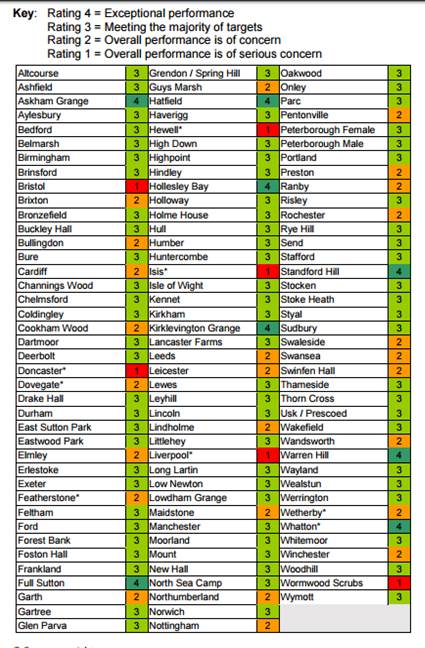
Following on from news that Michael Spurr has had a massive pay rise, lets take a look at how things are doing in a big chunk of his balliwick, namely prisons. Last week a whole load of prison statistics were released by the MoJ and as usual the Howard League did a great job in teasing out the main points, such as that the 8 exceptional establishments are all publicly run and the number in the lowest category has doubled:-

Now call me an old cynic, but I could write the press release on behalf of Serco who have the dubious honour of being responsible for one of the worst performing prisons, HMP Doncaster. Of course only a few years ago it was regarded as one of the 'jewels in the crown'. Anyway, that press release:- 

"That was then - a lot's improved - but there's more to do." 

Blimey. This from the Doncaster Free Press:-

Doncaster prison rated as one of the worst in the country


Performance at a Doncaster prison has been deemed to be of 'serious concern' by the Ministry of Justice, who gave the jail the worst possible rating in a report published today. HMP Doncaster was one of only six prisons across the country to be given the rating, in annual report looking at the performance of 121 jails across the country. This comes after the prison, run by private firm Serco, was branded inadequate by HM Inspectorate of Prison chiefs following their visit in October.

An official inspection report following the visit said levels of violence were higher than at other jails. It also stated that eleven inmates had died in the 18 months leading up to the inspection, including three who had taken their own lives. Hostage incidents had taken place, drugs were widely available and clean bedding was reportedly hard to find.

Julia Rogers, Serco’s Managing Director for Justice, said: 

"At HMP Doncaster, with considerable help from our customer we have been working hard over the past year to improve the prison. I am pleased to say that since March, when these ratings were given, the measures we have taken are having a real effect and as a result safety is improving and violence is gradually reducing. The measures we have taken include the appointment of a new Director and management team; achieving and maintaining full staffing levels over the last six months and providing improved training and support for our Officers and these have all contributed to reducing the levels of violence. We have also introduced a new ‘Social Responsibility Unit’ in June, to work with all offenders who display acts of violence and aggression towards other prisoners and staff. This Unit addresses the root causes of issues causing violence in Doncaster prison and we have seen marked reductions in violence.

However we know we have much more to do; we will continue to work hard to drive down violence in the prison and to support the victims of violence and support those prisoners in crisis. Doncaster has a history of having previously been an excellent prison and we are determined that it will be once more in the very near future.”

The other prisons also awarded the worst possible rating were: Bristol, Hewell, Isis, Liverpool and Wormwood Scrubs. The number of prisons awarded the rating has doubled since last year.

Andrew Neilson, Director of Campaigns at the Howard League for Penal Reform, said: 

“That more prisons have been awarded the worst-possible performance rating provides further indication of how the system is failing after years of rising numbers, chronic overcrowding and deep staff cuts. Once again, official figures spell out the urgent need for prison reform. Prisons are not only becoming more dangerous; they are becoming more dangerous more quickly."

--oo00oo--

Despite just announcing the fitting of a new hip, Frances Crook is still blogging. This is her latest with a plan for sorting out the IPP mess:-  

The manifest injustice of the IPP

The Chair of the Parole Board, Nick Hardwick, suggested this week that the people serving indeterminate sentences should be released once their tariff has expired unless it can be proved they continue to be a risk. This is a reversal of the current burden of proof that requires people to prove they are safe.

This is a sensible, level-headed and just reform. We cannot continue to incarcerate thousands of people because of something they might do. It is manifestly unfair and it is causing chaos inside prisons as people are caged for years past the date they expected to be released with no end in sight.

It is extremely hard to prove you are safe to be released when you are in prison. Compliance does not necessarily imply that people will adjust well in the community. Indeed, it could be argued that people who challenge the system may be more likely to face up the exigencies of life outside.

I am pleased that efforts are being made to remedy the manifest injustice of the IPP by easing people through prison more quickly. But, and this is a very big but, there is a ticking time bomb that has yet to be dealt with.

People sentenced to an IPP are recorded on the prison computer as having a 99-year sentence because they are subject to a life licence. When they are released they are on licence for life but they are able to request that the licence is lifted after ten years. So far, no one has done this.

People released from an IPP are being recalled to prison under these administrative powers. The figures published yesterday show that 410 IPPs have been recalled to prison in the last 12 months alone.

I met with David Blunkett last week. You will recall that he was the Secretary of State who introduced the IPP. He has publicly admitted that what happened was not what he intended and far too many people were caught in the net.

He has agreed to support a call from the Howard League to get rid of the life licence and to have instead a fixed period of supervision of two years, with the possibility of a further year if the Secretary of State deems it is required for public safety.

The iniquitous element of the IPP is the uncertainty. People are languishing in prison for years with no idea of when they may be released and this uncertainty is replicated when they are eventually released as they face the possibility of being recalled to prison at any time because they behaviour is deemed ‘risky’. This could mean a man going to the pub with friends when the original offence, committed maybe a decade ago when the he was in his twenties, involved alcohol.

When Parliament comes back in the autumn we will be working with David Blunkett and government to get this change.


--oo00oo--

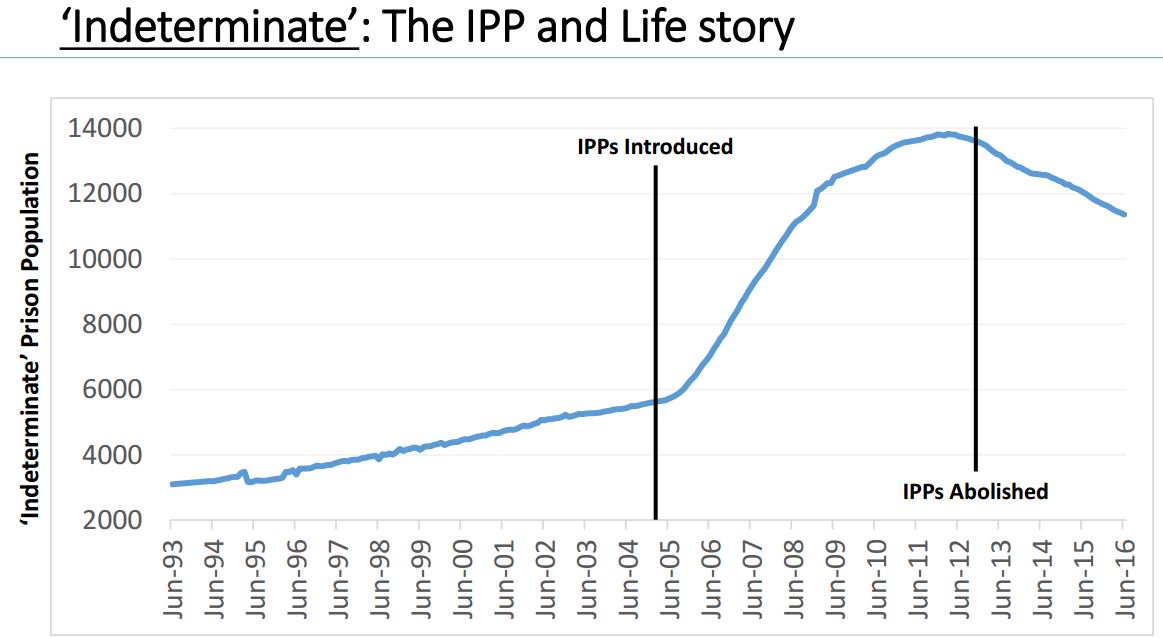
This graphic admirably illustrates how IPP sentences affected prison numbers:-


--oo00oo--

The House of Commons Justice Committee is seeking evidence on prison reform by 30th September:-

Prison reform inquiry

Scope of the inquiry

On the assumption that, as indicated by the new Secretary of State for Justice, Rt Hon Elizabeth Truss MP, there will be no substantial change to the ambitious programme of reforms to prisons already announced—including the £1.3bn estate modernisation programme, the creation of reform prisons to give prison governors greater autonomy, and the implementation of Dame Sally Coates' education review—the Committee launches an inquiry on Prison Reform.

As details of the reforms are still emerging, we pose high-level questions in our inquiry's terms of reference. In doing so we wish to seek overall views initially which will be followed up in greater detail with a series of sub-inquiries following the publication of the White Paper expected in October 2016.


--oo00oo--


Meanwhile, here's a strong indication of how Ukip would deal with the issue of prison reform as suggested by one of their number standing for leader. This from the Shropshire Star:- 

Prisoners should pay £40,000 a year says Ukip MEP Bill Etheridge

A West Midlands MEP who hopes to succeed Nigel Farage as Ukip leader has announced a series of radical jail reforms – including charging prisoners £40,000-a-year during their sentences. 
Bill Etheridge says he wants to see “a return to the days” when prison focused first and foremost on punishment, and vowed to “rehabilitate without using significant financial resources”.

His measures include:

  • Removing all luxuries from jails, including all electronic devices
  • An automatic 10-year sentence increase for prisoners who attack prison officers
  • Locking prisoners in their cells for the first six months of sentences
  • Banning all visits over the same period
  • A £40,000 annual charge on prisoners to be levied until ‘their assets are depleted’
It comes after Mr Etheridge called for a referendum over bringing back the death penalty, a measure which he says he is in favour of. Mr Etheridge, who is also a Dudley councillor, said the measures would reduce re-offending and ‘ensure people do not want to return to a hostile environment’, as well as driving down the cost of prisons.

“There should be no requirement to provide miscreants with the sort of electronic gadgetry that the poorest in our society struggle to acquire,” added Mr Etheridge, who says he has never seen the inside of a prison. "Prisons should be there to provide shelter, toilet provision, food and access to reading materials for self-advancement. Anything more than these basic essentials is an unnecessary waste of tax payers’ money.We must drive down the cost of prisons and ensure that they are places that no one would wish to return to.”

The prison population in the UK is around 80,000, with the cost of imprisoning someone in excess of £40,000 a year. West Midlands Police and Crime Commissioner David Jamieson, said: “I would be more than happy to take Bill on a tour of one of the region’s prisons to inform him of how they actually operate. I’d also be happy to take him to meet some of the West Midlands employers who take on former offenders and turn them from tax burdens into tax contributors.”


--oo00oo--

Finally, not to do with prison reform, but it's good to see one of the candidates for Napo National Chair using YouTube as part of their campaign:-


Monday, 1 August 2016

MoJ Rewards Failure

With both prisons and probation in chaos, well done to the Mirror for digging out and highlighting Michael Spurr's 10% salary increase as CEO of the failing National Offender Management Service.  


Prison boss enjoys bumper pay rise - despite a year of budget cuts and turmoil behind bars

The man in charge of prisons has enjoyed a bumper pay rise of nearly 10% – despite a year of turmoil behind bars. Michael Spurr, chief executive of the National Offender Management Service, is now earning £180,000, up from £165,000 the year before. Meanwhile, his agency – the wing of the Ministry of Justice responsible for prisons in England and Wales – has been forced to make swingeing budget cuts, reports the Sunday People.

Mr Spurr’s pay rise comes amid claims of growing problems in jails, ­including violence, drug use, radicalism and use of drones to smuggle contraband. Yet demoralised staff who deal with the mess on a day to day basis have been given a ­measly rise of just 1.3%. A prisons source said: “This is a real kick in the teeth for staff. “And critics will question whether the guy in charge deserves a hike given the mess we are in behind bars.”

The chief executive’s pay rise was ­revealed in the service’s annual report, published on July 7 – the day after the Chilcot Inquiry report on the Iraq War. Glyn Travis, of the Prison Officers’ Association, said ­yesterday: “Michael Spurr has presided over a ­prisons sysyem in total crisis. Anyone else with his output would be out of a job, unless he is doing exactly what the Government wants – doing more with less.”

Mr Spurr joined the Prison Service in 1983. His pay and perks package is better than that of Prime Minister Theresa May, who earns £143,462. The Sunday People has catalogued the explosion of drug use and violence in our prisons.

--oo00oo--

The MoJ Annual Report can be found here.

Foreword

I’m pleased to present the eighth Annual Report and Accounts of the National Offender Management Service Agency. The last year has been particularly challenging but I’m proud of the way colleagues across the Agency have responded to the pressures we have faced with a commitment and determination to deliver the best possible service we can for the public. 

In Probation our priority has been to ensure the successful implementation of the Transforming Rehabilitation reforms which have fundamentally changed the way offenders are managed in the community – extending statutory post release supervision to all offenders who receive short prison sentences. 

The National Probation Service (NPS) is now responsible for providing advice to court; allocating cases; and managing high risk offenders and 21 Community Rehabilitation Companies (CRCs) are responsible for managing medium and low risk offenders (around 80% of cases) across England and Wales. The CRCs were transferred to eight independent providers in February 2015 and new ‘Through the Gate’ resettlement services for all offenders leaving prison were implemented in May 2015. The scale of these changes should not be underestimated and it is a huge tribute to Probation staff that in the words of the National Audit Office “Services have been sustained throughout a period of major change, with users reporting that services had stayed the same or improved since the reforms”1 . There remains more to do to ensure we gain maximum benefit from these reforms, and we are reviewing resettlement services in particular to ensure these are as effective as they can be – but overall performance in both the NPS and CRCs is continuing to improve which provides a solid platform for future progress. 

In Prisons, despite considerable effort both nationally and locally, levels of violence, self-harm and suicide have risen and remain unacceptably high. Tackling these issues is our top priority, firstly because we have a duty of care for both prisoners and staff but also because we know that a safe, secure and decent environment is fundamental to support effective rehabilitation. The causes of the rise in violence and self-harm are complex. It is undeniable that the rise has coincided with major changes to regimes and operating arrangements in public sector prisons combined with significant staff reductions which have reduced overall unit costs in line with our 2010 Spending Review commitments. But the rise in violence and self-harm crosses the whole sector (public and private) and affects a wide range of establishments, including those where resources have been maintained or increased through this period. 

The massive increase in supply of illicit psychoactive drugs into prisons has been a key factor in undermining safety and driving violence (as acknowledged by the Chief Inspector of Prisons and the Prison and Probation Ombudsman) and tackling this issue is critical to reverse the current trend.

Over the next 12 months we will be concentrating on this issue, as well as taking forward the exciting reform agenda set out by our Secretary of State. Ultimately, increasing the emphasis on rehabilitation; providing a positive purposeful environment and rewarding prisoners for taking positive steps towards becoming responsible citizens will transform the way prisons work. Providing hope and opportunity for prisoners to ‘turn their lives’ around is the best way to combat violence and to reduce reoffending. Giving Governors the tools and the autonomy to make this happen is at the heart of the Prison Reform Programme. It has the potential to make a real and lasting difference to the lives of the offenders we manage, which will make both prisons and the public we serve safer. 

Michael Spurr 
Chief Executive National Offender Management Service

--oo00oo--

This is what the report has to say about probation:-

Community
Overview 

In 2015-16 our key priority for community services was stabilisation and delivery through the new structures created by the Transforming Rehabilitation reforms. We achieved this through three key areas of work: 
  • ensuring no reduction in operational performance
  • delivery of the NPS Stabilisation Portfolio, over 30 projects designed to embed activity prompted by Transforming Rehabilitation 
  • launch of the Effectiveness, Efficiency, Excellence Programme (E3) to design a new operating model for the NPS and learn from the best practice across the newly unified service 
Two significant advances in offender management have been made under the Transforming Rehabilitation reforms over this last year. 

Commencement of the Offender Rehabilitation Act 2014 (ORA) means that virtually all offenders now get statutory support and rehabilitation upon release. The ORA means that any offender whose offence was committed on or after 1 February 2015, and who are sentenced to a custodial term of more than one day, will receive at least 12 months of supervision after release. As a result, there has been a gradual build-up of eligible offenders over the course of this year. 

In addition, we introduced the nationwide ‘Through the Gate’ resettlement service run by CRCs, meaning that the vast majority of offenders should be given continuous support from custody into the community. 

The owners of the 21 CRCs have now been running their CRCs for just over a year. The focus over this period has been on stabilisation of the new system and delivery through the new probation structures. The performance of the CRCs has continued to improve and is now broadly comparable to performance before the reforms. This is a substantial achievement in itself. 

CRCs launched their ‘Through the Gate’ service on 1 May 2015. This element has the objective of providing offenders with support to find accommodation and jobs, finance and debt advice, and support given to former sex workers and victims of domestic violence. The CRC may also choose to offer additional rehabilitation services with the aim of reducing reoffending. 

The vast majority of prisoners will spend at least the final 12 weeks of their sentence in one of their home area’s designated resettlement prisons meaning that the CRCs should have sufficient time to engage offenders prior to their release into the community. 

We continue to monitor CRCs closely and are committed to ensuring that delivery of resettlement services meets the high standards expected. Our contract management teams are closely monitoring and robustly managing providers to make sure they fulfil their contractual commitments to maintain service delivery, reduce reoffending, protect the public and provide value for money to the taxpayer. 

The NPS manages the highest risk offenders. This is a critical public service and it is essential that we ensure services are delivered effectively. 

In 2015-16 we sustained stable performance across the majority of our key performance targets. We saw continued improvement, in line with plans, on measures relating to new processes introduced by Transforming Rehabilitation, for example the timeliness of case allocation decisions after sentence. This strong record of performance was achieved alongside the challenge of adapting delivery to absorb a caseload in the NPS that was materially higher than originally forecast. 

In the final quarter of 2015-16 we saw a slight drop in completion rates for Community Orders and Suspended Sentence Orders. A priority for 2016-17 will be reversing that trend.

Our investment in a new generation of Probation Officers continues, with the recruitment of 650 additional trainee Probation Officers during the year and the qualification of 192 probation officers in the final quarter of this financial year. 

In 2015-16 activity continued to fully embed the new structures created by Transforming Rehabilitation. As the CRCs have started to implement their strategies to move away from Local Authority provided ICT and buildings, we have ensured that the NPS has the resources in place to operate effectively. This has included a programme of building moves to ensure that the NPS makes efficient use of the remaining estate following the CRC exits.

Significant progress has also been made to continue the migration of the NPS business applications and data from IT servers maintained by the CRCs. We have continued to engage with the Future IT Sourcing Programme to deliver improvements to the NPS ICT infrastructure. 

In 2015-16 we launched the E3 Programme to design and implement a new operating model for the NPS. The NPS inherited significant variations in ways of working from the 35 legacy Probation Trusts. The programme undertook detailed engagement work with staff, managers and stakeholders to design an operating model that will improve the outcomes we deliver and which is financially sustainable. We published an early design of that operating model in the E3 Blueprint in November 2015 as a basis for improvement. 

The model has since been refined and was published in April 2016. We have started implementation of operational improvements and changes to roles and structures will start to take effect during 2016-17.