Showing posts with label A4E. Show all posts

Sunday, 15 January 2017

Welfare to Work Cuts

Here's an article in the Guardian that confirms yet more bad news for the criminal justice sector and the chances for many probation clients gaining employment:-  

Thousands of jobs to go in government shakeout of welfare to work sector

Thousands of experienced employment coaches are expected to lose their jobs over the next few weeks as ministers trigger the first stage of a massive shakeout of the government-funded welfare to work sector that will see it shrink by 75%. The employment services industry is preparing for what one insider called “a bloodbath” as the Department for Work and Pensions (DWP) moves to replace the work programme with the much smaller work and health programme.

Documents seen by the Guardian reveal that seven of the 15 work programme prime contractors, including big private sector names such as Serco and Maximus, have not made it on to the initial shortlist for the new scheme. The work and health programme shortlist, which is to be officially announced next week, begins a process in which the remaining eight work programme firms will compete with three new entrants for just six new regional contracts.

The final outcome, expected when contracts are awarded in late spring, could result in some firms being forced to abandon the market, or diversify into other contracted out public service areas, such as criminal justice or apprenticeships.

“This decimates the welfare to work industry. It represents the unravelling of nearly 20 years of unemployment support experience,” one industry insider told the Guardian. Work coaches provide long-term unemployed clients with help to acquire a range of employment and life skills designed to increase their chances of finding work, such as CV writing, IT skills and literacy, as well as liaising with potential employers.

Thousands of work coach jobs are expected to be lost. “This means large job losses among really experienced frontline advisers, the majority of which are in charities,” said Kirsty McHugh, the chief executive of the Employment Related Services Association.

The work and health programme is expected to start in the autumn and aims to provide specialist support for long-term unemployed people, especially those with health conditions or a disability. Funding will be about £100m a year over four years. This is about a quarter of the current annual spending on the work programme, which closes at the end of March, and work choice, which will continue for a few months longer.

Ministers have been warned that the cuts will undermine the government’s ambitious commitment to halve the disability employment gap by 2020, which requires it to find jobs for about 1.2 million people with disabilities or long-term illnesses able to work.

Ministers are understood to believe that rising employment levels, coupled with the provision of extra disability employment advisers in Jobcentre Plus, means that recent high levels of investment in employment support are no longer needed. But the Commons work and pensions committee warned in November that the scale of the cuts to the work and health programme meant that many disabled and ill claimants would be unable to access support.

Tony Wilson, the director of policy and research at the Learning and Work Institute thinktank, said: “The work and health scheme will support far fewer people and it would not be able to deliver services to the extent that could be done previously. Our assessment is that this scheme will make a vanishingly small contribution to the halving of the disability employment gap.”

Of current work programme contractors, Serco, Maximus, Seetec, Interserve, Learndirect, NCG and Rehab Jobfit are not on the work and health programme provider shortlist. The following firms have made it on to the shortlist, known as the framework: PeoplePlus (shortlisted in all six contract regions), Shaw Trust (5), G4s (5), Ingeus (3), Reed (3), Working Links (3), Pluss (2), Prospects (1), APM (1), Remploy (1) and Economic Solutions (1).

The regions covered by the framework are: central, north-east, north-west, southern, home counties and Wales. London and Greater Manchester will run their own devolved work and health scheme.

The work programme – which was launched in 2011 by the then secretary of state for work and pensions, Iain Duncan Smith – achieved mixed results and was fiercely criticised for the low numbers of disabled and chronically ill people it succeeded in supporting into work.

It was also dogged by controversy over alleged misconduct by work coaches, and the high salaries earned by top executives. Emma Harrison, the founder of A4E, was criticised for paying herself dividends of £8.6m in 2011, on top of a £365,000 annual salary.

Harrison, who had a brief spell as former prime minister David Cameron’s “families tsar” sold her personal stake in A4E to Staffline group in 2015 for a reported £20m. The relaunched company, PeoplePlus, is shortlisted in all six work and health programme areas.

Industry insiders expressed surprise that Maximus – which has gained notorietyas the provider of the DWP’s controversial “fit for work” tests – failed to make the shortlist as it had been seen as one of the best performing work programme providers in terms of getting long-term jobless people into sustainable jobs.

A DWP spokesperson said: “Our new work and health programme – which our providers will help us deliver – will allow us to give more tailored support for jobseekers and there will be an overall increase in funding for people with health conditions and disabilities. Work coaches play a crucial role in supporting people into work and these changes will allow us to do more through our Jobcentre Plus network.”

Friday, 27 May 2016

Responses to Inspection Report


Let's not forget that this report is based on pre-arranged inspections, NOT random unannounced visits. It therefore beggars belief that despite being in a position to polish their turds, neither CRC nor NPS could produce anything like acceptable results. How can 25% or 33% failure to meet standards be even vaguely acceptable, let alone "more than two-thirds"? This is the impact of TR on what was previously a gold-standard public service.

*******
Yes, it is all true and as a CRC PO I am told to do all I can to avoid breach and go to huge efforts to get offenders through the door. I have no problem with that but being asked to alter a decision on a record from unacceptable absence to acceptable is something I will not do. Remember that as CRC staff we carry some of the riskiest and unpredictable cases, namely domestic violence, accountable for majority of murders in UK. Ok, if they do it they go to NPS but we are holding the risk before it happens. I refuse to massage the figures like G4S and will breach if I feel I need to as a matter of public protection. Do not forget fellow officers that if the shit hits the fan it is your name that will go up in lights and when you look back, there is no one there to support you. You will be on your own in the spotlight! So stick to your guns and breach if you have real concerns.

********
Fuck me! Probation in the headlines. What will we do to capitalise on some public awareness of the TR scandal that we already know all about? Not much if past form is anything to go by. On another note, maybe some bright journalist reading this blog might pick up on this story too. Its a good one. Here's your free headline. "Grayling's Reforms Cause Prison Drug Crisis". I am reliably informed that HMPS have identified a worrying new trend where people on PSS are deliberately breaching in order to get a two week lie down in their Cat B local. Back in with a couple of ounces of gear in a condom up your arse equals a highly lucrative payout. Perhaps Grayling would approve of this example of the entrepreneurial spirit or maybe the CRC's will use it as an excuse for not breaching? Great to see someone else is making money out of TR though, isn't it?

*******
60% staff gone in CRC Training Team through EVR or resignations since split. Several recommendations regarding insufficient training. Am one of 40% still in post and really concerned about future staff training and development. Focus however on impact of TR on operational staff.

*******
The BBC news item was welcome. I am a PO in a CRC and I am certain that with increasing regularity that breaches and recalls are not being made because of the contract. I know that when this happens people go on to reoffend when they otherwise might not have, a very few will reoffend in a way that grabs the headlines although some who are not breached and recalled when they previously would have been will do neither, but this is not the real story with TR. 


Rehabilitation for many of the people we work with, those revolving in and out of the Courts, cannot be done on the cheap and quick, certainly not the quick and I would say not on the cheap. The models the profiteers are working to want everything ticked off in the first 3 months of a community sentence or licenced supervision period with tokenistic interventions. For some cases this may appear to work but for the remainder, the people caught in the system more regularly, these are people who are usually faced with multiple problems, substance misuse, unemployment, homelessness, mental health, emotional affects from an abusive childhood or adult relationships, problematic peer associations, anti-social attitudes and much more. 

In these cases, all cases, a good starting point for effective and efficient work is a good initial professional assessment and then professionals who can develop a good working relationship to support people to bring about self-directed or guided changes in their lives. This can take quite some time, perseverance and effort and is aided by well trained, experienced and skilled professionals. Sodexo et al did not sign up to this vision and when they figure out that a profit cannot  be squeezed in the way that they had anticipated they will be gone, either that or Probation work will be?

*******
Could morale be any lower in CRCs? Every evening I get home (late of course) and contemplate resignation but at my age (50 ish) I would struggle to get another job and still have a mortgage to pay. I work in a resettlement team where stress related illness is rife and we are struggling just to do the basic custody screening (target of 95%) let alone any meaningful work arising from this. We try and focus on the most pressing need of soon to be released prisoners - housing, but have very few meaningful resources to achieve the target of 90% of 'sustained accommodation' (clients remaining in that accommodation for at least 3 months following release). 


We are struggling, to put it mildly, but face the wrath of managers and prison governors when we fail to deliver. Indeed, we are regularly held to account for the shockingly poor results of the pathways we are supposed to be addressing and we are constantly reminded that prison did resettlement so much better when it was in-house. Colleagues in the field also apply the pressure with 'well it's your job to find him somewhere to live.' Impossible with many of our medium risk revolving door clients who have fouled up with every housing provider in a 60 mile radius. Not sure where CRCs can go with TTG apart from to admit failure and push it back to governors.

*******
I'm sorry. I'm one of the people on the receiving end of the awfulness of Basic Custody Screening. It achieves nothing. I usually know the person being screened and have yet to see one that is true. It is a total waste of time and effort and you guys must be knocking yourselves silly trying to achieve the target. For the first time ever I have heard two people in one week talk about trying to get back inside so they can make a bit of money. It's totally and utterly fucked up.

*******
I was paid off by CRC last year on a non-EVR rate. I found myself between a rock & a hard place so chose to jump with a basic parachute rather than being thrown out without one. Within 24 hours I was cold contacted by two agencies offering me generous rates & "guaranteed" 6 month contracts, the higher offer being £34/hour as a private limited company or £25/hour as a PAYE staffer. They also offered to link me in with "a consortium" of independents who share the legal & accountancy costs... I gained the impression it was a tightly organised arrangement where everyone was in clover.

I refused & am quite happy pottering around doing gardens, painting sheds, occasional labouring to keep the mortgage company happy. The stress-free lifestyle is blissful. Its painful reading about the pernicious, divisive & abusive murky depths into which the probation landscape has been plunged.

*******
I'm agency. I'd jump at being permanent if there was a chance. I'd lose about £500 a month. I might be able to apply for a mortgage though and I wouldn't have that sick feeling when the SPO asked to see me. 3 placements already this year. 5 days notice each time when they finished me.

*******
I've just breached a class A user who agreed to UPW as he was looking at custody. It got him out of the mess in court but now he's hit a problem as he can't attend UPW - I think he's capable of doing it but his lifestyle is such that there's no chance. Anyway, he DNA court, picked up on warrant and not only have they not deleted the hours (as per my application) but they've also given him an 8week curfew for breach. Fecking joke and bet ur bottom dollar he'll breach again, get custody and lose his flat etc etc. I wonder if people are deliberately set up to fail?

*******
Absolutely right, some of the sentences coming out of the courts these days are absurd, the legacy of under-trained NPS staff not having enough time or enough information to do a proper job.

*******
FFS. Probation ALWAYS had worked with short term prisoners albeit on a voluntary basis before CG decided this group of people would make a good 'market' for profit. Those who didn't want the intervention weren't forced, whereas now they are forced and the non compliant running rings around their officers and playing the system, wasting everyone's time.

*******
South Yorkshire had one of the best Unpaid Work set ups in Probation, with an excellent compliance rate. However, under Sodexo, the compliance rate has spiralled down and down to 35%. Meanwhile, staff were told that they were breaching too much, and that the system could not cope, so every breach should be run past a manager. Clients are voting with their feet in regards to unpaid work, as are senior managers, and PSO staff.

*******
It took decades to build our workforce up and 12 mths for privateers to destroy it. Slash & burn with staff there will be no option but to re-merge soon purely to pool resources - one simply cannot survive without the other. Diversity of staff personalities is what cannot be quantified on a spreadsheet so when privateers were rubbing their grubby little hands at the prospect of shedloads of money, they totally under-estimated that ultimately they could only control some of the staff, some of the time and this has been their undoing.


--oo00oo--

The following 'guest' piece was submitted anonymously yesterday and sounds a timely warning:- 

The cost of saying yes!

It was interesting to read the latest update from the HM Inspectorate of Probation and I noticed the headline “Staff told not to take action against probation breaches”. Where does that leave hard working staff that are being pushed to achieve these profitable outcomes? It's worth going back to see what has happened to staff that have followed the line of “just do it” or “JFDI”.

Look at A4E and its management of the DWP contract, this from the Independent “A dossier of evidence and complaints given to Ms Hodge, details of which The Independent on Sunday has seen, include allegations of past financial fraud, in-work bullying, claims of bad treatment and accusations that the welfare-to-work company delivered poorly run services. One complaint, written by someone who describes himself as a former A4E employee and whom the IoS has agreed not to name, described A4E as "nothing short of a gravy train". He said fraud at A4E had been "systemic" and "common practice".

Margaret Hodge MP, chair of the public accounts committee, who said of the leaked document about A4E "This appears to be devastating evidence of systemic fraud within A4E. Either A4E failed to act or to inform DWP, or they did inform DWP and the department failed to investigate properly.”

The BBC noted in the report on A4E that "potential fraudulent or irregular activity is not confined to one particular geographical area… and shows a potential systematic failure to mitigate the risk towards this behaviour at both an office and regional level".

So what happened to the people who just say yes? This from the Daily Mail, “Four former employees of scandal-hit welfare-to-work firm A4E admitted swindling taxpayers yesterday. The guilty pleas follow a police investigation into the troubled company which is paid more than £200m by the Government each year. Julie Grimes, 50, Aditi Singh, 30, Bindiya Dholiwar, 27, and Dean Lloyd, 36, admitted dozens of offences of fraud and forgery. A whistleblower claimed forged signatures and blank timesheets were 'routine' techniques used for bumping up the numbers of successful job placements. The four former A4e recruiters admitted a total of 32 offences during a hearing at Reading Crown Court yesterday”.

Wikipedia noted “In March 2015 six former (A4E) employees were jailed for forging files in a scam that was said to have cost taxpayers almost £300,000. Another four ex-members of staff received suspended prison sentences.” Interestingly the Judge in the case commented "No amount of pressure justifies the wholesale fabrication of information in files or the forgery of other people's signatures on documents, all of which is designed to extract money from the Department of Work and Pensions." The judge also “said it was not for her to decide whether more senior managers should also be held to account”.

Wikipedia notes on its A4E page “A former employee from the Manchester office of A4E reports that pressure to meet quotas made fraud commonplace: 'Forging signatures used to go on all the time. You had no choice because it was made very clear to you that you would lose your job unless you reached your targets. That comment sounds vaguely familiar. The response of senior management at A4E was blunt “A4E chief executive Andrew Dutton said the company has a "zero-tolerance policy" towards fraud.

So what has happened to A4E, a small number of staff have been jailed or given suspended sentences. A4E move on they are now People Plus and according to their home page “We are a leading employment support and training services company with a mission to transform people's lives and businesses through work and training.”

It goes on to state:- 

“Justice relates to our operation of the probation service in Warwickshire and West Mercia through a Community Rehabilitation Company (CRC) formed as part of the Ministry of Justice’s Transforming Rehabilitation project. Across the country we also operate programmes to help ex-offenders take their first step back into work upon their release. This includes the delivery of the Offender Learning and Skills Service (OLASS) in ten prisons in the East of England. Our unique position as a provider of mainstream services both in custody and in the community enables us to provide a seamless transition into dedicated employment search and support upon release”.
 So where does that leave staff in a culture of “Just do it”? 

1. Don’t do anything without an audit trail
2. Keep copies of all relevant documents (off site)
3. Keep notes
4. If all else fails, record conversations.

Wednesday, 29 July 2015

Guest Blog 43

Reform is a right wing think tank that specializes in pushing the case for the privatization of the public sector. Of all its monies 70% comes from companies and 30% from the general public. Reform’s donors include corporate giants such as the General Healthcare Group, BMI Healthcare and BUPA Healthcare, all of whom would benefit from the selling off of public run services. The head of Reform (Nick Seddon) was also Head of Communications at Circle partnerships which describes itself as 'Europe’s largest healthcare partnership’ and is one of the great beneficiaries of the privatisation of the NHS. 

In 20012 the company took over Hinchingbrooke Health Care Trust the first time that an NHS hospital was handed over to the private sector. Seddon has written articles that call for the sacking of 150,000 NHS workers, real term cuts to the NHS budget and charges for GP visits. He has also called for healthcare to be 'largely funded by the government but organised outside the government' by insurance companies and other organisations.

Early in 2013 Reform published research endorsing the privatisation of Britain’s prisons, a policy from which even the Conservative-led government had been edging away. The report was widely cited in the British Media; the BBC flattered it by describing it as ‘thought provoking’. But what was not mentioned was Reform’s substantial funding from security firms G4S, SERCO and Sodexo – companies that were already running 14 prisons and stood to benefit from further privatisation. In 2012 alone Reform received £24,500 from G4S and £7,500 from SERCO.

In 2013 Seddon left Reform to become Cameron’s new health advisor!!!

Madson Pirie, a free market fundamentalist, and his outriders, the followers of Hayek, have not just moved mainstream - they are the mainstream. They have made ideas that were once considered ludicrous, absurd and whacky become the new common sense. They have shifted the ‘Overton Window.’ What was once whacky becomes normal and even moderate. Thatcher did not dare threaten the privatisation of the NHS but eventually after years of Thatcherism and then son of Thatcher ‘Blairism’, this was turned into a theoretical and actual reality by the last coalition government no less. They have laid the foundations of right wing radical ideas and then popularised them, with their friend Murdoch, to a mass audience. The national political conversation is kept relentlessly on the terms favourable to those with wealth and power. The Private Sector is good the Public Sector is bad – ‘four legs good two legs bad!’ (Orwell)

Tax credits could be seen as a state subsidy to private companies that pay low wages and they are now being reduced; housing benefits go to greedy Tory landlords. Douglas Carswell, the UKIP MP, refers to an oligarchy of corporate cronyism that the traditional shire Tories find revolting. The state therefore is the backbone of scrounging corporate capitalism, subsidising wages, bailing out banks and paying for private sector profit making organisations to terrify benefit recipients. 

ATOS (with a £500 million ‘scrounge’ off the taxpayer) means testing the disabled who are ‘bullied off benefits’ many of whom appeal successfully (over 50%) and many others who committed suicide. ATOS simply walked off the job retaining its profits. SERCO (Group 4? – what’s the difference they are all Tory shareholders) and the Olympics – original contract £7.3m then stretching to £60m (G4S) then couldn’t do the task it had been paid to leading to three and a half thousand tax payer paid soldiers being drafted in to finish the job. 

A4E in 2004 was paid £200m of tax payers money – all its income coming from the public purse - a total scrounger - terrorising people back to work. The Chief exec had £8.6m in stocks and shares, £365k per year in salary and was renting out her 20 bed mansion to her own organisation (conflict of interest?) whilst abusing, insulting and sending people to work at Poundland for free and making lots of other workfare people go to companies with close ties to the Tory Party, acquiring no skills in the process, but providing free servile labour. And the Mandatory Work Activity Scheme leading to no work later on; in fact less work than those who obtained work whilst on benefit

G4S, SERCO and Sodexo get over half their income from the state – 3 huge scroungers! (£4 billion to SERCO, G4S, Atos and Capita alone). The National Audit Office says that of £178 billion of public funds, over half is earmarked for the private sector. Even police services (and probation) have and are being taken over. Care in the Community opened up massive contracts to private care homes, the Private Finance Initiative (PFI)  swindle will cost future generations up to £301 billion and £20 billion of £95 billion of existing NHS monies are ready for the big P!

Nigel Lawson once said that the NHS was the nearest thing that the English had to a religion! Codex cleaners are earning half the wages they had 20 years ago - insidious - cleaner on 18 hours leaves and is replaced by one on 16 hours doing the same work or perhaps more! NHS is now contracting out the actual commissioning! Privatising the commissioning so that they can give it to themselves! Recently Surrey contracted out £500m, Peterborough £1.1 billion, much of the work going to Tory donors and as one Dr (Chand would you believe) said ‘If it does not generate profit it does not wish to know..............there is now cherry picking of elective surgery.........2 tier service’

These are the real scroungers sponging off society taking vast sums of tax payers money, producing reduced and poorer services, reducing codes and conditions of service and generating millions and billions to their shareholders (who are these we might ask? The haves and the have yachts?) whilst refusing to pay their proper taxes themselves. There is a programme on TV called Benefits Street but as yet no programme called ‘Tax Dodger St’ or ‘Off Shore Account St!’ Lastly, what about the Serious Fraud Office launching an enquiry into G4S and Serco after they allegedly over charged the tax payer for tens of millions of pounds of tagging that never took place?

I have seen a general election that was won outright, surprisingly, by the Tory Party that now has a working majority of 12 seats. The election exposed a democratic system that is anachronistic and unrepresentative given that UKIP had nearly 4 million votes and got 1 seat, the Greens over a million and 1 seat and the SNP got 57 seats for 1.5 million votes. If you look at the majorities of the Tories 12 most marginal seats, you will see that they have in fact a working majority of 1250 votes from all 12 combined! In certain countries people would be taking up arms at such unrepresentative injustice. 

Nonetheless, despite this lack of democracy the ‘winning party’ is embarking on a scorched earth policy of replacing the entire public sector with the private sector over the next 5 years and during the last 5 years the gap between rich and poor has widened on historically unprecedented levels; one million people attended food banks last year whilst 1000 people currently own £520 billion between them. George Osborne announced the other day that we will now be able to sell our houses for a million pounds without paying a penny of inheritance tax and in the same breath he is removing child benefits for every child after 2 and has announced cuts to the welfare bill of £12 billion pounds. You could almost see him taking it from one poor pocket and stuffing it into a rich one!

So it would be nice to think that the new Criminal Justice Companies would be ethically inclined in the delivery of its criminal justice service without a pre-occupation with making profits at all costs. A service that would look to diverting people wherever possible away from the criminal justice system and one that would shield the service users from the harsh judicial excesses that are possible under the 2003 CJA and now the 2014 ORA Act. A service that uses new technology appropriately and sparingly to deliver justice and evidence based interventions that work in reducing crime and the number of victims within society. Also a service that respects the high quality of its existing staff that will also seek to maintain its standards and conditions of service in order to attract personnel of similar quality and ability in the future.

But there is also the possibility during the next 5 years that we will get massive judicial inflation - selling goods (Court Orders and TAGs etc) that nobody needs to generate profits from people who do not need to go on orders or be Tagged; a large rise in the prison population as sentencers can now get prison plus supervision (something suggested in New Labour legislation in 2003 but not affordable – remember custody plus?); ‘sharper axes for lower taxes’ ie reduction of codes and conditions of service, replacement of staff with personnel that do more for less and possibly with reduced or no qualifications ‘better for less’; the blurring of the distinctions between the professional and other workers and what work can and cannot be done with and by whom (PSOs become DV experts in an afternoon?); the achievement of a manipulated key Performance Indicator (KPI) rather than the delivery of a professional service. 


Lastly, an organisation that leaves a criminal justice detritus, that is unreformable, to rot, whilst simultaneously cherry picking and making claims of success following interventions with a population of net-widened entrants who should never have been intervened with in the first place!

So 150,000 NHS workers - how many Probation Officers I wonder? Apart from that, everything is hunky dory! You can only say it as you see it. 

Cheers 

Thursday, 11 September 2014

Pure Gold

I don't seem to have had time to catch up with the shenanigans that's been going on at the Public Accounts Committee this week, but as numerous contributors on here have noted, Margaret Hodge and her colleagues have been digging up pure gold. Here's the Guardian from Monday explaining that, despite what we were told by the government, there never was a ban on G4S and Serco getting extra contracts:-  
Hodge accuses government of 'shocking complacency' over G4S and Serco
Margaret Hodge has accused the government of "shocking complacency" after it emerged that two outsourcing firms being investigated for alleged fraud over Ministry of Justice deals worth more than £200m have been bidding for further contracts while potentially facing criminal charges.
The chair of the public accounts committee said it was "utterly extraordinary" that G4S and Serco were allowed to do so while being investigated over contracts worth more than £200m by the Serious Fraud Office and the City of London. Three G4S contracts worth more than £110m are being investigated by the SFO. They are a Ministry of Justice contract to administer tagging of prisoners on probation as well as two contracts for the management of "invoicing, delivery and performance reporting". One Serco contract worth more than £40.5m is under investigation by the SFO. Another contract for the escort of prisoners to and from courts worth £49.3m is being investigated by City of London police.
Chris Grayling, the justice secretary, wrote to his Labour shadow, Sadiq Khan in September 2013, saying the two firms would not be awarded contracts. "I am strongly of the view that we should not award new contracts for the two companies until we have established the facts about both their performance and their corporate behaviour. "That is why I have requested an audit of every contract that MoJ holds with G4S and Serco," he said.
But executives from both firms told the committee on Monday that they had both put together bids for more government contracts since inquiries by the authorities began. Hodge said in response: "I am shocked … Shocked that this can carry on. I think you should be dropped until the SFO has finished its inquiries. I do wonder what on earth the government is doing dealing with you if you are not, as you say, too big to fail. You have been found to have overcharged. In these cases if you are not too big to fail it is best to say 'hang on'," she said.
Peter Neden, the regional UK and Ireland president of G4S, said his company had continued to put forward bids for contracts but had not been awarded any during that time. Rupert Soames, the group chief executive of Serco, said the government was restricted in what it could do by EU law. "I understand that part of the problem around an outright ban was a ban under EU law which we would not have challenged anyway … We did not win any new business," he said.
The multimillion-pound tagging scandal, which emerged in July 2013, triggered a Cabinet Office review of all government contracts worth more than £10m held by G4S and Serco. Observers have claimed that there are very few other firms large enough or willing to bid for this type of work if Serco and G4S are excluded.
A National Audit Office report last week found that poor management of £40bn worth of outsourced public contracts had left the government exposed to the possibility of widespread fraud and overcharging. A test sample of 60 government contracts found that 34 – more than half – had "issues in the amount billed". Auditors also tested 73 contracts against a good practice framework and found many elements of the deals were at "material risk" of overbilling, but the problem could be far wider. Departments relied on the information supplied by the outsourcing companies rather than carrying out their own checks, according to the report. It also found that in some government departments no one could say which civil servant, if any, was in charge of making sure that an outsourcing firm was honouring a particular contract.
This from the Watching A4E website:- 
When it was revealed that G4S and Serco had been overcharging by millions on the offender tagging contracts we were assured by Chris Grayling that they would be barred from bidding for any more contracts until a thorough investigation had been carried out (including an investigation by the Serious Fraud Office). But then, a few days after G4S were pronounced "cleared" (though not be the SFO) they were included in the list of bidders for the probation contracts - so they must have been tendering while supposedly barred.

Well, it's now clear; they were never barred in the first place. That's just one of the revelations to come out of the latest hearings of the Public Accounts Committee. As the Guardian reported on Monday, the chair of the PAC, Margaret Hodge, was shocked.

The hearings continued today, and the shambles which outsourcing has become was laid bare. Two of the top civil servants in the procurement area are fairly new in the job, and have bags of experience. They were interviewed today, and said they had found that the people doing the work didn't have the skills, experience or competence for the job. There was no contract management. 
Applications to vary the contracts were numerous, and with one particular contract there had been so many that no one could now remember what the original contract specified. Basically (although they didn't put it like this) the companies have been running rings round the government.

There is obviously a lot more to come out about specific contracts. Right at the end Margaret Hodge reduced the G4S chap to quivering silence when she demanded to know if it was true that in the probation contracts it was specified that if the contract was terminated by either side before it was completed, the company would get the full amount of the contract. Apparently it is true - and she didn't like it.

The last Labour government started this outsourcing bonanza. When the coalition got in they didn't stop to find out whether the competence was there to do it; they just went ahead and outsourced everything that hadn't already been flogged off. And we have been paying the price.
This from Hugh Muir in the Guardian:-
More news of the overactive justice secretary: Chris Grayling’s empire has devised a cunning plan. After triumphs at the Department for Work and Pensions he moved to the Ministry of Justice, where his enthusiasm for contracting-out knows no bounds. Most offender management is being outsourced, save for the hardest cases and those involving celebs, which will continue to be supervised by a rump public probation service. 
Mindful that the coming months may bring regime change, MoJ negotiators have been told to insert into contracts a proviso that if a future government tries to break them, it would have to guarantee contractors the equivalent of the profit they would have made for the duration of the contract. In some cases this could be as much as £400m. 
So if Labour were elected in 2015 and tried to pull out of Grayling’s probation arrangements, it could face huge financial penalties. Huge financial penalties. A few weeks ago the American company Raytheon won £750m from UK taxpayers after the Home Office pulled out of its busted e-borders contract. So even when the Gray-man is gone, he might cost the nation a pretty penny.
As this piece in the FT confirms, there's a growing chorus of concern regarding further privatisations:- 
Half of voters feel that no one takes responsibility when outsourced public services go wrong, according to a leading think-tank, which is urging the government to focus on fixing “broken” public service markets. The finding, in a poll commissioned by the Institute for Government, came as it called on politicians to increase transparency in the way such markets worked and ensure there was clear accountability for failure.

The survey, by Populus for the IfG, also found a widespread scepticism that parties would deliver on their election pledges in government. Only 15 per cent were confident that parties knew how they would fulfil their promises, while almost two in three thought political parties in the UK “generally do not keep their election promises”. Fewer than one in five thought the political parties were good at explaining how their proposed policies would be implemented or paid for.

Peter Riddell, IfG director, said that whoever took office after next May’s general election would have to govern differently if they wanted to build public confidence. Mr Riddell added: “Crucially, this does not mean a shift to a technocratic or managerial view of government; rather the reverse. Our advice is about how to get the politics right in order to achieve political goals. ”Publishing a “manifesto for effective government” for parties wishing to win public trust, it noted that about £90bn of public services was now delivered by private and voluntary organisations. Yet, said IfG, more complex outsourcing projects often underperformed because of “perverse contractual incentives, weak public sector oversight, and a lack of transparency and competition”. It cited recent scandals in areas such electronic tagging, where Serco and G4S were both forced to repay millions of pounds to the taxpayer after they were found to have overcharged for some services. The IfG said that “worryingly” half the people in the survey it had commissioned “felt that no one takes responsibility when problems occur in outsourced services”.

In order to improve public services, the think-tank renewed calls for government to “slow down on outsourcing more services to allow greater focus on fixing broken and underperforming public service markets”. It should “share information on the costs and performance of providers with the public and parliament to show that government is in control, and increase the focus on ensuring value for money”. Government should also increase the scrutiny of new outsourcing deals, particularly those worth more than £100m, to ensure they were “sensible”, adds IfG. It recommends seeking “independent, formal advice on competition issues” from the Competition and Markets Authority, which has a brief to ensure competitive markets.
These exchanges are particularly revealing:-  
Q165 Mr Bacon: I am not interested in the philosophy; I am interested in the hardcore reality of the fact that for every year of the contract that Ms Beasley was talking about, systematic over-billing was going on, and that when there was reform to try to improve the situation, the amount of over-billing actually went up. That has nothing to do with philosophy.
Dame Ursula Brennan: And the cost went down. It is a complicated story.
Q166 Mr Bacon: I am really not interested in the philosophical heebie-jeebies; I just want to get to the root of this and understand at a practical level how it is that they can do it but apparently it is less easy to do it in-house.
Dame Ursula Brennan: At a practical level, you are talking about two distinct things. One is about the ability to recruit and retain people and what you pay in order to get that expertise. The second is the advantage you get when you outsource a service, which is not simply that you get the same service back for a cheaper rate. When you outsource a service, it is usually because you want something done differently in a different kind of way by people with a different set of—
Q167 Chair: Richard’s point is that you could do it differently in-house.
Dame Ursula Brennan: And there are certain services where we do do it differently in-house. If you take the Prison Service, we currently have a regime in which we have some outsourced prisons and some where we are driving down cost internally. But to come back to the point about what we pay for people, there are occasions when you are operating in the public sector in a period of pay restraint which completely makes sense across the public service as a whole, but which gives you difficulties in certain specific areas. One of the things that we have done in recent times is to create in the centre—in the Cabinet Office—a new capability to lead policy on contract management, and I think you are going to be hearing from Bill Crothers and his colleagues about all that later in the week. One of the things they are doing is looking at how we can recruit some of these people who are expensive to recruit and retain, because, otherwise, we have to pay—
Q168 Mr Bacon: My point is these private sector people are obviously recruiting and retaining these more expensive people, yet they are still able to do the job better for less.
Dame Ursula Brennan: That is because they—[Interruption.] Well, one could have an interesting debate about—
Mr Bacon: Please finish the sentence; that is what I want you to do.
Dame Ursula Brennan: That is because they structure their organisation in a completely different way, so that their pay regime includes paying higher rates of pay for extremely scarce resource and lower rates of pay for people doing more basic jobs. The pay structure, the pension structure and the organisational structure of private sector companies and the public service are quite different, so simply saying, you know—
Mr Bacon: I don’t know. If I knew, I would not be asking the questions.
Dame Ursula Brennan: I think it would be an interesting debate about why we outsource.

Saturday, 16 August 2014

Bidding extra

Following on from this mornings post about the MoJ fiddling with the bidding process and the recent news that A4E had pulled out of the London prison education contract, these comments seem extremely relevant:-

Now we have a lot of discussions with the Home Office regarding suitable addresses for bail for detainees. Many of the places proposed by the Home Office/UKBA are multi-occupancy hostels run by the usual suspect big companies ...and they have decided to pull out as they can't make enough money from this 'client group'...no doubt because there are no staff anywhere so there will be a significant amount of damage and loss.

Who would have thought it eh? I think the 'bidders' and those in Govt so closely linked to the bidders need to wake up to the reality that this chronically underfunded sector, criminal justice, is NEVER going to earn them an easy buck. As someone said above, it takes time, skill, patience, resilience to work in this area because there are so few happy endings, emotionally or financially. Fool's gold.


******
On the flip side it could be that he MoJ, being aware of the potential fallout should a bidder just walk away (as we have seen with A4E) are simply tightening their own belts so to speak. Unlike contracts to deliver services to those in Prison, if a bidder walks away mid contract then there will likely be major problems. Additionally, there are many Daily Mail readers who are somewhat caustic with their comments when offenders kill themselves; the same readers will be less so when, and I mean when, an offender in the community kills someone else!

******
It's not the savings that are an issue here, as this will go to the MoJ, it's the cost(s). Now ABC Company must put in a bid to run the CPA which should be lower than the MoJ currently do. From this bid they must then make a profit. Both are which are going to impact on their finances. Now I know there is much talk about redundancies etc, however, if they make you redundant I think I am right in saying that they cannot then offer your job (supervising offenders) to another, for less money. This leaves them open to civil action (which is expensive if done en-mass. Also, I very much doubt they can get rid of staff, at least not yet, as they will be taking on the U12 month cohort which is going to be a massive ball ache for all involved!!

Also, they will need qualified staff to train the new TPO's (yeah, good luck with that one) as cases in the NPS are highly unsuitable for them. They will probably charge the MoJ for this and will need to show that they are able to do it; laying off staff is not going to cut the mustard.

Factor into this whole sorry mess the fact, and it is a fact, that they have taken on hundreds of pissed off staff, who will blow the whistle on poor practice at the first opportunity. The same staff (if my area is anything to go by) which will do all it can to undermine whoever tales over the CPA.

In their ivory towers there will be lots of flow charts prepared by people who do not have the first idea of how to manage offenders, and will quickly learn that flow charts are useless, and what they need are capable OM's/OS's who can identify and react to the fluid nature of our offenders BEFORE they commit a crime. If we only have a 'process' to follow then this is not going to work!

As I have said before, there will be a lot of money lost, massive reputational damage and a heck of a lot of tears before the whole things reverts back to normal. In a strange way I'm looking forward to it, if only so it serves as a reminder to other Ministers who may have the same shitty idea as Grayling!


The subject of what happens when a contractor decides to pull out is covered extensively in this blog post on the LSE website, and although principally concerned with the health and social care sector, it's just as relevant to us. Interestingly, the author concludes by reference to a growing view that some things can't be privatised:-
But perhaps the most vital health and care debate is about what the popular philosopher Michael Sandel has termed the ‘moral limits’ of markets. In this context public services like health and social care are viewed as the manifestation of communal solidarity, expressing a sense of moral obligation that citizens feel for each other. They are something more than a contract put out to the market to secure ‘value for money’. The state is the vehicle for negotiating these obligations with citizens, for developing strategic thinking, coordinating inputs and serving as the ultimate source of legitimacy. This is the debate we need to be having, rising above dry and technical consultations on ‘service continuity’ and ‘commissioner requested services’ to think about what sort of society we want to live in.
This is a subject I talked about last May in a post entitled 'What Money Can't Buy'. Here's a clip:-
I think he could have had probation in mind when writing this book. He cites many more quite shocking examples of how market philosophy has been applied in all sorts of inappropriate and repugnant ways, such as trading life insurance policies on people with terminal illnesses, and companies like Walmart insuring for the possibility of customers dying on their premises. Every death provides a useful windfall apparently.
If you add to this examples of the perverse operation of markets, and apocryphal stories of buses not picking up passengers in order to keep to schedules, and trains cancelled instead of running late to avoid penalties, I think most people can see plenty of potential pitfalls in privatising probation. 
and an excellent review of Sandel's book can be found here. 

Finally, I notice that Mark Leftly in the Independent yesterday picks up on a theme he's written about previously, namely that the big boys are so big, we're effectively stuck with them, what ever happens:-
From running the Defence Academy in Wiltshire to housing asylum seekers in Liverpool, from training thousands of headteachers to cleaning our streets, Serco is as powerful as the government departments that are its major clients.
The company is one of the biggest players in the hidden state: the outsourcing industry that has received £87.7bn of government contracts since the Coalition came to power four years ago, according to the research firm IGS.
Postscript - Just noticed this about Serco pulling out of the UK Clinical Services market. Well done Andrew for spotting it on the Health Service Journal website and posting on the Napo Forum:-
Outsourcing giant Serco has announced plans to withdraw from the clinical health services market in the UK after making a multimillion pound loss on its NHS contracts. The move follows a review of the cost of delivering “improved service levels” and meeting the performance requirements of several existing contracts, the company said in a stock market statement.
“During the period, the group continued to monitor performance in the UK clinical health operations against which an onerous contract provision was made in the prior year and where the group’s intention is to withdraw from the UK clinical health market,” it said. “The group has revised upwards the estimate of the costs of running the contracts to term, resulting in an additional non-cash exceptional charge of £3.9m in the period (year ended 31 December 2013: £17.6m).”
Serco’s planned withdrawal could influence significantly how other private firms view the prospect of bidding for contracts involving patient facing services. It also follows months of speculation about the outsourcing giant’s clinical operation.

Wednesday, 13 August 2014

No Profit - No Service

Today we have yet more evidence that the 'silly season' is in full swing. Both the Prison Service and Probation Service are in states of crisis brought about by Chris Grayling's mismanagement, meddling and TR omnishambles, but the MoJ continues to insist Canute-style that everything is just fine. 

Meanwhile the same MoJ spin doctors are telling us that everything is also just fine with the bidding process that will see the CRC's providing probation work divvied out to the likes of Sodexo, Interserve and A4E. But I've been led to believe that the majority of the bids are 'crap' and this is why the hopefuls have been sent away and told to 'try again'. 

One of these hopefuls is A4E, but in today's Guardian we have a graphic example of why privatising vital public services like probation is such a stupid and dangerous idea - because the privateers can walk away anytime they like:-    
The welfare-to-work provider A4e has prematurely pulled out of a £17m contract to deliver education and training to prisoners in 12 London prisons on the grounds that it was unable to run the contract at a profit. The decision was criticised by prison charities as likely to cause significant disruption for inmates. 
Announcing that it would be terminating its contract, the company said delivering the Offender Learning and Skills Service (OLASS) had become "extremely challenging" in the past two years because of "a number of constraints" which had "a heavy impact on learner attendance, completion and achievements"."We have concluded, in order to not continue to deliver the contract at a loss, to terminate our provision of [the contract] in London," it said. "This has been a very hard decision to make because A4e and its employees are passionate about the delivery of education services to offenders and believe education is critical to an offender's long-term rehabilitation." 
The company, which was due to continue providing training until July 2016, employs 400 teaching and support staff within London prisons. A4e runs another teaching contract in prisons in the east of England which it has decided not to terminate.A4e did not specify the constraints it cited in its statement but prison charities said access to education in a number of prisons had been impeded by staff shortages which had hampered prisoners' ability to get to lessons. The company is paid according to the amount of training it provides. 
Juliet Lyon, director of the Prison Reform Trust, said: "It's difficult to know precisely why A4e finds itself running this contract at a loss but it is clear that prisoners are spending more and more time locked down in overcrowded cells in understaffed prisons. Wasting time rather than doing time is a far cry from the rehabilitation revolution. Withdrawal of prison education calls into question both this government's capacity to award contracts for delivery of essential services and its commitment to rehabilitation. Our prisons are being reduced to warehouses – nothing more." 
Rod Clark, chief executive of the Prisoners Education Trust, said: "The delivery of education for prisoners across the country is being seriously affected by overcrowding and staff shortages which are leaving people locked up for longer, so they can't get to class and providers struggle to meet their targets. These pressures are having a negative impact on safety and rehabilitation. It may be that this latest decision by A4e to stop working in London's prisons is a result of these problems."
But this is not the first time A4E has thrown in the towel:-
The start of A4e's prison education contract was complicated by a delay of several months as the company underwent an extra level of auditing, amid fraud allegations in its welfare-to-work contracts. 
This is not the first time that A4e has prematurely terminated a prison education contract; the firm ended a similar contract providing education to eight prisons in Kent early in 2008, citing huge losses. 
The decision to terminate service provision then was criticised by teaching unions, as evidence that outsourcing education contracts to private providers was not a reliable way to guarantee a good quality service. 
Sadiq Khan, shadow secretary of state for justice, said: "This is a vote of no confidence by the private sector in the disastrous way the Government have allowed our prisons to descend into crisis. Providing good training and skills to offenders in prison is crucial in rehabilitation to stop them reoffending on release. Leaving prisoners to fester in their cells or on landings as a result of this shambles is no good for anyone."
This comment nicely sums things up:-
This is just another fine mess within the shambles that is the prison system under Team Grayling. Prison education - which has always been seen as a key element in rehabilitation and reducing re-offending - has been severely undermined over the past two years. No courses above Level 2 are now provided by prison education departments (anything higher now has to be funded by the prisoner, either using their own resources or a loan). 
Since payment under these OLASS contracts is by results (eg prisoner attendance in class and completion of course hours) if sessions have to be cancelled because there are insufficient staff to escort prisoners to and from education departments, then of course providers are going to lose money. It all comes down to Mr Grayling's complete and utter inability to manage the prison system. He is totally out of his depth and unqualified for this role. 
Having closed prisons and cut front line staff numbers, he and his team have brought many prisons close to the verge of collapse. The number of people incarcerated is now at an all time high and overcrowding, at a time when there is a lack of experienced staff, is leading to a surge in violence, self-harm and suicide. Healthcare provision in prisons is a national disgrace and the latest crisis in education and training is just one more example of Team Grayling's collective failure. 
It's high time for Mike Spurr, the head of the National Offender Management Service (NOMS), to stop parroting Mr Grayling's denials that a complete meltdown is imminent and to start being honest about the current crisis and its causes: mismanagement of resources; ideological grand-standing; political interference in the day-to-day running of prisons and undermining of staff morale.

Thursday, 12 June 2014

Omnishambles Update 51

First off, here's that email sent yesterday to all staff in Kent, Surrey and Sussex with news of the failed bid, together with an explanation:-

Dear all

It is with great sadness that we write to inform you of Chalk Ventures' decision to withdraw from the Transforming Rehabilitation competition. This is not a decision that we have taken lightly, and we have tried very hard to find a way to continue but all three joint venture partners (Co:here, A4e and Bridges Ventures) were in complete agreement and informed the Ministry of Justice on Monday (9th June) of our decision.

The Chalk Ventures consortium is an incredibly strong partnership, with all three parties bringing different skills and playing different roles, but all three were in agreement that the contract contained some commercial and operational terms which, for us, were too difficult to bear. We have been working with the Ministry of Justice to try to overcome these via dialogue, but unfortunately were unable to resolve them in the time available. 


We had, with your help, co-produced a robust solution that was locally tailored and financially viable (with significant financial investment from A4e and Bridges Ventures) and we still passionately believe we could deliver these services. However, unfortunately this is not possible for us on the current contract terms, and so the only real option to maintain our integrity was to withdraw from the competition. A4e had already taken the decision not to bid in any CPA in its own right, including in Kent, Surrey & Sussex, in order to focus its efforts on the Chalk partnership and in recognition that the ‘joint bid’ was better than a ‘sole bid’ could be. This means that neither Chalk nor A4e are in the competition for the Kent Surrey & Sussex CRC.

We know how disappointed you will be with this news, the Chalk Board and whole bid team are devastated. We felt strongly that you should know as soon as possible given your overwhelming support to date including the vast majority of you voting in favour of the mutual back in October 2013. I personally feel that, although it was an incredibly difficult decision to take, it is the right one.

Sarah Billiald, on behalf of the Co:here bid team and Chalk Board (Co:here, A4e and Bridges Ventures)


Here's an excerpt from the latest blog by Ian Lawrence, Napo General Secretary, and some interesting news regarding the wall of silence being demanded by MoJ/Noms HQ - a sure sign things are going seriously awry when any institution orders silence:-

Criticism inevitable

In a struggle like the TR campaign it’s entirely understandable that our member’s frustrations come through, especially given the unprecedented attack on your profession and the chaos which is not of Napo’s making. But its frustration which now, as I am increasingly convinced, is being fuelled by a deliberate disinformation campaign by the opposition. The orders from on high to new CRC and NPS Chiefs to not divulge information, whether it be the truth about the state of the IT systems, the actual numbers of outstanding vacancies, or the names of the remaining bidders for a CRC as a number of them start to drop away, is an absolute disgrace and an insult also to the several hundred of our members who have turned to the campaigns@napo.org.uk inbox to help us to raise the questions by giving us a picture of the reality. Graylings people are quite simply denying that the shambles you are facing is a problem, and that anyway it will all soon just pass over.


I notice from the latest blog by Joe Kuipers, Chair of ASPT until final windup, that he's encountered the paranoia and new wall of secrecy prevailing at the MoJ as well. Whatever happened to that much lauded coalition promise of 'open' government? This is what he says:-

HIDDEN TREASURE?

I have resisted the urge to blog but I read others with interest and a certain amount of dismay. I feel for staff who are finding the going tough, but then I do know I get to see the contributions of those who either feel most aggrieved or in most pain. There is little, if anything, I can do and I know when to stop trying - at least for now - we just have to watch and see how TR unravels or not.

That said, and looking to the future, I have been trying to get the contact details of the CRC CEOs and NPS divisional directors, for no other reason than to alert them to the NoOffence awards, which I thought might be of interest to them to nominate their staff. As readers may know I am on the advisory board of NoOffence. I even approached one CRC CEO who advised that s/he did not know them - I was not sure whether to believe this.

So, what I thought would be a simple request turned into a Kafkaesque event, as the reply to my question shows:

"Thanks for your e-mail.

As with Probation Trusts, our standard practice is not to release contact details for CRC/NPS Chiefs. The reasons for this are practical - we keep the contact lists regularly updated and if we shared a list with you it would quickly become outdated. Furthermore we need to ensure communications to CRC/NPS Chiefs are streamlined and issued through our standard, agreed process to help prevent Chiefs receiving too many communications.

However if you would like to send out something to Chiefs we are happy to help, please send us your request and we'll work to get it issued through standard NOMS communication channels."
Now, as a kind soul I have refrained from naming the NOMS official who sent this, but it comes from the Briefing and Casework team in the MoJ. I draw attention to the factual inaccuracy, namely that until 31 May all contact details for Trusts, their CEOs and Board Chairs were freely and openly available, as were Board meeting minutes. 

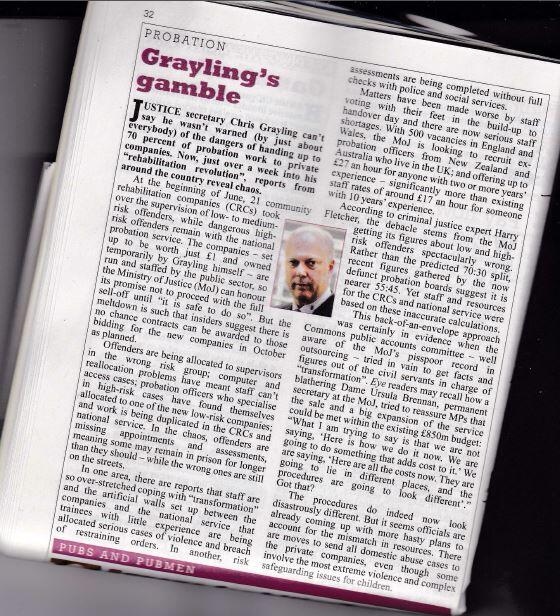
Finally, I see Grayling's TR omnishambles has made it into Private Eye again:-

Image

Postscript - Forgot to mention, due to massive demand, those 'novelty' mugs are back on sale through ebay - just search 'probation novelty mug'. Well done Warks Napo!  

C.R.C Collapsing Rehabilitation Company Novelty Coffee Mug 

Wednesday, 11 June 2014

Mutuals in Trouble!

One of the government's key arguments for the TR probation privatisation omnishambles was that the bidding process would result in getting "the best in the business" and that staff groups would be encouraged to form 'mutuals' and bid for the work. 

Many of us were sceptical from the beginning, that it was all a cruel con trick to win support from the staff and just so much window-dressing, smoke and mirrors. Even if successful, they would merely be wolves in sheep's clothing having to make swingeing cuts in order to undercut all the big boys. 

Of all the mutuals that emerged, the one covering Kent Surrey and Sussex seemed to press all the right buttons for the government, especially as Sarah Billiald the CEO had previously been a civil servant and had worked in the No10 policy unit. Surely this one would win so that Grayling could say TR was a huge success? Err, no! I'm told Chalk Ventures, the consortium with A4E, pulled out on Monday. 

Saturday, 5 April 2014

More on Bidding

This is a key time as bidders try and decide whether to proceed or not, so here's a few more bits and pieces on the topic:-

Now Grayprils fools day is gone it's probably worth looking at whats really going on from a different perspective. Once upon a time Serco and G4S were the governments golden boys, but now sadly for them they're bruised and tired and known as dirty companies.

Then it was ATOS. They did great things curing more sick and disabled people then were cured by divine miracles at Lourdes. They for a while also dined at the top table with our neoliberal gods. Now? Towel thrown in, bloody nosed, and a corporate reputation that can only be described as toxic they're going back to France. All of these companies not only have been labelled filthy companies, but they've paid the government many millions of pounds for achieving that reputation.


More recently Buddi have looked to become that favoured child. But after years of trying and at considerable financial cost they decided to cut their losses and go. Losing time and money is one thing, but seeing the true cost of a government contract, they decided it just really wasn't worth it. The odd thing is that Buddi, unlike the others, have enhanced their corporate reputation by walking away. It's clear that whilst money's good, moral fibre, social values and ethics are priceless.


The favoured one at this moment in time would appear to be Capita. Tagging contract, and top of the pile for any new contracts awarded. Indeed their share price has risen recently because of the favour shown towards them by government.


But all is not as it seems. Local councils that have awarded them contracts are beginning to grumble loudly. Birmingham in fact are trying to oust them. They can do the same job themselves at a fraction of the cost that Capita charge. So how long before they start to feel the wrath of Whitehall, begin to reel from reputational damage, and be forced to hand back multiple millions of pounds? Who knows - but it's sure going to happen!


Government contracts? Be smart and leave well alone, don't get Graypril fooled.


***************
I have no doubt that Graylings plans took a massive hit when Serco and G4S were identified as very crooked companies. They would have taken most of the TR contracts as prime providers. With the withdrawal of many interested parties and bidders becoming so few, I'm left wondering if this move by Serco recently may have any significance towards TR?
Rupert Soames is joining Serco as its chief executive a month earlier than expected as the security giant looks to quickly rebuild its reputation in the electronic tagging scandal's wake. Serco said in a brief statement that Soames, who is the grandson of British wartime prime minister Winston Churchill, will now take the helm on May 1 rather than in June. He joins from his role as boss of energy firm Aggreko. The business is under criminal investigation by the Serious Fraud Office (SFO) after it emerged that the Ministry of Justice had been overcharged on Serco's contract to carry out the electronic tagging of criminals. In some cases it was alleged that taxpayers were billed for tagging work that was never carried out. Serco's rival G4S, another outsourcing firm, is also caught up in the scandal. When the SFO investigation was announced, Serco's then chief executive Christopher Hyman quit. Serco was subject to a ban on government contracts until early 2014 as a result of the tagging furore.

*************
I heard from someone working for a potential external bid team that they are concerned about the deals struck by the unions in terms of no redundancies and maintaining T&C's for a set period (obviously, as we all knew, part of their business model was to cut staff). Also, concerns about a dissatisfied work force (highlighted by this weeks strike), and the potential union involvement at a later date if job changes etc take place.

I doubt the main players will have these concerns, they'll just ride roughshod over people. But a lack of competition may leave scope for the unions to make waves; the likelihood is the proposed CRC services will be scaled back when they realise they don't have to offer so much (and thereby reduce their profit) to win a bid for the contracts. 


Then there's this continuing problem for A4E as reported in the Daily Mail:-
Four former employees of scandal-hit welfare-to-work firm A4E admitted swindling taxpayers yesterday. The guilty pleas follow a police investigation into the troubled company which is paid more than £200m by the Government each year. 
All four were arrested after the Daily Mail revealed concerns about taxpayer-funded employment schemes run by A4E two years ago. The company was employed by the Department for Work and Pensions to deliver an employment and training scheme called 'Inspire to Aspire'. It pocketed huge sums from the public purse for getting people off benefits by delivering training and helping people to find work.
But Whitehall officials called in police over concerns that staff were billing taxpayers for 'successful' work that was not carried out or for non-existent clients. A whistleblower claimed forged signatures and blank timesheets were 'routine' techniques used for bumping up the numbers of successful job placements. The four former A4E recruiters admitted a total of 32 offences during a hearing at Reading Crown Court yesterday.
All the offences took place between over four years until February 2013. No date has been set for the former employees to be sentenced. They each face up to 10 years in prison. The A4E controversy began in February 2012 when it was revealed that its founder Emma Harrison had paid herself £8.6 million. Damaging allegations followed that workers at the firm were inappropriately claiming 'success' fees, sometimes for individuals who worked for no more than 24 hours. Officers from Thames Valley Police's economic crime unit searched its headquarters in Slough, Berkshire, as politicians called for a full inquiry.
The furore forced Mrs Harrison, worth an estimated £70 million, to step down as chairman and resign from her role as David Cameron's 'back to work tsar'. Mrs Harrison remains the majority shareholder after building up the company, formerly called Action For Employment, into an operation spanning 11 countries. Her boasts that she can find jobs for the long-term unemployed have won her a string of lucrative Whitehall contracts over the past 20 years. A4e is one of several contractors which earn payments for helping the out-of-work find a job. Half of its work is subcontracted to charities, generating millions in management fees. A further eight former A4E employees, aged between 25 and 43, are expected to go on trial in October accused of fraud.
To ordinary citizens it seems incredible that any government would even consider giving yet more contracts to companies whose employees have been proved to be involved in systemic fraud that benefits the company rather than the individuals directly. This is what the Public Contract Regulations 2006 says:-  
Criteria for the rejection of economic operators

23. (1) Subject to paragraph (2), a contracting authority shall treat as ineligible and shall not select an economic operator in accordance with these Regulations if the contracting authority has actual knowledge that the economic operator or its directors or any other person who has powers of representation, decision or control of the economic operator has been convicted of any of the following offences—

(a) conspiracy within the meaning of section 1 of the Criminal Law Act 1977 where that conspiracy relates to participation in a criminal organisation as defined in Article 2(1) of Council Joint Action 98/733/JHA;

(b) corruption within the meaning of section 1 of the Public Bodies Corrupt Practices Act 1889) or section 1 of the Prevention of Corruption Act 1906;

(c ) the offence of bribery;

(d) fraud, where the offence relates to fraud affecting the financial interests of the European Communities as defined by Article 1 of the Convention relating to the protection of the financial interests of the European Union, within the meaning of—

(i) the offence of cheating the Revenue;

(ii) the offence of conspiracy to defraud;

(iii) fraud or theft within the meaning of the Theft Act 1968 and the Theft Act 1978;

Finally, I saw this interesting observation on facebook which rather neatly sums up the dilemma for NPS-bound colleagues:-
So I started reading the Becoming a Civil Servant Guide this morning...I managed to get to point 2 before wanting to throw it in the fire....Not convinced I want to come back to the UK and resume with NPS anymore!

"2. The duty of the individual civil servant is first and foremost to the Minister of the Crown who is in charge of the Department in which he or she is serving. In the context of the National Offender Management Service (NOMS) and the Ministry of Justice, this is the Justice Secretary, Chris Grayling."