Sunday, 24 April 2016

Private Probation - A Soundbite World

Dear Jim,

As a probation 'long-termer' who managed to get out some time ago, I thought you might be interested in some observations from the West Yorkshire CRC Stakeholder event in Wakefield last week.

It's fairly clear that owners Interserve spent a tidy sum preparing their Purple Futures bid to impress the mandarins at the MoJ and of course they were duly rewarded with 5 out of the 21 CRC contracts, including that of West Yorkshire. They were canny enough to get into bed with a number of charities that included Shelter - although they seem to have a very low profile nowadays - and of course we know Addaction didn't like the way things were going and were quick to get out. 

The image consultants gave them some clever slogans that to be honest wouldn't be that out of place with outfits that could range from the Freemasons to Unilever I guess:  
  • Do the right thing
  • Take pride in what you do
  • Everyone has a voice
  • Bring better to life
They also invested in some cool marketing and graphic design for their operating model 'The Interchange Journey - intervene, interact, integrate' and even paid Manchester University to evaluate it. Of course, despite the fancy graphics, to those of us who've been around awhile, there's basically nothing new in the concept, but judging by the enthusiastic presentations by newer recruits to the service, it certainly appears to have captured their imagination.    


Although being repeatedly told everything would be tailored to the individual, the cogs rather give the impression of a machine cleverly designed to process 'service users' through a system that produces rehabilitated individuals as efficiently and cost effectively as possible but commensurate with contract performance and payment-by-result targets, naturally. Something tells me it's not going to be quite as straightforward as the designers envisage, but I can certainly see how the MoJ have been seduced by it.

There was no surprise in hearing that OASys, that all-singing, all-dancing computer-based timewasting device was indeed a complete waste of time and will be got rid of as soon as possible, in favour of a brand new simpler assessment system. Lets hope it works then. 

Despite all the warm words and exhortations of the need to "all work together", I got the distinct impression from some quiet mutterings between 'stakeholders' in the room hoping to get a slice of the action that there was a degree of cynicism regarding Interserve's contracting policies and philosophy. The repeatedly-dangled carrot of lots of cash just waiting to be given away by the 'Innovation Fund' to stakeholders with bright ideas seemed to generate rather more hollow laughter than serious interest.

We learnt that:
  • There's to be a 24 hour helpline for former and current service users
  • A search is on for a bright new shiny contemporary Head Office in Wakefield
  • An online Directory of Services will facilitate 'Pick & Mix' for busy OM's
  • A Rent Deposit Scheme will help with accommodation problems
  • Every service user will get a certificate at the end
  • There will be Service User Councils 
  • Practitioners can share ideas via Panels to be set up
  • TTG 'is a bit of a ropey contract spec'
As always at events like this there were some extremely variable presentations, mostly it has to be said from the more senior management team. But it will come as no surprise to hear that 'Right Direction' volunteer peer mentors proved stars of the show, thus demonstrating to me at least, that in all this sorry mess that TR has generated, the reason many of us got involved in the first place remains exactly the same.  

Friday, 22 April 2016

Probation Realities 2


I left my post because of targets. I could see that meeting the target and getting the payment was the only goal. Innovative ways of working and helping clients to change was not even considered. Examples of fraudulent behaviour included; 
  • a programme was deleted from Delius towards end of the Order, as it had not been completed, and would have been a 'failure', (it had been taken back to court for amendment but the magistrates had refused to remove it), it was not uncommon to have 20 or more acceptable absences as breaching the order may have led to a resentence: another failure,
  • clients not recalled on licence when they commit new offences as this would be a failure! 
  • pretending clients stayed with 'family or friends' on first night of release in order to meet TTG target. 
Working like this became too stressful, and combined with the other pressures of a high case load; 
  • staff sickness, 
  • the threat of what would happen when it became apparent that some of my clients would not complete their programme or UPW (resulting in more failures, and less payment), 
  • the frustration there were no agencies to send them to, to complete their RAR days,
  • the fear of an SFO and the guilt of knowing there was a seriously injured or worse victim, but also knowing that I would have my work scrutinised, and it would be found wanting, as I didn't have enough time to get to know my clients properly, and knowing that management would not back me, 
  • completing OASys in 10 days, 
  • breaches within 8 days,
all became to much. It became a choice of my health and integrity v a monthly pay cheque, my health and integrity won and I now feel like a burden has been lifted from me.

******
Agree. It's ludicrous. We have case loads in excess of 115% no time to see offenders and do what we should be doing. Simply too much work. Yet they want us to fanny about with yet another stupid system that probably is unfit for purpose. These people are just so distanced from the coal face. Don't even get me talking about the ARMS training. 3 hours to complete the assessment. Get real people. Who dreams this shite up?

******
Does it really matter as it won't make any difference! I will still be struggling just to get to the end of the working week, feeling increasingly under pressure and impossible to do all the tasks required to manage a caseload of DV. Worrying about what I'll find they have been up to when I get in on the morning and whether my contacts and OASys will bear scrutiny because everything so rushed. Who will be off sick and how many of their cases I will need to see. Sounds familiar?

******
In a CRC someone who has zero experience of carrying a caseload and who is not PO trained has become a manager. How is this possible? What qualifies them to manage and give advice to PO/PSOs when they've never done the job? Spent warnings (that were questionable in the first place) being used to deny someone a post. Admin all having to apply for posts and then finding out they've not been successful despite doing the job for years. All leaves a bad taste.

Wednesday, 20 April 2016

Pick of the Week 4

Feeding this monster I've created can be difficult at times and you're never quite sure when or how things are going to 'kick off'. Saturday and Sunday's heated debate as a result of Guest Blog 52 popping up is a classic but very welcome example and I like the blog to be as relevant and responsive as possible. One result has been the postponing of a couple of 'roundup' posts. 

As I've said before, the blog can move at an alarming pace sometimes and I'm loathe to miss some important contributions along the way, so here is what had been scheduled for last Sunday. (By the way, I rather like the banner I nicked from Facebook and hope the clever creater doesn't mind me using it now and then - thanks).     


It is an appalling abuse of power to sell public services off to companies that are not competent to run them. It's THE scandal of this and the previous Tory Government. Taking generally effective public services and replacing them with incompetence and amateurism. It is everywhere. I am an ex-PO who is not working in another field. All the clients I work with are being processed by private companies who have replaced public providers and all of them are basically waiting and waiting and waiting for services that are woefully inadequate and who are proving incapable and insensitive to the needs of their service users. The truth is, we all expected this. We all saw it coming. We all SCREAMED that this was going to happen - it is a matter of record. Despite this, the civil servants, ministers and commissioners all put their own career aspirations before common sense and the public interest.

I heard yesterday that POs in Suffolk (NPS) were being asked to provide reception cover for the office because there were no support staff available to cover it. We all saw it coming. We all said it would happen. Most of these critics have already left and the rest are leaving almost daily because it is a farce that few are willing to continue perpetuating. Agency PO this week (working with the NPS) explained that s/he left the local CRC because s/he was not willing to continue interviewing offenders in these open plan 'booths' that have been installed. It's a professional disgrace and those who facilitated it should hang their heads in shame. As an ex-SPO, I am increasingly embarrassed by the disclosures of those who remain involved.

*******
I left Probation some years ago. Now working for a Social Services department. You can see privatisation slowly creeping in but Social Workers appear to believe it will never happen to them (like many of us before them). At the risk of sounding like a bitter cynic, I see no point in further professional development at the present time as the goalposts are constantly being moved. What is the point in spending 20k plus developing ones practice and studying new qualifications when there is a very real risk of the requirements of having to have any qualification being removed. It's soul destroying. It's the government saying "anyone can do your job".

Whilst I admire talk of standing up to the bullying; it is a lost cause. 'They' have all the power. Just look at the junior doctors. They had public sympathy, a well organised fight with a strong Union and are a profession that has a degree of respect from ministers. They fought the good fight and lost. What hope is there for the rest of us who are even more susceptible to the effective divide and rule strategy? Unfortunately the public on the whole aren't interested. It's the mentality of..... 'I don't get that much in the way of job protection.... pension..... salary... whatever.... so why should you?

Going back to the ambulance issue, in London they have never had so many paramedics leaving. They have had to hire private support in the way of Medicare and have had massive recruitment campaigns in Australia and NZ to try and plug the gaps. Yet no-one seems to be examining why so many are leaving in the first place. Instead of spending money to improve working conditions they would rather fill the void by various private companies filling the gaps or recruiting from abroad. It's a massive false economy. It just goes to show there is no duty of care and ideology rules for the foreseeable future.

********
Did anyone see the recent programme about the PIP scandal? An ex mental health worker went undercover to expose the shameful situation when a private company trains and employs staff to do this work with vulnerable patients. He shadowed a man who was apparently 'the best'. It was sickening. This man gloated about earning up to 20k a month by rushing through reports. Was happy to say that in some cases he had written the report before he met the patient. He ridiculed one woman saying he had turned her PIP down because she didn't deserve it being simply 'too fat to wipe her own *rse'. Thankfully he was sacked but how many more like that? It worries me that we could go the same way. We could be corrupted by being offered bonuses or the like for reaching targets. Pushing through shoddy reports. What sort of people would this attract?

*******
I saw the programme. It was disturbing. Assessors, target-led, adopting exploitative methods towards those hoping for holistic assessments. Totally unethical methods. They sacked the arrogant thug who was in fact the hero of the office, the go to man who was a whizz kid at the assessments. But he was only a symptom of the diseased working culture.

*******
I'm a CRC PO and I was in a meeting recently and when I suggested that we recognise that if we are now a private company that was grossly under resourced to deliver what we had delivered as a Trust and that we should ask the MoJ what it is that must be done and what we can stop doing. Their reply was we must appear to do everything including going through the motions of returning people to court even though we know the applications will be rejected. They also said they were aware things were crap but were in no position to say so.

Yesterday I met a trainee on placement and had a long chat. She told me that she had initially been confused about the difference between proper POs in the NPS and those now called POs (but aren't really) in the CRCs. She said she had been put straight by experienced NPS colleagues and the situation explained to her that all the best staff had been hand picked to go to the NPS and that all those in the CRC were basically rejects who were not fit to hold any real responsibility for high risk or report writing or speaking as a professional in court or at oral hearings. She on the other hand as a recent psychology graduate whose only work experience had been a Saturday job in Boots was more qualified. She accepted some people may have slipped through on either side but her experience of unprofessional CRC staff tended to confirm what she was told. She had noticed they tended to dressed more shabbily have lower vocabularies and appeared to be less well educated and basically a lot thicker than her NPS colleagues.

She was warned not to take too much notice of CRC staff who were no longer considered proper probation staff along with other 'partnership odd bods' like housing association staff who would in any case be made redundant soon as they were not fit to do the job and privatisation was the most efficient way to finally get shot of them. She said she had been told it was very hard for an ex CRC person to join the NPS and if they did, their previous CRC experience counted for nothing and they were at a disadvantage as they had already been rejected. She had apparently heard these kinds of things from several sources.

The most worrying thing she said was that those who were physically disabled had been deliberately left in the CRC because she had been told they were a nuisance and the private sector was more efficient at encouraging them to resign. I was also told that financial institutions now give better rates to NPS staff than to CRC so even the banks think CRC are second class. Welcome to the future.

*******
Trouble is, this isn't the future, this is the 'now'. Hey ho, I've quickly scanned the E3 blueprint, and noticed in the section on courts that 'POs will support the PSO's in court' with PSO's doing the lion's share of the work. What a turnaround hey, once upon a time it was PSO's supporting PO's in their role. But what do I know? I'm just a badly dressed, less well educated (2 first degrees anyone?) thick CRC PO.

*******
There is some irony that Amey is also the company that has the NPS cleaning contract as well as being part of MTCnovo in London. The Courts, Police and others have some evidence to think that the CRC is basically a beefed up cleaning company with ideas above its station and beyond its skill set. They haven't even got a proper email address. Some in the NPS have taken a little too eagerly to the notion that they are some kind of elite rather than 3rd class civil servant wannabees and you can spot these by the increase in the number of people now wearing suits to the office. CRC staff on the other hand seem to be reinforcing their identity by dressing down.

*******
You might want to tell that trainee PO the following: I am a PO in CRC. I have two good university degrees. The latter being a post grad degree in social work with CQSW probation option. I'm better qualified than some Chief PO's. Prior to graduating with post grad degree, I worked my arse off working with children an care. My first ever job was working in a bail hostel at 23 years old! I do not come from an advantaged background and went to an awful school. I witnessed DV growing up and also as a young adult. My first partner died of a heroin overdose. I was the victim of two sexual assaults as a child and had anorexia. I have dragged myself up from my arse and am proud of what I have achieved and the effort I put into my job which I remain committed to. 


I worked in the public protection team with offenders such as NPS now have. I have also worked for YOT and Home Office drugs prevention initiative as a senior practitioner. I chose to go to CRC and turned down a job i was offered at NPS as CRC suited me better. More face to face work. She sounds inexperienced and maybe being fed detritus so I won't take this personally. What I would day is NPS role has a shelf life. How long can the average person cope with working with high risk offenders? My experience is maybe 3 years or so and then you become emotionally drained. Burn out or even PTSD are not uncommon. 

I coped until I had kids and then it began to effect me emotionally and I became hyper vigilant and terrified for my own kids. In this job you need alot more than a professional qualification. My training was great and I consider myself very lucky to have had that opportunity, but life experience and working with relevant groups are also vital. It worries me that newly qualified PO's, some with no previous experience, will be in this position. I don't want to be patronising, but has anyone considered how they will cope emotionally long term and where will they go if they need a break from high risk offenders?

*******
I completely agree. In NPS and stressed out my box by the relentlessness of what my clients have done. There is no light relief.

*******
At present we in CRC still have daily contact with NPS. We are in seperate offices but same building. Often discuss the cases I have risk escalated. Are they doing anything different so me? No, we come from similar position so no real difference there. Also frequently converse with NPS court staff when they are dealing with a CRC breach etc. Have never felt looked down on. I'm too much of an old timer for anyone to get away with that. Sadly we will move out to our new offices soon to save some pennies. Our only contact with NPS will be by phone. 

The split just goes on and on. Admin will go to their call centre or whatever and we will be a very small team managing all the DV cases. Any so called low risk will be 'remotely controlled' via a human maybe a robot at the call centre. I must start practicing my new phone voice, maybe a dalek or darth vader would be appropriate! Why even bother having an office..it would be easier to have us working at home making calls all day to people we haven't even met using a checklist devised by..could save even more money if it was all done by phone minus a human or robot..'if you have re-offended please press 1' 'for all other options or to speak to someone with no qualifications or experience on the minimum wage press 4'..otherwise just bog off.

*******
I like this blog because it very often mirrors my experiences of working in the post Transforming Rehabilitation (TR) apocalypse world. There was a time when it was referred to as a TR revolution. We pointed out at the time that the problem with revolutions was that people often got hurt and post revolution euphoria, the reality was not so pleasant, that voids and divisions would emerge and so the evidence is now presented. Our on message management refer to these as 'transitional issues'. Those of us at the sharp end are not so understated in our sentiments regarding these issues, they were and will continue to be predictable consequences of an extremely bad plan. An appeal then, therefore, to our leaders and politicians, put away your fixed and entrenched positions whatever side of the divide you are on and concentrate on what our common goals and needs are to bring about a settlement that works. Too idealistic and unrealistic?

*******
I'm fairly certain that, though a staunch neoliberal who would privatise his own grandmother, Gove genuinely does want out of the CRC contracts as he can see a duff deal and will be aware that Grayling screwed them over too. Gove is perfectly aware that he has no real investment in seeing them succeed at any cost as he can blame Grayling for failure. He can't simply end the contracts because of the poisonous clauses, but he does have the option of turning the screw and systematically starving them of funds to frustrate the contract then renegotiate. 

Private probation service providers have made a total mess of everything and no sane person would have suggested such a barmy system in the first place. An idea apparently being given serious consideration and gaining momentum at the MoJ is that it makes sense for NPS and CRCs to be brought back together in the community under the working title of National Community Rehabilitation Service (a public private sector partnership) with larger package areas roughly coterminous with police areas and courts probation to be absorbed by the courts service and prison probation to be absorbed by the prison service. Interestingly, APs would be part of the new NCRS but will be managed by a private prisons contractor. Apparently this is the preferred option at the moment and it's all being kept under wraps so as not to alarm the CRC owners as their relationship with the MoJ is a little strained. Waiting for costings.

*******
You only have to check your emails from the recruitment agencies to see how desperate both the CRC and NPS are to recruit, here in the South East at least, as they grapple with fire fighting approaches to work demands and how to provide an efficient and effective service whilst valuing their staff because no one from middle managers to directors to CEO's have a proper understanding of what the hell is going on as the private companies take charge. 

It's no surprise good staff are leaving, yet there are huge numbers being forced out without any consideration on how the businesses are going to meet their contractual requirements when skilled, experienced and dedicated staff have walked or been discarded through a redundancy all over the country. I work in the South East for CRC and for the former Trust for over 10 years and the Trust arrangements were always problematic given the restraints on Trusts from the government, despite being told they would have autonomy. Now the CRC's have been created on the premise of more autonomy, only to be at the behest and strangulation of the private companies. Notwithstanding NAPO assisting these pirates in strengthening their hold over the CRC's by attempting to bargain away collective agreements on pay, which will facilitate the race to the bottom on professionalism and skilled labour. 

One day Napo says we want to support the PI and influence decisions to protect the professionalism with a licence to practice and whilst doing so they are meeting with the CRC purchasers round the back of the filing cabinets to sell off the protections we have from the transfer. In the mean time the CRC leaders are unequipped to understand the legal implications and obligations of being a director and CEO of a subsidiary and have handed all the power to the parent company, who also has no idea about how to be a parent company of their subsidiary when they don't 'own' the employees. 

In summary folks there is no one looking after your terms and conditions, not your employer because they are too busy understanding the contract and delivering on their super doopa new delivery models to prevent the pains of a breach, not your union because they are too incompetent to know the difference between the employer and parent company to be able to negotiate with your boss. In the mean time, and I have this on fairly good authority after seeing a friend over the weekend who works for Noms policy department, that they are well aware the CRC's are ticking boxes to be able to report that yes guv course we're doin it right, here's our returns you asked for and it's all goin swimmingly mate. Just anuver 200 staff to get shot of and we should be able to deliver streamline services!!!! 

Local branches haven't the resources to deal with this, there is no strategy to help them from Chivalrous Road only to sell em off. It's a waiting game as far as I can see on the union, the members and the staff but not how long, just when. Ultimately if NAPO stays on this road it will no longer be able to demonstrate it is acting in the interests of its members.

*******
Totally agree that the owners are calling the shots with a big controlling hand thrust firmly up the rear of the puppets that are the CRCs. If you could find one backbone amongst the CRC bosses to resist staff redundancies, then you would be doing well.

*******
The next month is going to see a lot of changes in Purple Futures CRC. All staff are being transferred into 'flex teams' and we have it on good authority that PSO (now known as Case Managers) caseloads will be 65 as opposed to current 95-00. 8 office closures in Gtr Manchester; Merseyside HQ closing in May and moving to an already occupied building by Interserve which is in Liverpool city centre and has good bus/rail links. Admin find out this week where they will be based and what role they will do some expecting to leave probation and work for Interserve but all will be revealed. New case management system is called the Interchange model - seems to heavily focus on referring to partnership agencies and groupwork rather than the traditional 1-1 delivery. So we just need to see what the next month or so brings.

*******
Do you work for the company as this is nonsense. There are always little lying minions of private companies that come here to peddle their wares. The Interserve flex/interchange model is not sound. Use your brain. If 8 offices are closing it means caseloads will increase not decrease. It means admin and others will eventually be jobless and I doubt Interserve will absorb them. Group work over 1:1 work means reduced individual contact with offenders so no need for probation staff. Ker-Ching.

*******
Replace 1:1 work with groupwork and reporting to other providers? What an absolute farce. I am splitting my sides here. You can try and put a positive spin on it but the reality at BGSW CRC is that service users are routinely waiting 6 to 12 months to get on the BBR group. These are DV offenders and most are classed as medium risk of harm. Who ends up working with them, liaising with DV unit/police intel..even contacting partners to check they are ok..oh and social care if you can persuade them to get involved. 

A real practitioner, be they PSO or PO will know the hard reality of being left holding unpredictable and risky cases whilst they try to negotiate a start date for BBR. Even once they are on the group, do you think we have a break and put our feet up? No, of course not because we are still liaising with the agencies mentioned, checking their progress and seeing them to address any other issues that inevitably come up. I really wish that managers, CRC/Noms etc. would actually speak and take note of what practitioners and service users say. Maybe then they would have a service fit for purpose as opposed to the shambolic mess we are in now.

*******
I'm currently holding 60* cases of DV and now sex offenders since the Mappa rules were changed!! I've not got time or motivation to even try as I've got 5 ISP's stacking up with no relief of sending these people to anything remotely meaningful. People have moved to our new central it fits all office and are already pointing out the obvious mistakes for example a fire door propped open for the clients to attend and then to be told "it's a brave new world" No it's bullshit of the highest order!! Where the fuck are the union?

*******
60 plus cases mainly DV and now sex offenders! At BGSW CRC we have also heard rumours that Working Links may want us to take back some sex offenders from NPS. Sex offenders = more cash from Noms. Sex offenders traded for cash in this brave new world of private sector. Do you not have any programmes to send people to? If not, how on earth can you be expected to risk manage so many risky cases? Saying that, there is a huge backlog of service users waiting for programmes in BGSW and we were told recently that we are likely to lose all programmes other than Thinking Skills and BBR. I think we need to think about taking alternative action such as a vote of no confidence, writing to your MP or writing to magistrates (perhaps anonymously) I'm sure the latter would be interested to hear practitioners version of events as opposed to what they are fed by NPS managers at meetings.

Tuesday, 19 April 2016

Probation Realities

Seen on Facebook:-

Well my comrades, friends and colleagues along with those I can't stand (can't think of any in this group) and those who can't stand me (there are probably some), I will be departing the Probation Service soon. I am CRC and still claim the right to capitiaiise PROBATION SERVICE.

I had my third redundancy interview on Friday and will formally join the ranks of the discarded and no longer required early in July at the end of my statutory notice period. I am a mere sprog and stripling of 16 years service in the Probation Service (as it will always be in my head). However, I will leave with wonderful memories of amazing dedicated knowledgeable people and also, like most I suspect, a delight in leaving behind some sociopaths, pychopaths and downright unpleasant people. Many of whom have made a comfy career in higher management pretending they give a shit.

For those who know me, there will of course be a leaving do, perhaps more than one. For those who don't, apologies across the board if they are needed. Finally (for now) keep up the good fight one and all. Hold in your sometimes tired hearts the knowledge that what we do is worth the pain and as Dylan Thomas said, 'Rage, rage against the dying of the light.'


I love your description of comfy careers I think we all know at least 2. Carry on the good fight mate.

So sad ... I left the CRC in January and am back in the NPS in a prison probation role .. And it's the best thing I've done .. Love my new role .. Good luck for the future X

Good luck for the future. Glad we were able to meet up.

Good luck for a happier future outside of this mess.

Good luck - I know it's a weird feeling but personally I can say that leaving was a great move for my family, my stress levels and my happiness! Best wishes love xxx

I don't know you but felt from your post a sadness. You like so many deserve so much more then a meeting and probably a very small cheque. This is your career your profession. I'm not a qualified PO I'm a PSO with 26 years in but the Probation Service as was runs through my blood. It's what I do it's part of my identity. We await our fate in HIOW. I don't blame the companies at all they do what they do because they're allowed to. I blame Grayling and the TORY government. I wish you well in your future and pray for an end to the privatisation of everything under this government. Sad times for all xx

I agree with you about Grayling and the tories with their devotion to the 'private better than public' ideology with no evidence to support this and much to the contrary. However, we shouldn't forget the contribution to this by 'New Labour' with the dreadful Offender Management Act with it's weasel words like 'contestability, offender and management' as if people are mere entries on a balance sheet.

Good luck for the future.

Any plans for the future? Hopefully some long needed rest and holidays are on the horizon. Your leaving is a real loss to Probation. Take care mate and remember when one door shuts...eat donuts.

Hi, I have a granddaughter and grandson and my good lady and I are off to Rhodes for 3 weeks in September. I have also made contact with an agency used by some retired colleagues so there are options to consider after a couple of months sleep.

So sad to read more posts from dedicated people who are leaving or being booted out - good luck!

Compulsory or voluntary?

Compulsory. They side-stepped the voluntary stage in the policy claiming no time for a voluntary stage despite a timetable of their own making. Were I a cynic, I might possibly think they wished to cherry pick.

It sucks. Their own policy says voluntary has to be considered first. So disappointed in our union. How can no time be a legit defence? Anyway, you seem like a really decent man with sound politics. I wish you well for the future.

You should appeal.

I'm shocked by multiple redundancy interviews which probably add to the punishment? I can only offer comradely greetings. Such a pity that despite the heroic struggle of NAPO/probation workers - this is how it seems to end. Were "we" to treat clients this way we would never get away with it.

What a loss. If it's any help never met a better SPO, thanks for giving me confidence in myself and the courage to apply for a job by the sea.

Very sad to hear this. Good luck and follow advice.

Very sad but good luck for the future.

Thank you for your honesty!!

You don't know me, but in your Napo forum posts (remember that?) and others placed, you have always struck me as a thoroughly decent individual. Good luck to you.

I'm sorry to hear you're leaving. I wish you all the best for the future. Sad times.

The phrase "Cutting off their nose to spite their face" has never felt more appropriate. They're literally throwing away all the experience they're going to need desperately! However, from your point of view, there definitely is life outside probation. Enjoy your break and all the best for the future.

Monday, 18 April 2016

Guest Blog 53

An ignorant old mans take on probation

The Harvard Law of Animal Behaviour, states "under carefully controlled experimental circumstances, an animal will behave as it damned well pleases."

This law explains why all prison regimes, interventions and courses based on what I will call Folklore Psychology fail. I predict Incentives and Earned Privileges will have no effect on recidivism rates. Putting someone on basic and taking away their TV will build resentment, if you mistreat any animal you are likely to get bitten.

There is a paradox, international comparisons show that the countries with the lowest ratio of Probation Officers to Prisoners have proportionally a lower prison population the exact opposite of what you would expect, but you could be comparing apples and oranges so you cannot draw a conclusion. Scotland has a very similar prison population per hundred thousand as England and Wales, the crime rate and prison population mirror each other, not very surprising social factors are about the same. The probation staff in Scotland is about half that of England and Wales pro rata, for a similar outcome.

It would be reasonable to conclude that the number of Probation Officers employed makes no difference to re-offending. “The animal behaves as it damn well pleases”. However there is an important difference between Scottish probation and England and Wales that could be giving the Scots an advantage. Their Criminal Justice Social Work Services, is an integration of Scottish probation services and generic social work departments, through the Social Work (Scotland Act 1968.) Since then Scotland has experienced criminal justice policy trends similar to the rest of the United Kingdom resulting in an increased emphasis on public protection through risk management and on reducing re offending. Nevertheless, practice in Scotland has remained firmly rooted within social work principles with a commitment to social inclusion.

In 2010 an Advisory Group emphasised the need to support practitioners and managers professional autonomy within a framework of accountability, whilst ensuring the personalised delivery of criminal justice social work services. In addition, a key focus of the revision was to support the active participation of offenders in work towards outcomes.

The personalised delivery may be a key. In England and Wales the trend is to group offenders into bands, cohorts or whatever, not as an individual. I am not a psychologist, but I understand that our behaviour depends on what we have experienced in life and it can be changed by new experiences.

It is possible that as the CRC's reduce their staff by 40% the recidivism rate will not change. If that happens it doesn't mean Martinson was right when he said “Nothing Works”, just that Nothing Works based on the “punish and protect” philosophy. Could that be a time to switch to a new philosophy based on giving positive experiences to change behaviour? The only intervention that I can think of as positive, is Circles of Support and Accountability as conceived by the Mennonites and taken forward by a couple of American states. Many adoptions of this are tainted by elements of punish and protect, some accidental, I believe in the UK many volunteer 'friends' are criminology students anxious to get something on their CV's, more interested in questioning the core member about his crime than giving them a positive experience socialising.

I remain open minded, it's a complex subject, but I have a belief that in a contest between good and evil, good will eventually prevail, so something must work.


Rhys Toogood

Saturday, 16 April 2016

Guest Blog 52

TR, E3 & the death of the probation officer

A recent Twitter conversation between an anonymous Probation Officer and Sally Lewis, former Chief Probation Officer, went like this;

@PoOfficer: Well the boss has said that the number of PO's will soon decrease as they hire more PSO's in NPS. PSO's will manage all low / med risk.
@CEOLewis: I don't think Courts, etc know that PSO's are not qualified officers. PO's won't sign with their prof qualifications #BigMistake
@PoOfficer: PSO's now writing the bulk of reports on templates which restrict the amount of text. They are shockingly bad. I'm embarrassed.
I'm going to start and finish by agreeing with Sally Lewis because probation officers should be stating their credentials. Every other professional completing formal reports and assessments states their qualifications as standard. I couldn't imagine reading a letter, assessment or report from a psychologist, medical practitioner or legal representative without reference to their professional qualifications and authority. I think our omission in doing this is partly because our report and letter formats are not designed for us to state BSc, MSc, DipSW, DipPS and DipPP, but also because the culture forced upon us doesn't encourage it.

I read a lot of reports completed by colleagues as we gate-keep each others work to check for errors missed. This mostly includes reports for court sentencing, parole hearings and other formal settings, but only the parole report asks for qualifications and even then many don't state their professional qualifications. Of the others, never do I find these signed "Mr or Mrs Smith BSc, DipSW". Even our letters and emails omit any record of professional qualifications. It's as if we are not professionally qualified or fear stating it, when in fact we have probation officers who have a wealth of formal qualifications. Off the top of my head this includes those with the Certificate of Qualification in Social Work (CQSW), Diploma in Social Work (DipSW), Diploma in Probation Studies (DipPS), Diploma in Probation Practice (DipPP), etc. Most already held formal qualifications and degrees at varying levels before they began probation officer training. I once read a survey that canvassed staff qualifications in a probation trust (when we were trusts) and found the vast majority of staff at all levels held university degrees right up to PhD, but they only stated these when asked.

TR, E3 and the Diploma in Probation Deprofessionalisation

In my humble opinion the probation qualification and professionalism has been slowly eroded over the past two decades. Even our union has omitted "probation" from its title and went from calling itself the National Association of Probation Officers to adopting the acronym Napo! The Probation Institute has gone in a different direction by wanting to sell everyone working in probation, qualified and unqualified, the title of MPInst. I think this problem of hiding our qualifications started when probation began employing huge numbers of Probation Service Officers (PSO's) to do our work, who were not professionally qualified and in many places had poor access to training. 


The government also separated probation from social work in the mid 1990's which was really the beginning of the end for us. The Diploma in Probation Studies that followed was adequate, even considered to be a "gold standard" of professional education/training by some academics. It did, however, help push probation into an identity crisis about whether it was an enforcement agency or a social work agency. Unfortunately before probation could figure it out our training was morphed into the Diploma in Probation Practice under the Probation Qualifications Framework (PQF). This seemed to disproportionately attract young graduates (mostly female) with no experience and then qualified these recruits in about 15 months. 

Never have I seen so much tears and anxiety amongst probation trainees as in this period, which I think is now reflected in their varying levels of competence/incompetence upon qualification. The newest edition of our training commencing this year is the Probation Qualification in Probation (PQiP), which costs £75 just to check eligibility to apply. So far we don't know if there's any improvement on the PQF but I doubt it and there must be a reason why the word "diploma" is removed from the final award, which is the "equivalent" of an honours degree rather than an actual one. It doesn't take an idiot to parallel the erosion of our qualifications with the deprofessionalisation of probation officers, the privatisation of probation work and the governments Transforming Rehabilitation policy.

For years probation leaders have been implicit in downgrading the role of probation officers. For starters I blame the Probation Chiefs Association, the Probation Association and now the Probation Institute. These organisations are inter-related, and their actions have been self-serving to preserve their positions. Under what I call the "judas watch" of most of our former Probation Chiefs (they received a lot more than 30 pieces of silver) we've witnessed the probation service and the status of the probation officer reduced to nothing. We've become subservient to the agencies of the community and criminal justice, and even within probation our roles have been handed to unqualified PSO's, volunteers and mentors. Not content with selling 70% of probation to private companies, the current "E3" drive by the Ministry of Justice and the National Probation Service is now replacing qualified Probation Officers with unqualified Probation Service Officers.

I am a Probation Officer, DipSW, DipPS, DipPP, PQiP

In the new world of probation we are called by names most of us never use, "responsible officers", "offender managers" (and sometimes b*stards and c*nts) which can be applied to nearly anybody. This is very different to probation under social work training arrangements up until the mid 1990's when probation officers were Probation Officers and would generally include their professional qualifications as an indication of authority, expertise and competence. CEO Sally Lewis is right to question whether "courts, etc know that PSO's are not qualified officers", and to state that PO's not signing with their professional qualifications is a big mistake. Likewise the Ministry of Justice and the National Probation Service are wrong to replace qualified Probation Officers with unqualified Probation Service Officers. We should distinguish ourselves from the inexperienced, the untrained and the unprofessional, and I believe we can start doing this by signing our emails, letters and reports to state BSc, MSc, DipSW, DipPS and DipPP, etc. When we are asked our role at Court, Parole Boards and other formal settings to state our professional qualifications as standard.

If you're a qualified probation officer and agree with the above then you know what you need to do. It is our professional qualifications and experience that gives us the authority to do our jobs and sets us apart from the untrained, unqualified and inexperienced staff currently being recruited to replace qualified probation officers in the National Probation Service, Community Rehabilitation Companies and other organisations. If nobody knows what we are professionally then how will the Courts, Parole Boards and others, including offenders and their families, know the differences between qualified and unqualified. More importantly, how else will they know to request their preference for a "qualified officer" because of all that comes with it. 

I've no doubt the time will come when we'll witness a reversal of E3, TR and probation privatisation (probably not under Dodgy Dave's Conservatives). I'm not wishing bad tidings on myself or anybody, but sadly I fear there'll be no constructive change by any government to reverse probation privatisation and deprofessionalisation until too many of our probation staff have been implicated for misconduct and corruption, until too many of our prisons are rioting and on fire, and until too many of our supervised offenders are raping, maiming and killing members of the public.

Probation Officer
15 years to retire

Friday, 15 April 2016

Latest From Napo 102

The latest blog post by Napo General Secretary:-

PAY 2015/16 – NAPO SECURES PAY OFFER FOR STAFF ON MAX

The Officers have agreed the recommendation from the Napo negotiators to ask our members in the NPS and CRCs to signal their acceptance of a pay offer which has been made to the NNC Joint Secretaries this week. This has emerged from the discussions between the probation unions and NOMS about the outstanding elements of the joint unions pay claim which I have mentioned in a previous blog posting.

A branch circular is being prepared for issue on Monday which sets out the detail behind the recommendation and the timetable for the conduct of the ratification process, which we are hoping branches will help us conclude by on 16 May.

Nobody here will claim that the offer (which provides a minimum and pensionable £300 underpin) is a huge victory, or that it represents a fair reward for the efforts of our members in maintaining services in the post-TR world.

Nevertheless, it’s worth reflecting that:

  • It’s the first pensionable pay award of any sort for staff at their pay maxima since 2010.
  • Napo has successfully argued that the terms of the Local Government Pension Scheme should apply to the offer and have negotiated extra funding to make this possible.
  • Napo does not agree with and reserves its position on the assertion by NOMS (which will be seen in the full offer) that future payments of this type would not attract a pensionable element.
  • The offer needs to be seen in the context of other pay awards across NOMS and elsewhere which have not provided a similar payment.
What you would get

The increases on offer by pay band are as follows. These amounts only apply to staff at their pay maxima as other staff will be entitled to payment of their contractual increment. Our understanding so far is that (with the exception of two CRC’s who are currently transitioning their payroll services) all outstanding increments should have been received by Napo members working in a CRC. Branch Chairs are asked to let us know if this is not the case.

Band         Basic Salary  Payment % of pay
Band 1       £17,243        £300.00    1.74%
Band 2       £21,605        £300.00    1.39%
Band 3       £27,373        £325.00    1.19%
Band 4       £36,084        £375.00    1.04%
Band 5       £39,818        £450.00    1.13%
Band 6       £47,117        £475.00    1.01%
Band A      £52,846        £528.46     1.00%
Band B      £63,214        £632.14     1.00%
Band C      £71,939        £719.39     1.00%
Band D      £87,783        £877.83     1.00%

Of course the offer makes it clear that NOMS cannot make payments of the lump sums on behalf of the CRC’s, and that the unions will need to establish communications with the CRC’s (through the NNC Joint Secretaries) for them to effect payment should their respective members signal acceptance.

The Officers share my view that while this represents some welcome news in tough times, it merely highlights the continuing inadequacies of the probation pay structure.


Looking ahead

We will soon be engaging in ‘shadow discussions’ with NOMS whilst we await a remit for 2016-2017 pay and beyond, where the focus must be on attaining a shorter route for pay progression and a reward structure that more fairly reflects your skills and the work that your employer expects from you.

Look out for more on Pay and the current negotiations on E3 next week when I hope to share some positive news about what Napo is trying to achieve for our members.

Enjoy your weekend

PI and the Brave New World

With some trepidation, I think it's time to mention the Probation Institute again. I notice they are looking for two Directors (unpaid):-

Dear member

PROBATION INSTITUTE DIRECTOR APPOINTMENTS

I am writing to let you know that the Probation Institute has two vacant director positions and to invite you to consider applying. Directors – who need to be members of the Institute - are responsible for the management of the Probation Institute, setting its direction of development and ensuring that it operates in the interests of all its members.

The Institute’s Representative Council, at its next Annual General Meeting on 24 May 2016, will consider nominations and conduct an election.

To be a candidate you will need the support of a member of the Representative Council (an up-to-date list can be requested from admin@probation-institute.org) and you should also submit a short - no more than 500 words - personal statement setting out why you wish to be a director and the relevant experience you would bring to the Board. Electronic submissions are preferable. To be eligible to be considered for election as director, you must, at the time of application, be a member of the Institute. Nominations should be received by no later than 18 May 2016 and should be sent to admin@probation-institute.org.

The Institute’s Board generally meets on the second Tuesday every other month. At this stage of its development the Institute is not in a position to remunerate directors for their time, however reasonable expenses incurred on Institute business will be reimbursed.

You can find out more about the work of the Probation Institute at probation-institute.org. If you would like to discuss the role or process please get in touch with me at savas@probation-institute.org or telephone 020 3053 9280/1

Looking forward to hearing from you

Best Wishes,

Savas Hadjipavlou
Chief Executive

--oo00oo--

I also notice that they very recently published their 2016-17 Business Plan. This from Chairman Paul Senior:- 
I am pleased to set out the Probation Institute’s Business Plan for 2016/17. The Plan represents a move from the start-up phase that has created the structures for a high functioning professional body, to an Institute that now must grow in its visibility, its authority as a professional body and its membership. This will be a critical year that will establish the sustainability of the Institute. 
The need for a membership body that is independent of the MoJ and employers is clearer now than ever. We have suffered compared to similar professions because we have lacked such a body. However, this plan recognises the significant challenges of recruiting and retaining membership at such a volatile time. It sets out the substantial achievements of the start-up phase which have created good foundations on which to build. It then sets out our key objectives for the coming year in respect of membership, visibility, professional development, practice, partnership and stakeholders and resources. 
I look forward to engaging with current and new members in delivering these objectives.
The opening section graphically sets out what an uphill task the Institute has in the brave new world of TR:-

Background

The Probation Institute was set up in 2014 on the initiative of its founding organisations: NAPO, Unison, the Probation Chiefs’ Association and the Probation Association. A Steering Group including representatives of these four organisations had been set up the previous year.

The rationale for the creation of the Institute was the lack of an independent body that represented the profession as a whole. This contrasts with other professions such as in medicine, nursing, teaching and social work. The lack of a coherent continuing professional development (CPD) structure and code of ethics were two manifestations of the absence of a recognised professional body.

This rationale was strengthened by the government’s “Transforming Rehabilitation” reforms which have created a mixed market of Probation and criminal justice providers. Community Rehabilitation Companies are in private ownership and have supply chains that include both private and third sector providers. The National Probation Service comprises about 30% of the sector and remains in public ownership whilst commissioning services from private and third sector providers. This diversity of provision strengthens the case for a professional body spanning the whole sector. Such a body has benefits for all parties and provides underpinning for the system.

The setting up of the Institute was resourced by donations from the Probation Chiefs’ Association and the Probation Association together with a grant from the Ministry of Justice. The latter followed submission of a business case to the MoJ and meetings between Steering Group members and the Minister for Prisons and Probation, Jeremy Wright. The minister was adamant that the funding was to assist in the setting up of the Probation Institute which needed both to be seen and be independent.

The aspirations set out in that business case were as follows:
  • Providing professional leadership, enhancing the professional status of the sector 
  • Publishing a code of ethics which provides an underpinning for the development of practice 
  • Being a centre of excellence which provides an independent view of what constitutes good practice 
  • Contributing to the setting of competence levels with the profession 
  • Providing a professional register that records levels of qualification and continuing professional development 
  • Enabling providers to demonstrate that they adhere to common standards of practice with a firm evidence base. 
It was unclear at the time that the Steering Group was setting out their aspirations and composing the business case to MoJ, how the TR reforms would play out in practice. The reality, perhaps inevitably given the accelerated timetable for implementing the programme, has been complex and, one year after the sale of the 21 CRCs to their new owners, the system remains very much in a transitional stage. 

Lack of certainty about work volumes with consequent volatility of funding streams has been a complicating factor for CRCs and their supply chains. At the same time the National Probation Service is undergoing significant structural reform under the “E3” programme. 

This uncertainty and volatility has had a clear impact on some of the early planning assumptions made by the Steering Group. 
  • Recruitment and retention of members has been much more of a challenge than anticipated. Reduction in staffing numbers, changes in roles and the sheer pace of change in the day to day roles have not created the ideal climate to focus on longer term aspirations about professional development and recognition, critically important though these remain to the future of probation. 
  • Achieving sufficient visibility and getting the Institute’s voice heard amongst the noise in the system has been hard. 
  • Whilst the Institute has established good working relationships with most of the new providers, it became clear that the concept of “corporate membership” was not one that was likely to be viable and has been replaced with a focus on partnerships.
--oo00oo--

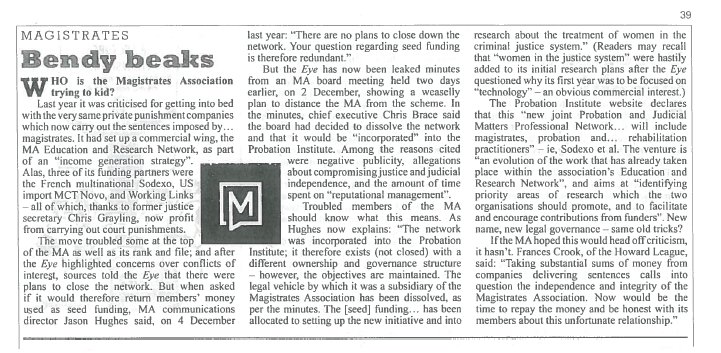
Finally, I see that Frances Crook of the Howard League appears to still be deeply suspicious of the Magistrates Association, their connections with some of the CRC owners and now their relationship with the PI. This from Private Eye:- 

Peter Wright, a former Probation CEO on twitter:-

"I wonder what Probation staff (NPS & CRC) think of the 'network' being "incorporated into the Probation Institute?"

Thursday, 14 April 2016

Flawed Business Models

As regular readers will know, occasionally I'm tempted to go a little 'off piste' and this story caught my eye as a perfect illustration of how many similarities there are between our own shambolic situation with that of other areas of privatisation of public services. Despite the political rhetoric, we are all sleep-walking into a stealthy privatised world, including the NHS, and created for us by 'dodgy Dave'. (Thanks for that moniker Denis Skinner.) From the Guardian:-

Ambulance privatisation descends into 'total shambles'

Hundreds of patients including people with cancer and kidney failure have missed important appointments for treatment because ambulances did not arrive to take them to hospital, after privatisation of NHS non-urgent transport services in Sussex this month.

Some elderly patients have had to wait more than five hours for ambulances and been stuck at hospital for long periods after their appointments because the transport service, now run by the private firm Coperforma, has proved so unreliable.

Patients, relatives, NHS bodies and local MPs have severely criticised the service’s performance, and a trade union representing ambulance crews said it was an “absolute shambles”. The NHS organisations that awarded the four-year, £63.5m contract have now launched an investigation.

A host of problems have arisen since Coperforma replaced the NHS’s South East Coast ambulance service (Secamb) as the provider of non-emergency patient transport services on 1 April. 


  • Cancer patients have missed oncology appointments after ambulances failed to turn up to collect them.
  • Patients with kidney failure have not been able to receive scheduled sessions of kidney dialysis for the same reason, with some missing two of their three treatments in a week.
  • So many patients have become stuck at the Royal Sussex County hospital in Brighton because their transport has not arrived that it has paid for taxis and other private vehicle suppliers to take them home.
  • Staff there have had to stay until midnight to ensure kidney patients arriving hours after their scheduled start time have received vital dialysis.
  • Coperforma crews have been left doing nothing, despite patients’ need to get to hospital, because poor mobile phone reception in parts of Sussex has meant they did not receive details of calls to attend via an app the firm saw as pivotal to the service’s smooth running.
  • Patients, relatives and NHS staff have faced waits of 45 minutes and more to get through to the firm’s phone lines, which have been unable to cope with demand.
  • Coperforma vehicles have turned up to collect patients who have already died.
--oo00oo--

So, who the hell are 'Coperforma?  This from their website:-
Coperforma specialises in running comprehensive patient and other hospital transport services in the UK. As this is our core business we have focused 100% of our time and energy on getting it right. We are now the leading provider of patient transport consulting and managed services to the NHS and currently arrange more than 1,500 patient journeys every working day – though we have the capacity to handle tens of thousands more.
Michael Clayton is the Managing Director. Prior to founding Coperforma, Michael Clayton was Group Services Director for AssetCo Plc, a £124m company responsible for UK public sector clients including the London Fire and Emergency Planning Authority, University Hospitals Leicester and the Metropolitan Police.
Who the hell are AssetCo? Why, they bought all the Fire Engines that used to be owned by the London Fire Brigade. This from the Telegraph in 2012:-

AssetCo sells UK fire engine fleet to equity firm for £2

The troubled Aim-listed company has off-loaded its UK business to private equity firm AB&A Investments. The move means that AssetCo, which was the subject of a shareholder revolt in 2011, has shed ties to both the Lincoln and London fire brigades amid mounting losses.

The company said the decision to exit its historic UK business was because the management team believed that operations were “based on a flawed business structure”, which was at the heart of why shareholders had lost so much money. The UK division made a loss of £16.5m on revenues of £33.5m for the audited 18-month period that ended Sep 30 2011.

Overall, the parent company, which also operates in the Middle East, had assets of £5.6m, with sales of £5.2m and profits of £470,000, for the six months to March 2012.

--oo00oo--

Back to Coperforma. This from their website FAQ's:-
SECAmb calculated it would cost them £30m pa to deliver the contractual services required by the CCG from 1 April 2016, how can Coperforma do it for £12m pa? 
As we do not know the basis of the assertion from SECamb who did not tender for the work, it would be wrong to comment in the first instance and in the second instance we would never comment on another company. Coperforma will ensure we provide the service we are contracted to deliver with a continual emphasis on continuous improvement and efficiency.
Will Coperforma recognise Unite, Unison and GMB for transferring employees? 
This is still being considered. Coperforma does not recognise any trade unions at present and will consider whether to recognise any or all the currently recognised trade unions. There is no legal obligation to recognise the trade unions after the transfer.
Do you feel assured that Coperforma and its sub-contractors will be able to deliver the required service, despite their lack of experience of PTS on this scale? 
Coperforma has been awarded the contract by the CCG as it has a proven track record in the delivery of high quality, consistent, flexible and Award winning patient transport services that meet the needs of patients and the NHS and improve the experience of patients, carers and NHS staff. Coperforma won the Health Service Journal (HSJ) Efficiency Award for Transport & Logistics in 2012 and the HSJ Value in Healthcare Awards for transport and logistics for their Efficiency Review Service in 2014. Coperforma was also independently recognised as providing the best performing patient transport service in the UK by Clock Tower Consulting in October 2015. 
Patient safety is the CCGs' number one priority, and we are assured that Coperforma will provide a safe and high quality service for patients. CoperformaÕs performance will be managed and monitored by the CCG in the same way as any other NHS contract; using a clear contract monitoring process and Key Performance Indicators (KPIs) covering performance, quality and safety. The CCGs will hold Coperforma to account for maintaining these standards across the entire Sussex PTS, and for every element of the service, whether this is delivered by Coperforma itself or one of its qualified sub-contractors.
--oo00oo--

Who awarded this contract? This from the Guardian again:-
Sussex Clinical Commissioning Groups, a group of seven GP-led CCGs in the county, which handed Coperforma the contract, said: “We recognise that the first few days of the new non-emergency Sussex patient transport service provided by Coperforma were not acceptable and apologise to all patients who were affected by this.

“A combination of initial technical hitches and problems with some of the patient data and journey information transferred from the previous service have created delays. These triggered a significant volume of calls to the call centres, which in turn created further issues; including some patients spending a regrettably long time waiting for transport.”
An explanation can be found on the nhsccc website:-
Clinical Commissioning Groups (CCGs) were created following the Health and Social CareAct in 2012, and replaced Primary Care Trusts on 1 April 2013. CCGs are clinically-led statutory NHS bodies responsible for the planning and commissioning of health care services for their local area.
Commissioning is about getting the best possible health outcomes for the local population, by assessing local needs, deciding priorities and strategies, and then buying services on behalf of the population from providers such as hospitals, clinics, community health bodies, etc. It is an ongoing process, and CCGs must constantly respond and adapt to changing local circumstances. CCGs are responsible for the health of their entire population, and are measured by how much they improve outcomes. CCGs are:
  • Membership bodies, with local GP practices as the members;
  • Led by an elected Governing Body made up of GPs, other clinicians including a nurse and a secondary care consultant, and lay members;
  • Responsible for about 60% of the NHS budget; or £60 billion per year;
  • Responsible for healthcare commissioning such as mental health services, urgent and emergency care, elective hospital services, and community care;
  • Independent, and accountable to the Secretary of State for Health through NHS England;
  • Responsible for the health of populations ranging from under 100,000 to 900,000, although the average population covered by a CCG is about a quarter of a million people.
No mention of community involvement or oversight and of course GP's are private contractors to the NHS and have been since the beginning. Being a private contractor, Coperforma are not subject of FOI requests. 

--oo00oo--

I'll end with the Guardian article:-

Coperforma refused to say how many patients had so far been caught up in the problems, though the CCGs said at least several hundred were involved. The firm, which claims to be “transforming hospital transport”, also works for the NHS in Hampshire and London.

Gary Palmer, an official with the GMB trade union, which represents many of the Coperforma personnel involved, said: “Regularly patients are missing their appointments at hospital because they are just not being collected or are so late in being collected that they miss them. We know that hundreds and hundreds of patients have been affected. But given that Coperforma are carrying out 300,000 journeys a year, or about 1,000 every weekday, it could easily be 2,000 or 3,000. It’s been and still is an absolute shambles – chaos.”

Michael Clayton, Coperforma’s chief executive, has apologised for the failings and blamed Secamb, the previous provider, for not supplying it with enough information in advance about the patients it would be transporting, and for asking thousands of patients to contact it on the first day of the change, overloading the company’s system.

In a statement, the company said: “Coperforma apologises unreservedly to all patients who have and are still experiencing delays in patient transport services. We investigate all out-of-line situations and report back to any patients or NHS staff affected.

“Our total focus is in improving the service we are able to provide in partnership with our transport providers and are working through core issues such as validation of patient data. We are currently in receipt of 19 formal complaints, three of which related to patients who had sadly passed away more than a year ago, information that should have been passed on to us prior to the start of our service.”

Wednesday, 13 April 2016

Court Report

Seen on Facebook:-


I keep saying that this NPS\CRC professional divide will happen and widen as time goes by, as new staff join both services, and it is! I am now hearing that CRC staff are feeling that they are being spoken down to by Prison and NOMS staff as well as Courts and some previous colleagues. Personally I wouldn't take this but then again I'm an old Probation gunslinger. I would not like to be joining either service in this era.

I think it will actually be easier for those joining now. At least they know what they're coming into. As a CRC PO who still sits in an office with NPS, I still struggle to accept all the tasks I miss from my preTR role, especially when listening to other staff still doing this work. It's difficult not to feel 'second class' sometimes, even though I know sifting was largely down to luck (or in my case, maternity leave). I for one will be glad when we do move out, I think it will actually improve morale.
Recently a Magistrate in our area admitted he did not realise that CRC staff were still the same staff from the 'old service', he thought we had all be drafted in by Interserve. They also refused to revoke an Order for good progress (which was entirely justified) because we were 'just doing it for targets'. Unfortunately we are getting a lot of resistance from the NPS court staff who are not helping the situation and are sometimes just rude to us.

I am NPS court staff and it's really hard because we don't mean to be resistant or rude and I always email the CRC OMs to tell them what's happened in my breach courts in case they need to show it to managers or something. The revoking for good progress is a really contentious issue because court services have had a directive that the applications aren't necessary (because when an Order is made, 12 months is just the maximum, but if they do their RAR and UPW in 8 months that isn't especially good progress, it's just them doing what they were ordered to do) and I can see the court services point of view. But then equally I understand that for OMs having lots of cases sat on your case load who have finished is hugely problematic and you want to get rid of them. Aside from that, CRC senior management is pushing OMs to put the applications in court, NPS court managers are telling us we have to accept them, sign them off and list them in the courts, then make the applications despite knowing the outcome will be a rejection (all applications are currently being rejected) and HMCTS managers are telling legal advisers to reject them.

I'm really sorry you feel that NPS staff are being rude and unhelpful (I hope it wasn't me) as we are also at the end of our tether, not that that's any excuse. I'm a Xxxxxxx Mags CDO and if you need any help with breaches or applications then you're more than welcome to phone me personally because nobody should be being rude to you, you're all following directions same as us and the courts. I try to remember that you are Xxxxx trust colleagues and friends and you're under lots of pressure and it isn't OMs fault that management can't get things right at all.

Thanks, I think you hit the nail right on the head, we are all just at the end of our tether!

It doesn't give people the right to be rude though, we really should all be saving that for higher management!!!

Awful to hear that people feel so low altho I'm very lucky n never have any problems with Xxxxxxxx or Xxxxxxx court staff - they're ace x

Thanks, if all applications were for orders a long way along, that would be one thing. However, a blanket ban on revocations is outrageous and needs to be challenged, if any senior management can be found willing to support their field colleagues. Not likely though.

I think in fairness, the difficulty in Xxxxxxxx and obviously I'm not sure about other areas but I'd be interested to find out, is that our breach courts (2 each week with around 25 available slots in each) currently are 50-60% applications. Almost all of those applications are to extend the 12 month period in which someone should complete UPW, which the courts are arguing doesn't need to happen, a CO doesn't die til the hours are done so why are we clogging up available slots with those apps when they were never seemed necessary pre split, and then applications for people who have simply done their requirements within the allotted time (ie they've done 100 hours UPW in 5 months) which also would never have come back to court pre split.

CRC are being told to make the applications, so it means time taken to write reports, NPS court staff like me are checking them and signing them and listing them and making the applications which takes a lot of time, and then court legal advisers have been told to refuse them because they just aren't necessary. It's causing really bad feeling because sometimes I think OMs think we aren't putting forward a good argument in court but in reality, once the legal adviser sees the information, court officers barely get to say anything from the report before they get refused. Senior management from the CRC have been to court and have spoken to managers there but as someone in the middle it's hard to figure out what was said because they're both still ploughing ahead with their own decisions leaving NPS piggy in the middle.

Partly it is an unfortunate side effect of conflicting targets and changes to practice on both sides. Also compounded by changes to court practice. Before we could adapt to the needs of the Court and Probation would adjust accordingly and all staff would be pulling together. I guess it is easier to grump at your old colleagues than get targets changed.

Myself and several CRC colleagues were transferred to the new TTG teams and now work from inside a Prison. A prison officer said he felt sorry for us as we had been demoted, asked why he thought that, apparently a NPS PO had told him that was the case and that NPS had retained the best staff. Also when we ring around re offenders that are now in Prison the number of times we are told we aren't qualified to deal with NPS offenders. The mind boggles tbh, we were one united front not long ago and had little say in where we ended up in the split yet lots seem to have forgotten when we all had each others backs. A very sad affair x

It is a very sad affair. It's also sad when our colleagues and good friends from CRC have been moved out of offices and told they cannot come in as they are not NPS. For gods sake it's all pathetic xx

If I heard any NPS staff make such outrageous comments about CRC colleagues  - as you well know - they'd get both barrels... I'm hoping the delightful prison officer was just meddling!

You would tell them in no uncertain manner I am sure, as would Xxxxxx, you are sadly in the minority it would seem these days. As for the Prison Officer he was stating what his wife had told him and was surprised and apologetic when he found out the truth. The amount of times we are spoken to in a not so pleasant manner is now becoming the norm. Several trainee PO's telling our qualified with many years under their belts that they don't know enough or aren't experienced enough to deal with their offenders. I have no idea where they are getting their superiority complex from xx

I'm truly astounded... & bloody furious. Staff - like yourself with a few yrs in - will have forgotten more than the trainees have learned - cheeky sods...do you mean his wife was NPS? She needs to be reminded mischievous gossip & meddling is wholly inappropriate from an alleged professional. Just sorry for the trouble from a few x

Yeah his wife is NPS PO, sad really. As for the trainees I still laugh when they want to revoke an SSO, er no you activate it, or tell me a licence has ended because our involvement has, er no licence has an expiry date we have no control over. But hey what do I know lol. I just laugh to myself tbh, it's the best way xx

My god it's disgraceful. Some of the best PO are with the CRC go no further than the staff at Xxxxxxx. And if I heard a trainee telling staff they don't know enough they would get my foot up their arse xxx

Sad times xx
I'm NPS and I wouldn't be too happy to hear people talk about CRC staff that way. We shouldn't be split like this in attitude, even though we're physically different now.