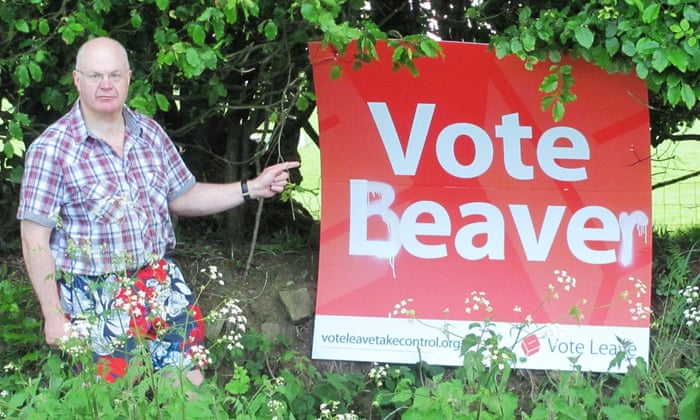
Saturday, 4 June 2016

Democracy Would Be A Good Thing


Following on from last weekend, I'd like to return to the subject of the Referendum and in particular the view I see being frequently voiced that a vote to exit the EU would leave us at the mercy of an increasingly right-wing Tory party. Readers will recall this was the opinion expressed by the former Channel 4 journalist Paul Mason, who used it as a reason for reluctantly voting to Remain, despite his extreme antagonism towards the EU as an utterly undemocratic and failed institution. 

I have to say I find this an extraordinarily negative position to take, coming as it does on top of all the other negative arguments that make up 'Project Fear', namely figures plucked from the air regarding economics and migration, security, the threat of war and probably plague if the Tories thought they could get away with it. The Nation has indeed been scared witless and clearly the Remain camp think this is the only way to win. This might well prove to be the case, but of course it just makes the chances of the Tory party reuniting on June 24th that much more unlikely. There will surely be carnage in the Conservative Party at the way David Cameron has conducted himself.

To put it bluntly, I not only find this argument depressing, I find it it flawed because even if there is some truth in it, shouldn't the answer be to make sure we don't elect a government that is leaning ever-more to the right, or at least that such a party is not able to command a majority in the House of Commons? The Tories only have a majority of 12 and they are in deep trouble over the election expense scandal uncovered by Channel 4 News. Their desperate attempts at thwarting a thorough investigation have been effectively torpedoed both by the High Court and now a District Judge in Kent. This from the Independent:-
  
Tory MP's attempt to block police investigation into election fraud allegations fails    

An attempt by a Conservative MP to block a police investigation into allegations his party broke election spending rules has failed. Kent Police last week applied for an extension of the 12-month statutory limit into investigations of potential breaches of the Representation of the People Act at the 2015 general election.

An investigation by Channel 4 News and the Daily Mail newspaper alleged that the Tories broke spending limits in key marginal seats at the last general election. Strict spending limits are put in place to ensure that parties with wealthy financial backers do not have an unfair advantage over others. It is alleged that in South Thanet, accommodation for bussed-in activists was not properly recorded locally and that this led to spending limits being broken by the Conservatives.

However Craig Mackinlay, the Tory MP for the constituency, and his election agent Nathan Gray, launched a legal bid to argue that no extension should be granted to the police for the investigation. Their legal team argued that no special circumstances are in effect and that no extension should therefore be given. If they had succeeded, the investigation into the marginal seat would have effectively been stopped in its tracks.

Folkestone Magistrates Court however granted Kent Police the extension on Wednesday afternoon. The force will now have an additional year to look into the allegations.

“There is a very significant public interest in the matter being fully investigated,” a district judge Justin Barron said, according to local newspaper Kent Messenger. “The consequences of a conviction would be of a local and national significance with the potential for election results being declared void.”

There are also questions about other 29 key constituencies in the General Election where Channel 4 alleges which some £38,000 of accommodation for visiting Tory activists was undeclared locally.

--oo00oo--


"Democracy is not a given; it must be fiercely protected."

I saw this statement on twitter recently and it got me quite angry. Firstly, what a toothless bloody waste of space the Electoral Commission has proved to be when it takes the dogged efforts of Channel 4 News to unearth the election expense scandal, not the official watchdog. What do they do with the damned election expense statements each year - just file them without checking anything? It strikes me they're not 'firecely protecting' our democracy - they had to have a bomb put under them to take any action at all.

Secondly, what exactly is the nature of this 'democracy' we supposedly have when it's based on 'first past the post'? A system that only works if we lived in a two-party state, which we don't, so very neatly always splits any opposition to the majority party, thus delivering the sham of a democratic decision when more people have voted against that majority party! How can anyone claim we live in a democracy when 4 million UKIP votes resulted in only 1 MP, for goodness sake?

But this very neatly takes us to the very worrying totalitarian argument I heard voiced the other day that the People can't be allowed a truly democratic option because they might vote the wrong way and elect a right-wing government. Until explained to me by a staunch life-long Labour Party supporter, I had completely forgotten how this extremely illiberal view still holds sway on the Left. I'm assuming that the same view is held by the Right who fear the People just might vote-in a socialist government? 

It suddenly occurs to me how radical I am when believing that democracy would be a good idea and that the present system is completely untenable, undemocratic and we must campaign for Electoral Reform at the earliest opportunity. And yes I know we had a Referendum on that a few years ago, but the Liberal Democrats f*cked it up by selecting a completely incomprehensible system.        

Of course the EU Referendum is completely democratic, which is why it's proving so unsettling to so many people and especially the Westminster elite. You'd think there'd be no scope for tactical voting, but bizarrely that's exactly what's happening! Boris Johnson suddenly becoming eurosceptic in order to try and become Tory leader and Jeremy Corbyn suddenly keen on staying in the EU, not just for party unity, but because he's shit-scared of what an unfettered Tory government might do. This from the Vox Political website:-         

Corbyn puts clear red water between him and Cameron, promising Labour would veto TTIP trade deal

This is why Jeremy Corbyn and David Cameron could never share a platform, even though they both want the UK to ‘Remain’ in the EU. Corbyn may be lukewarm on the idea of remaining – but he is absolutely sure that a Tory Brexit would result in a deregulatory free-for-all that would be “a disaster for the majority of people in Britain”. Here’s the best example of what he means:

Cameron wants to force through the Transatlantic Trade and Investment Partnership (TTIP) agreement as soon as possible, forcing down the quality of goods produced across America and Europe, and forcing down the wages and quality of life of the people who make them. The plan is already in considerable trouble, with many EU member states expressing concerns – and Jeremy Corbyn said today that the UK would refuse the deal altogether if Labour was in government.

--oo00oo--

So, I'm tempted to ask, why cast a vote in the Referendum on the basis of what the Tories might or might not do? Rather, why not vote according to whether it's felt the EU is a good thing or not and ensure the Tories don't get back into a position of unfettered power by campaigning for Electoral Reform? 

There's some interesting news about the last general election, again on the Vox Political website:-  

Labour shift leftwards had no effect on general election defeat – report

There is no evidence that Labour lost the general election because of a shift to the left, a new post-mortem into the bruising defeat has claimed. The report by the University of Oxford adds that while immigration, welfare, and Ed Miliband’s leadership all played a part in the unexpected defeat, it was more about perceived competence and rhetoric than policy. It also claims that the party’s anti-austerity message led to some gains in England.

The authors add that Labour’s “equivocal support” of benefit caps did not necessarily help the party win any more supporters at the election. “Perceptions of welfare matter,” they said. “But it is not the precise amount that is important. Rather people care about whether the amount given to people is enough to live on.”

Professor David Stuckler, of Oxford University’s Department of Sociology, told The Independent: “We analysed the election results using the British Election Survey data that can tell us what happened to Labour voters over time and, unlike focus groups, cover the entire country. What also sets apart our approach is that we can use these data to look at those who switch parties; the key swing voters.

“What we’ve learnt so far is that Labour didn’t lose because they were seen as having moved to the left. In fact, on a left-right spectrum, the public consistently see Labour as closer to their own views than the Conservative Party.”


--oo00oo--

Finally, there's this on the politics.co.uk website:-

Labour's only hope of survival is if Britain votes for Brexit

It is now generally accepted that if Leave win the referendum, David Cameron will have to resign. However, nobody has so far asked what a Leave result would do to Jeremy Corbyn. After today's speech backing Remain, I believe it's obvious that he would have to go too.

In truth Mr Corbyn has so far had a dismal referendum campaign. Not only has he disappointed many of his supporters by falling into line on the EU with the ruling elite whom they asked him to challenge, he has also disappointed his enemies by campaigning for the EU so tepidly. If he really wanted people to believe in his conversion to the EU after 40 years of denouncing it as a capitalist conspiracy he should have barnstormed the country to denounce the folly of his giddy youth.

If Corbyn is unable to prevent a Leave vote then there will be little or no reason for the Labour party to persist with him as Leader. So let's suppose Labour MPs right across the party spectrum pass a vote of no confidence in him and ask party members and supporters to choose another leader. Unlike last time, few MPs would repeat the mistake of nominating him, or any other hard left candidate. Labour MPs would surely only nominate leadership candidates they believe could win a general election.

Suddenly, the prospect of a new and electable Labour leader in 2020, leading a united party against a fractious and embittered post-Cameron Tory party looks compelling. It's certainly a better prospect for Labour than the Remain scenario: Corbyn leading a fractious and embittered party against Cameron’s anointed successor, in an election almost no one believes the party can win.

It is also very possible that a Remain vote will have highly unpopular consequences in a short time. Britain will have signed up to anything the EU wants to throw at it. The EU would then push ahead with its plans for a European army and more European taxation, more European control or influence over business law, social security and employment law. Although Britain is allowed to stay outside the Eurozone, it is forced to share the ever-increasing costs of propping it up. And of course we continue to face uncontrolled migration from the EU – accepting an indefinite supply of refugees from the euro, with no hope of change.

All or any of these would quickly make Cameron's government very unpopular. But Labour would not necessarily benefit considering Corbyn’s own Remain stance. Instead Ukip would be able to say "we told you so" and mop up droves of disenchanted Labour voters.

To make the Leave scenario even more attractive to Labour: the party could join a grand post-Cameron coalition to secure the best possible terms of Brexit. Frank Field, a leading Labour Leave advocate, has already called for this. If they really want to win the referendum then Tory Leave leaders should commit themselves to this because it could have a major impact on the campaign.

All of a sudden, Labour MPs would see a chance of gaining office in 2016 instead of waiting for 2025 at the earliest. This could concentrate minds powerfully. Even the most ardent Remainers might find it their patriotic duty to return to government to help negotiate Brexit and to deliver the country from a pure Right Wing free-market-crazed Tory government. The fear of such a government after a Leave vote is a major deterrent to Labour and left-of-centre voters – so the Leave campaign should remove it.

Labour ministers could serve in the grand coalition until the terms of Brexit are established. Labour would then leave and holds a serious, meaningful debate with the Tories until the 2020 election over Britain’s new independent future.

Of course the Scottish Nationalists would demand a new referendum on Scottish independence. But it's difficult to see how they would win it. Labour could easily say to the Scottish voters: “You know damn well that there is no oil bonanza to finance an independent Scotland, not now and not for years to come. So do you seriously believe that Scotland will have importance and influence in the EU – as much as it does in the United Kingdom? Do you really believe that the EU will transfer more resources to Scotland than it now gets from being in the UK? Independent Scotland would be a small applicant member of the EU. It will not get any special terms. It will have to sign up to anything the EU demands. It will have to use the euro, if not immediately, then before very long. Will the EU care if unemployment goes through the roof in Scotland – any more than it cares about mass unemployment in Greece, Italy, Spain or Portugal or anywhere else in the Eurozone? Are you really sure that so-called “independent” Scotland will thrive in the bureaucratic, undemocratic and economically foundering remains of the EU? Or would you prefer to share a democratic, outward-looking, independent future within the UK?”

This would offer a better hope of reconquering Labour votes in Scotland than limping along in the status quo.

Suddenly the prospects for Labour after Brexit look fairly rosy. The end of David Cameron, a new electable Labour leader, early return to government, a serious mission for the country and even a possible revival in Scotland. Like any other Leave scenario, this golden future for Labour is of course highly speculative. It would mean taking big risks and could end in tears. But that is surely better for Labour than accepting the certainty of further decline and defeat after a vote for Remain.

Friday, 3 June 2016

Latest From Napo 108

We have three offerings from Napo today, firstly a circular regarding E3, secondly a mailing from Pat Waterman and finally the latest blog from the General Secretary:-

E3 Napo Briefing - Initial advice in respect of Job Matching

Napo has today issued a briefing that gives initial advice to Napo members and manager members about how to approach the initial 'one to one' meetings between line managers and staff which form part of the five stage job matching process under E3.

These are not formal meetings and therefore the attendance of a Napo representative will not be required at this stage. Napo members may seek individual advice further on in the process including assistance with appeals if these become necessary.

Meanwhile, any questions arising from stage one of the matching process may be channelled through your Napo Branch who will consult with your Napo Link Officer.


--oo00oo--

E3 Initial advice to members and Napo manager members in respect of Job Matching

E3 Job matching process to start soon

At this week’s national NOMS/TU engagement meeting Napo relayed initial feedback from members which has been critical of the quality of some of the communications that NOMS have issued to staff and managers in advance of the intended implementation of E3.

Napo asked for sight of the questionnaire templates that line managers are being asked to use in order to conduct the first stage of the five part job matching process that was published on the NOMS Intranet on Tuesday.

Our understanding from senior NOMS management is that these meetings are taking place on the basis that they are fact finding discussion and are aimed at securing individual responses to the E3 plans and an early opportunity for staff to indicate a preference for a particular role if they wish to do so.

Therefore they do not constitute a formal meeting where you or your manager will be expected to agree anything and we expect that they will be conducted by using the pro-forma which is summarised below.

Napo will issue further advice on how members may seek assistance in the later stages of the job matching process and certainly at any appeal stage should this be required.

Again can we ask that members who still have unanswered questions channel these through their Napo branch to Chivalry Road.

E3 'One to One' checklist - the questions that we expect to be asked

Below are the checklist questions that NOMS is asking line managers to use during the E3 'one to one' discussions.

Staff 1:1 Meeting Pro-forma - E3 Implementation

Employee Name
Employee Number
Pay Band & Job Role:

Mapped to: …….
Current workplace location ‘office base’

Key notes from discussion re how impacted by E3, options, personal circumstances, development needs

Home Postcode (this should match the one recorded on Phoenix Oracle).
(If different please explain reason for difference and plan to correct)

Normal method of travelling to work and journey time taken.
Are there any compassionate grounds which you think we need to consider when redeploying you?
Are there any health / disability issues that you think should be considered or you would like to make us aware of?
Do you have any assistive technology installed at your current workplace? Give full details please.
Are there any health / disability issues that you think should be considered or you would like to make us aware of?
Do you have any assistive technology installed at your current workplace? Give full details please.
Are there any domestic or work life balance issues that you think we need to consider?
Any other comments/questions that have not been answered

Name of manager / date
Employee signature
(to confirm accuracy of note)

(To be completed by the person conducting the meeting. Please take a photocopy of this form and give a copy to the member of staff.)

Napo's overall position on E3

As has been pointed out in earlier communications, Napo has not agreed to the rationale behind the E3 programme, and still has major reservations about its overall viability. But in reaching an agreement about the process of implementation we have secured important pay protections and future role assurances for members.

Meanwhile, we are continuing our dialogue with NOMS about many aspects of the programme and the valuable feedback that Napo branches are sending in to us and will use this to press the employer on how they intend to make E3 operationally sustainable with minimum impact on staff.

More news on E3 will follow as soon as it becomes available, meanwhile Napo members are urged to attend their local branch AGM and provide feedback about E3 and other issues of concern to their elected representatives.

Yours sincerely

Ian Lawrence                Chris Winters & Yvonne Pattison
General Secretary         National Co-Chairs

--oo00oo--

TO: NAPO MEMBERS

Behold the future

In the past few months, like the rest of you, the Branch Officers and I have been struggling to keep up with the rapid pace of change in both the CRC and the NPS.

CRC issues:

We meet regularly once a month with Senior Management in the CRC at the Joint Negotiating and Consultative Committee (JNCC). It has become increasingly apparent to the trade union side that whereas the new Director is happy to “consult” over changes that she wishes to implement she has some difficulty with the concept of “negotiation”.

Fortunately the constitution of the CRC JNCC allows for outside intervention in the event of a dispute.

We were recently able to agree to an Agile Working Policy but only after much sustained “negotiation” during the course of which we pointed out that when the facility in the form of laptops was only available to senior management there did not seem to be any need for a specific policy.

It seemed to us that the principles underlying the original version of the policy were to enable staff to work as flexibly as possible when it suited the purposes of Senior Management. The final version of the policy contains some protection for members from over officious micro-management.

We are currently in the midst of negotiating a new Performance Improvement Policy (previously known as the Capability Policy). It was made clear to us that Senior Management thought that the old policy was too time consuming and not fit for purpose even when we pointed out that in our experience many of the delays were caused by management not implementing their own policy properly.

It is clear to us that there is a shift in emphasis from a Capability Policy which when properly implemented sought to enable staff to achieve the required standard of work and one that has as a clearly stated goal the ability to dismiss staff without any undue delay who are not “making the grade”.

We are trying to build in as many protections as we can for our members despite a seeming reluctance by Senior Management to engage in meaningful negotiation with us over some all important details. Our concerns are heightened by rumours of lists being circulated by Senior Management of staff they would like to see managed out of employment.

We will also be raising our concerns about the recently issued Directive 104 Building for Best and the extent to which it fails to consider the realities of working in the CRC. This was not discussed with the trade unions before it was issued and is indicative of the management style now prevalent in the CRC.

Assistive Technology Issues:

AT users in both the CRC and the NPS continue to experience problems that have yet to be resolved. In both organisations there seem to be systemic problems that fail to fully take into account their needs. Our best advice to those with disabilities that require assistive technology is to ensure that a current and comprehensive Reasonable Adjustment Action Plan (RAAP) is completed by their manager which makes allowances for any difficulties presented by a system which are beyond the control of the individual. We also advise you to record instances of IT problems on an A & I form.

NPS issues:

Members in the NPS will have received a message from Sara Robinson celebrating their second year as the National Probation Service. While she acknowledges that the move from Trust to NPS has been disruptive, and the challenges presented in the past two years could not have been overcome without the loyal support and hard work of her staff, I wish that I could share her optimism for the future.

We continue to remain in the dark about the full implications of the E3 Programme but are in regular dialogue with local NPS Senior Management as we seek to influence its implementation.

At last month’s meeting with Senior Management we presented a paper outlining the concerns that members have told us about their difficulties in following the guidance contained within the new Probation Instructions (PI 4/2016 – Determining Pre-Sentence Reports) to prepare Court Reports using the new Short Format Report Template.

Like with so many issues that we raise locally in the NPS this will be taken up at a national level We were advised by a member of the Senior Management Team that London seemed to be the only area reporting any difficulties. Can this really be the case???

National AGM and Conference:

Members will have received an email from our national office advising them that online registration for NAPO’s 2016 AGM and Conference is now open. Members of London Branch who regularly attend conference will no doubt be wondering why no details have yet been circulated about hotel accommodation in Cardiff.

A financial surplus, built up over several years, has enabled us previously to secure favourable advance group rates and make provisional hotel bookings for members. Decisions taken by our National Executive Committee meant that last year half of our surplus had to be returned to the national office and our branch grant was cut in half. As a consequence we have not been in a position this year to pay a deposit to secure a group booking.

I wrote in December last year, and again in April this year, to the National Treasurer outlining our financial position and asking for extra funds to enable us to book hotel accommodation for members. So far no assistance has been forthcoming.

As a consequence we may have to make some changes to the way we assist members to attend National AGM. We anticipate receiving a Conference Grant from national office in the region of £5,000. We can:

1. ask members to arrange their own accommodation and divide the grant up evenly.
2. we can arrange accommodation for a limited number of members (probably 35-40) and allocate on a first come first serve basis.
3. we can arrange hotel accommodation for a limited number of members as above and prioritise allocation to those who have never been before and the rest being on a first come first served basis.
4. we can arrange accommodation for a limited number of members as above and prioritise allocation to full members.

Under options 2,3 and 4 those who fail to secure a place at the branch hotel would have to find their own accommodation at their own expense.

No final decisions have yet been made. If you have a view please let us know by the end of the month by email to:

Branch AGM on Friday 22nd July:

Finally, both myself and David Masterson (Branch Vice Chair CRC) have completed the four year term of office allowed to us by the Branch Constitution and will be standing down at the Branch AGM on Friday 22nd July.

There will be vacancies for a part time chair in the NPS and in the CRC and also for a part time vice chair in the CRC.

In addition there are a number of other vacancies in the Branch such as Health & Safety Convenor (NPS), Women’s Staff Representative and Regional Organisers in both the NPS and the CRC. Facility Time for these posts is presently being re-negotiated.

Please consider standing for Branch Office.

Pat Waterman
Branch Chair


--oo00oo--

A late addition, the General Secretary's latest blog:-

Building belief that Napo's view matters

There is rarely a better time to construct a reflective blog posting than after having had the pleasure of addressing members at a branch general meeting. Wednesday evenings trip to Southampton and the members of Hampshire and Isle of Wight, was as good a benchmark as any of the current issues that are impacting on our members in the NPS and CRC's.

It also demonstrated yet again just how important our local activists are to the life of our union and professional association, as they go about the task of representing members interests with local employers, assisting individuals and keeping in touch with the centre so that Napo Officers and Officials are well informed when we get to engage in negotiations with senior NOMS or CRC management.

Yes, you can

The difficulty that all trade unions face, (with the exception of a few where the direct industrial route has prospered) is the innate belief among their membership that their union can't make a difference to the problems they face.

This breeds negativity which unscrupulous employers will seek to exploit. That's why even occasional attendance at a branch or workplace meeting can provide a safe environment for our members to talk safely about the difficulties they face and how they think the union can help. The many issues that I get to hear about on my travels can include excessive workloads, wider as well as personal health, safety and welfare considerations and, especially important this for Napo members, professional issues.

Other subjects that featured at Southampton, as they have at the countless members meetings I have attended over the years, were the effects of estate changes (actual or proposed) which members there, in common with those experienced by others elsewhere, have seen compounded by the impact of TR, and how these raise fears about client supervision and community safety.

This weeks straightforward message is that your views count; but to make them count even more, Napo needs you to direct your elected leaders and employees to pursue strategies that you think we should be pursuing. Better still, it might mean turning that anger you feel about your situation into positive energy.

The history of the movement shows that even the smallest local campaign can form the nucleus of something bigger, and that employers can be called to account once members start to build confidence by sharing problems and demanding union intervention at a senior level where necessary.

It could be about the impact of short format reports on sentences handed down by the local judiciary, being asked to transport clients in your cars, or interviewing them in the upstairs rooms of a pub (don't get me started) or it could be about appalling examples of ham fisted communications from above which are an insult to the members concerned. Some of the best examples of local campaigns that I have been involved in elsewhere have included lobbying to retain a workplace as opposed to it being closed, specially relevant with E3 and CRC restructuring ('keep probation local') and how members can pressure MP's and councillors to get onside.

Get active!

For these types of campaigning activity to be more effective, we need to rebuild and maintain confidence that all of the work we do for our members in the 24 employers that we cover makes a difference. That difference might sometimes be of major importance; but as is the case in life in general, successes often come in small steps.

That's another reason for our members to consider taking part in the local and national democratic structures of their union. So why not consider standing for branch or national office? Either role is often thankless, but its value to the life of Napo and the well being of our members (and our future) are inestimable.

That these structures have endured pretty much in the same form for the entirety of our history says much about the hard work and commitment of those who built them, as well as those who have served our members through them, for over 100 years. Its an impressive achievement that Napo and its members can rightly be proud of.

Time For Change?

Seen recently on Facebook, an interesting exchange:-

"But nothing will change"

I'm not so sure but please say 'told you so' if I am wrong. What I can tell you is that I have spoken informally to a fair number of people who might be in positions (including the odd CEO and front bench politician, senior political analyst etc) to change or indeed heavily influence the way things are currently organised. There appears to be a growing realisation in different quarters that Grayling's overly ambitious plans (that were not carefully prepared or considered) should have been formally curtailed and reined in to a greater extent than they were. 


When the proverbial hits the fan (a high profile offence etc) then that may well be the time that you will see some major policy reversals (dressed up as decisive action to address organisational weaknesses) and resulting organisational changes (a lot depends on the political climate and perceived damage to political careers and election prospects). This may result in short term chaos but we may find ourselves reunited a little more than at present. 

There are politicians looking for a smarter way out that saves face and doesn't cost too much and actually delivers something that might work for us too. There is also now some degree of genuine agreement across the political spectrum that hasn't previously existed (and this is important) and a narrative that probation was an ideologically driven privatisation too far - on a par with privatising the police or fire service (who need to be held responsible if matters go wrong) - and that there was no discernible benefit to be derived but quite a lot of risk created for virtually all MPs of the party responsible. 

There is also the faint but growing whiff of funny handshakes/back room dealing surrounding the bidding process which could well prove to be as devastating to corporate interests - in terms of reputational damage and lost contracts - as the Serco G4S Tagging Scandal which incidentally has not finished as the Serious Fraud Office are still investigating. Anyone with information that might assist would be failing in their duty as a citizen not to assist them. So I would not be overly pessimistic as TR may well become a significant battleground in a much larger war that could potentially lead to a change in government. Watch this space.

David A Raho

--oo00oo--

The probation service has been described as the oil on the wheels and the glue that keeps the whole criminal justice system together. When Grayling started dismantling and selling off the probation service like it was a used car in need of repair and could be run with little investment or maintenance on the cheap to any company who showed any interest, we knew that not only the probation service was doomed to inefficiency and chaos (let's remember it was previously a comparatively well run and award winning service) but the entire criminal justice system, including devastating impacts on the needs of victims and witnesses in trials. 

Politicians need to listen to the majority of experts and advisors (not just those who sit in right wing think tank bubbles) and realise that you can't run justice like a business. MPs were warned and many of them foolishly voted for Grayling's 'reforms' paving the way for this catastrophe, only to later realise their mistakes and appear not to have been part of the problem. Perhaps they should now be named and shamed for their stupidity and people like the Attorney General Jeremy Wright QC MP seriously questioned about their previous incompetence in office. 

In the wake of recent developments there should be a full independent inquiry into the state of the criminal justice system in England and Wales and I would certainly like to see Napo campaigning for one. [Just to clarify Yes I am calling on Napo to initiate a campaign for a full public inquiry. Yes I would be prepared to meet with politicians including Jeremy and Sadiq who are friends of Napo London Branch to help make this happen.]

David A Raho

--oo00oo--

All this reminds me that Napo members have the opportunity of considering who they might like to lead their union. I understand there will be a chance to voice a view in relation to the General Secretary next year.

BR 25/2016
IL/AV

23 May 2016
To: Branch Chairs, Vice-Chairs, Secretaries & Convenors
Family Court SEC
Cc: NEC Representatives

Dear Colleague,

Nominations for Napo Officers 2016-2018
Nominations for Black Representatives to NEC 2016-18
Nominations for Steering Committee 2017-2020

Officers
Nominations are sought for the following Officer posts to take effect from AGM in October 2016:- 

  • Chair 
  • Two Vice-Chair (Probation) 
All posts receive 50% facility time.

Black Representatives to the NEC
Nominations are also sought for two Black Representatives to the NEC, at least one of whom must be a woman. There is no facility time for these posts.

Steering Committee
This Committee is responsible for the ordering of business at General Meetings.
Nominations are invited for the 2 vacancies which occur this year - those elected will serve for three years, the posts taking effect from January 2017.

Branches/Family Court Section may make one nomination only.
There is no facility time for these posts.

Constitution

Section 9 of the Constitution contains the detail of the arrangements for Officers and is attached as Appendix 1 on page 4 of this paper.

At the 2014 SGM, the Constitution was amended with the effect of extending the terms of office for black representatives from one to two years and for no more than four years in succession. Section 16 contains the detail of these arrangements and is attached as Appendix 2 on page 5 of this paper.

Section 13d of the Constitution contains the details of the arrangements for Steering Committee and is attached as Appendix 3 on page 6 of this paper.

Nomination Process

Attached are the forms for completion by branches and candidates for election. The closing date for nominations is noon on Wednesday 29 June 2016. If an election is necessary there will be a postal ballot of all full members and the results of the election will be available by late August.

Candidates for election of Officers and NEC Black Representatives must be full members of the Association as per Clause 4a(i) and must be nominated by branches. Candidates for election for Steering Committee do not need to be full members.

Branch officers must complete and forward the attached form BR 25a/2016 so that the form is in the hands of the General Secretary (see procedural checklist and forms for details to email/fax/post) no later than noon on Wednesday 29 June 2016. Candidates must also forward their written consent by the same date using the attached form BR 25b/2016.

If a ballot is required we will circulate a statement to members from each candidate (see BR 25b/2016). Statements from candidates contain two sections:

Section (a) should cover career details, Napo/staff associations/other union roles and posts held. This section should provide only factual information.
Section (b) should include the aims and views that candidates wish to communicate, addressing Napo's objects as far as possible.
Please ensure that Section (b) is no more than 250 words in length. If this section exceeds 250 words it will be edited without consultation.

Candidates are required to sign a statement verifying the information they have provided (see BR 25b/2016) and should also complete and return Napo’s Monitoring Form, which is attached to BR 25b/2016.

Napo will be appointing Electoral Reform Services to act as Independent Scrutineer if an election is necessary.

Yours sincerely

IAN LAWRENCE
General Secretary

PROCEDURAL CHECKLIST

NOMINATING NATIONAL OFFICERS & STEERING COMMITTEE

Nominating Branches must:-

1. Ensure branch members are aware of date of branch meeting at which the vote will be taken on nominations.

2. If any nominations are endorsed, complete and return branch nomination form (BR 25a/2016 attached) by stated deadline.

3. Supply nominated candidates with a copy of both the candidate’s declaration/statement form (BR 25b/2016 attached) and Napo’s monitoring form (attached).

4. Ensure that candidates know of their responsibility for completing and returning the candidate’s forms and are aware of the deadline for return of these forms to Napo head office.

5. Forms can be posted to head office or faxed (020 7095 0963) or emailed to avalent@napo.org.uk.

NB: The branch is responsible for returning to Napo head office the branch endorsement of all nominations (BR 25a/2016) by the deadline, noon on Wednesday 29 June 2016.

Candidates seeking nomination must:-

1. Ensure branch officers know of your wish to stand in time for a vote to be taken on the nomination at a branch meeting prior to the nomination deadline.

2. If successful in the branch ballot, obtain from branch officers the candidate’s forms (BR 25b/2016) with monitoring form attached, and return the completed forms by the stated deadline.

3. Note that Section (a) of the election statement should be only a factual statement of career details giving roles and posts held in Napo/staff associations/other unions.

4. Note that Section (b) of the election statement must not exceed 250 words. If this section exceeds 250 words it will be edited without consultation.

5. Ensure that the branch has the personal details required to enable branch officers to complete the branch nomination form for Napo head office.

6. Forms can be posted to head office or faxed (020 7095 0963) or emailed to avalent@napo.org.uk.

NB: The candidate is responsible for returning to Napo head office the completed candidate’s declaration/statement form (BR 25b/2016) together with Napo’s monitoring form by the deadline, noon on Wednesday 29 June 2016.

Appendix 1

9. Officers

(a) The officers of the Association shall be full members of the Association as per Clause 4(a)(i) and consist of the Chair and five Vice-Chairs; of the five Vice-Chairs one will be an employee of Cafcass.

(b) The officers shall be elected by a secret ballot of full members, to be held at a convenient time prior to the AGM. They shall take office at the AGM following the election. They shall hold office until the AGM two years after they took office. They shall be eligible for re-election. The Chair and Vice-Chairs may serve a maximum of two terms (four years) successively in the same office.

(c) Candidates for election as an officer shall be nominated in writing by branches with the consent of the nominee. Nominations shall be delivered to the General Secretary not less than three calendar months before the date of the AGM.

(d) Should an officer for any reason cease to hold the office to which she or he has been elected before the period of office expires, the NEC shall be empowered to fill the vacancy by:

(i) the appointment of an acting Chair or Vice-Chair, or;

(ii) inviting nominations for the vacant post and conducting an election by secret ballot of all full members.

(e) An officer acting or elected in accordance with clause 9(d) shall serve until the completion of the term originally to be served by the officer they have replaced. The period of office shall be deemed to be a full term if it exceeds twelve months; any shorter period shall be disregarded for the purposes of clause 9(b).

(f) The Chair shall preside at General Meetings and NEC meetings at which she or he is present. The Chair shall have discretion to invite a Vice-Chair to preside.

(g) The officers shall have the power to act between meetings of the NEC in the interests of the Association. They shall report to the next meeting of the NEC on all such actions and decisions taken.

(h) The officers shall act as employers on behalf of the NEC. They shall report to the next NEC on all such actions and decisions taken.

(i) The officers shall act as trustees on behalf of the Association in accordance with Section 10. They shall report to the next NEC on all such actions and decisions taken.

Appendix 2 


16. National Executive Committee

(a) The National Executive Committee shall have responsibility for the furtherance of the objects of the Association. It shall carry out the policy of the Association as determined by General Meetings. It shall also have power to act on behalf of the Association and to formulate interim policy between General Meetings. It shall transact and oversee the general business of the Association and have responsibility for its financial affairs. It shall report to the next AGM upon all actions and decisions taken during the year.

(b) The NEC shall consist of the Chair, Vice-Chairs, a representative of each branch of the Association and two black members elected in accordance with clause 16(c).

(c) The Association will elect bi-annually by secret ballot two black representatives to the NEC. Where two people are elected at least one shall be a woman. Neither may hold the post for more than four years in succession. Candidates for election as a black representative to the NEC shall be nominated in writing by branches with the consent of the nominee. Nominations shall be delivered to the General Secretary not less than three calendar months before the date of the AGM.

(e) Except as otherwise provided for in this constitution every member of the NEC shall have power to vote at its meetings as follows: the Chair, Vice-Chairs, Treasurer and black representatives elected in accordance with clause 16(c) shall each have one vote; each branch representative shall have one vote for each 50 full members or part thereof in the branch.

NB: The NEC meets in London on five occasions throughout the year unless otherwise agreed.

Appendix 3

13. General Meetings – 13(d) Steering Committee

(d) There shall be a Steering Committee for General Meetings comprising six members who shall serve for three years, two retiring each year. Vacancies shall be filled annually from branch nominees elected by a secret ballot of full members. Retiring members of the committee shall be eligible for re-election. A maximum of three men may be elected to the committee. The NEC shall fill any casual vacancies by appointment for the remainder of that term. The General Secretary, the Chair and the immediate past Chair shall be members of the Steering Committee ex-officio. The immediate past Chair shall remain a member until the AGM following that at which she or he ceases to hold office.

Thursday, 2 June 2016

News Roundup 3

A collection of various news stories that we don't seem to have covered. First off, a reminder of what happens when you privatise a service to save money and payments are connected to performance - the figures get fiddled. G4S embarrassingly get caught out again with a high-profile police contract that was supposed to be emulated elsewhere. This from the Telegraph:- 

Five G4S police control room staff suspended amid 999 'test calls' investigation

Five police control room staff have been suspended amid claims they made hundreds of 999 calls at quiet times to massage performance figures. The workers, employed by G4S Public Services and working for Lincolnshire Police, are alleged to have made the test calls to ensure faster call answering times were recorded. Emergency call handlers for the force are required to answer 92 per cent of calls within 10 seconds, or G4S Public Services is fined.

It is claimed that hundreds of illegitimate test calls were made in October, November and December 2015. Figures show 724 were carried out across those three months. In November and December the handlers failed to meet targets, dipping to 90.19 per cent in November and 89.24 per cent in December on genuine calls.

The alleged bogus test calls would have put the figures at around 93 per cent. Managing director for G4S Public Services John Shaw said: 

"We have suspended five employees today and have taken swift action to begin our investigation process. While I can reassure the public that at no stage did the actions of these people put the public or police colleagues at risk, I am nevertheless dismayed that this group of staff sought to influence important performance measurements. We continue to work closely with the force and share any data and other information required. There is no place for anyone in our organisation who behaves in this way and their actions undermine the commitment and the good work of their colleagues."
The Crown Prosecution Service has said that there is no evidence of criminal activity at this stage, instead the inquiry is an internal disciplinary matter. Lincolnshire Police said:
 "Today five force control room staff have been suspended from duty and have been informed they are under investigation. We will be seeking further information by interviewing these members of staff jointly with G4S. These matters will now be dealt with through staff disciplinary procedures and the investigation must take its course. We have established that at no stage has there been any risk to the safety of members of the public. Arrangements have been made for the smooth operation of the force control room to continue and the service to the public will not be adversely affected."
Watchdog the Independent Police Complaints Commission supervised the investigation. The Lincolnshire Police 999 call centre is the only one managed by G4S. Shadow police minister Jack Dromey said: 
"These are incredibly serious allegations. Emergency response times can mean the difference between life and death, and yet call data appears to have been purposely manipulated for financial gain. Time and time again G4S have let down the public. This case raises serious questions about the ability of G4S to play a role in vital and sensitive public contracts."
--oo00oo--

Here's a report in the Guardian about another government attempt at saving money by privatising back office functions:-

Privatisation at Whitehall offices has cost £4m more than it saved

A Cabinet Office plan to privatise some of Whitehall’s office functions and save up to £500m a year has instead cost £4m and is beset with problems, an official spending watchdog has found. Ministers transferred back-office functions – human resources, payroll and accounts – to the private sector two-and-a-half years ago in a plan which was supposed to “radically improve efficiency across departments”.

At the time, the cabinet minister Francis Maude said: “There is absolutely no need for departments and arm’s-length bodies to have their own back-office functions, and duplicate efforts, when they can be delivered more efficiently by sharing services and expertise. Plus it will save the taxpayer half a billion pounds a year.”

The National Audit Office has examined the “shared services” initiative and found that instead of saving at least £128m a year, it has saved £90m – £4m less than it has cost. In a highly critical report, auditors said that delays in its roll-out mean that costs will continue to rise. Confidence in the entire project “is now low”, the NAO found, with further costs also incurred in drawing up contingency measures and dealing with the fact delays have already rendered some elements of the new system out of date. Auditors said the Cabinet Office “did not act in a timely and effective manner” because it “did not see this as its role” and had “only recently taken a more active approach to dealing with the issues that have been raised”.

Tom Watson, Labour’s deputy leader, said: “It’s shocking the Cabinet Office has failed to convince other government departments to adopt a programme that was supposed to deliver significant savings for the taxpayer. This comes after repeated warning from the NAO and the public accounts committee that the programme was not working. It’s yet another failure from the prime minister’s own department.”

Public and Commercial Services union general secretary Mark Serwotka said: “This is an all-too-familiar story of Tory ministers cutting and privatising, only to find they have wasted money and damaged services. We opposed the privatisation of shared services because we did not believe it would deliver the savings that were promised and we have been proved right.”

The 2013 civil service reform plan introduced by Maude saw the creation of two shared services centres which would handle human resources, payroll and accounts for up to 14 departments and their arm’s-length bodies. The Cabinet Office signed contracts with two private sector companies – Arvato UK and Steria – to operate the centres. Auditors found there were initial weaknesses in the programme and these were exacerbated by the Cabinet Office’s failure to take control of the project. While recent governance and leadership changes had been welcomed by departments and the two private suppliers involved, the NAO warned that “previous efforts in this area have not produced results”.  It said: “The government has repeatedly failed to learn the lessons from its experiences of shared services.” However, it acknowledged that blame lay also with contractors Steria and Arvato UK.

The scale of the problems was underlined when an arm of the Department for Business Innovation and Skills pulled out of its contract arguing it was “no longer viable”. The Cabinet Office has redrawn its projections and is now hoping for major savings. A departmental spokesman said: “As the report states, the Independent Shared Service Centres have already saved £90m, and are forecast to make a further £504m in savings for the government and police by 2023/24. “The report recognises that the Cabinet Office is addressing the challenges involved in managing digital transformation, but we accept that we need to go further, and we will.”


--oo00oo--

An interesting blog post from the Guerilla website citing another government flagship project that's in trouble:-

Fraud and error in Universal Credit

Universal Credit was supposed, through some process I can’t claim to understand, to reduce fraud and error in the benefit system. According to the Business Case, there were supposed to be reduced overpayments worth £14 billion over twelve years, or £1.16 billion per annum. I commented in 2012, and again last December, that I found this claim implausible: Universal Credit doesn’t do anything about most of the circumstances which lead to fraud and error, but it does add layers of complexity to make confusion and mistakes more likely. Now we have the first figures from the DWP on fraud and error in Universal Credit. Universal Credit was overpaid by 7.3%, compared to 5.0% of JSA (the nearest comparable benefit) and 5.2% of Housing Benefit. It was underpaid by 2.6%, while JSA was underpaid by 0.8%. The system makes more mistakes in both directions. The DWP points to the complexity of managing some claims – but that, of course, is the point.

The DWP summary pleads that the difference between UC and JSA is ‘not statistically significant”, and that in any case UC and JSA are not directly equivalent. True enough, but Universal Credit was supposed to cut fraud and error by somewhere between a third and a half of all overpayments. If UC was supposed to save a third but is actually costing nearly fifty per cent more, the level of fraud and error is running at more than double what was expected. If it was supposed to save half, it’s three times what it should be.

--oo00oo--

It doesn't look like the MoJ plans for modernising the courts is going to plan as the woman in charge jumps ship after barely a year in post. This from the Guardian:-

UK courts chief to leave job after just over a year

Natalie Ceeney, the widely praised senior civil servant leading the £700m programme to modernise the courts, is to leave after little more than a year in the job. Her surprise departure from the £180,000-a-year post of chief executive of HM Courts and Tribunal Service (HMCTS) was announced by the Ministry of Justice on Thursday.

Ceeney, 44, who served as president of Cambridge University students’ union, had previously worked as an NHS manager before moving rapidly through senior positions at the National Archives, the British Library, the Financial Ombudsman Service and HSBC in the City. She joined HMCTS in January last year as the service was belatedly attempting to join the digital age. Most trials are still conducted using massive bundles of paper. Underused courthouses are being sold off and mechanisms developed for online justice.

Ceeney, who was appointed a CBE in 2010, was hailed as bringing fresh energy to working methods she herself had described as “more than archaic”. There was no explanation of why she was going or what she intended to do next. In a statement issued through the MoJ, Ceeney said: 

“I joined HM Courts and Tribunals Service caring deeply about what we’re here to do, and determined to lead transformation so that we can continue to support the delivery of justice in a digital age. After years of underinvestment, we’ve now secured over £1bn of investment, and have well and truly started to deliver. Seeing the first stages of delivery over the last year, through the digitalisation of the criminal courts infrastructure, has, I hope, given everyone confidence that this transformation is real and deliverable.There is a strong team in place to lead the work, and it now feels like an appropriate time to hand the baton on to a successor to see through the transformation over the next four to five years. I’m also very grateful for the unwavering support of the senior judiciary and the HMCTS board, as well as the full support that ministers and senior departmental colleagues have shown to what HMCTS is trying to achieve during my time in post.”
Responding to her exit, the justice secretary, Michael Gove, and the lord chief justice, Lord Thomas of Cwmgiedd, said in a joint statement: “Supported by a strong senior management team, Natalie has laid the foundation for the HMCTS reform programme. We are both grateful to her for her hard work and dedication over the last year in setting in motion this programme which is of utmost importance to the government and the judiciary.” Ceeney will leave HMCTS at the end of the month. She will be replaced by Kevin Sadler who will be interim chief executive.

--oo00oo--

I guess this report might have something to do with her swift departure. From the BBC website:-

Criminal justice system near breaking point, MPs warn

The criminal justice system in England and Wales is failing victims and witnesses and is close to "breaking point", MPs have warned. The Public Accounts Committee (PAC) said the system was "bedevilled by long-standing poor performance, including delays and inefficiencies". The committee's report also warned that cutbacks were affecting the ability of courts to deliver justice.

The PAC found that about two-thirds of trials in crown courts were delayed or did not go ahead at all. There was a backlog of 51,830 cases awaiting a hearing as of September last year, it said, with an average 134-day wait between cases leaving magistrates' courts and the start of crown court proceedings. This was up from a 99-day average wait two years ago. Only 55% of witnesses said they would be willing to be witnesses again, with 20% being made to wait four hours or more to give evidence in court.

PAC chairwoman Meg Hillier said: "These are damning statistics. An effective criminal justice system is a cornerstone of civil society but ours is at risk. Too little thought has been given to the consequences of cutbacks with the result that the system's ability to deliver justice, together with its credibility in the eyes of the public, is under threat."


--oo00oo--

Finally, this seems too ridiculous to be true, but as it's in the Guardian, it must be:-

CPS reminds police that dead cannot be prosecuted over past child abuse

The director of public prosecutions has been forced to remind chief constables that the dead cannot be charged with criminal offences, amid a huge increase in investigations into historical child abuse. Alison Saunders issued the directive to senior officers, reminding them that only those who are living can be tried in a criminal court, because CPS lawyers are being bombarded with files of evidence from police seeking charging decisions on deceased suspects.

“Since deceased persons cannot be prosecuted, the Crown Prosecution Service will not make a charging decision in respect of a suspect who is deceased,” the guidance states. “This applies in all cases where the suspect is deceased, including cases in which the police made a referral to the CPS for a charging decision prior to the suspect’s death. The CPS will also not make hypothetical charging decisions.”

Prosecutors and police are dealing with a huge increase in investigations into past child abuse as the revelations about Jimmy Savile continue to resonate. They anticipate an even greater rise in the number of cases of non-recent abuse as the Goddard inquiry into institutional child abuse begins its public hearings into alleged institutional cover-ups in Lambeth, the Catholic church, the Church of England and Westminster.

Operation Hydrant, the overarching national investigation into sexual abuse in the past, which is liaising with the Goddard inquiry, has more than 2,228 investigations on its database, including investigations into 302 people of public prominence. The suspects involved include 286 dead people.

The warning shot to senior officers comes amid controversy over a decision by Wiltshire police to continue their investigation into the late prime minister Sir Edward Heath, after the claim which sparked the investigation was found to be groundless.

On Thursday, the Independent Police Complaints Commission (IPCC) said it had found no evidence to support an allegation by a retired police officer that a brothel madam’s criminal trial was dropped in the 1990s when she threatened to out Heath as a paedophile. It was alleged that the case against Myra “Ling Ling” Forde was shelved when she threatened to tell the press she had been “supplying young boys” to Heath.

However, both prosecution and defence told the IPCC that the trial had been dropped because of a lack of witnesses. Forde was later convicted and did not make any claims about Heath. The IPCC – in its report on Thursday – said former officers had rejected their colleague’s claim and the officer had made no note of what he said had taken place. But Mike Veale, chief constable of Wiltshire police, said the investigation into claims the former PM had abused boys would continue. So far the inquiry has cost £367,965.

Keith Vaz, the chair of the home affairs select committee, has raised concerns over the rationale for the investigation, its cost and an “inappropriate” decision for a senior police officer to stand outside the late prime minister’s house to make an appeal for witnesses. Vaz said: “We will be monitoring this issue closely.”


In the new advice, the CPS says that police may want to continue an investigation if a suspect dies during their inquiry, because living suspects could be linked to the dead person. But she said her lawyers would not be giving hypothetical advice on whether the deceased could have been charged.

“When advising on or making charging decisions in such cases, the CPS may need to consider the role played by the deceased suspect, and the evidence against that suspect,” the guidance said. “Although the CPS may undertake a detailed review of the evidence against the deceased in these circumstances, it will not make a charging decision in respect of the deceased.”

Wednesday, 1 June 2016

Charities and TR

Another day and another report into just what a roaring success Chris Grayling's TR programme has been for the probation service. I would add that the 'Third Sector' were warned by this blog about getting involved and they only have themselves to blame:-

The voluntary sector’s role in Transforming Rehabilitation

TrackTR is a partnership project between Clinks, the National Council for Voluntary Organisations (NCVO) and the University of Birmingham’s Third Sector Research Centre (TSRC). 

The intention of trackTR is to build a picture of the voluntary sector’s experiences of the changes to probation services brought about under the Transforming Rehabilitation reforms, and the impact this has had on their services, their organisations and the people they support. 

Transforming Rehabilitation 

The Transforming Rehabilitation reforms have replaced the previous 35 Probation Trusts with a single National Probation Service (NPS), responsible for the management of high risk offenders; and 21 Community Rehabilitation Companies (CRCs) responsible for the management of low to medium risk offenders across England and Wales. The CRCs also have a new responsibility for supervising shortsentence prisoners (those sentenced to less than 12 months in prison) after release. From 1 February 2015 the successful bidders in the competition for CRCs began to deliver probation services.

The role of the voluntary sector has been central to the government’s promotion of the Transforming Rehabilitation reforms. When the new CRC providers were announced, the Ministry of Justice stated that “75% of the 300 subcontractors named in the successful bids are voluntary sector or mutual organisations.”

The aims of trackTR 

Successful transformation: trackTR aims to support the improvement of services for people under probation supervision by advocating for the successful transformation of probation. We believe this includes the effective involvement of the voluntary sector in co-producing services and delivering better outcomes.

Understanding the role of the voluntary sector: trackTR aims to understand what role the voluntary sector is undertaking to support the rehabilitation and resettlement of people under new and emerging probation services. 

Supporting the wider ecosystem of services: the voluntary sector supports a vast range of people in need across England and Wales, all of which adds to the wider ecosystem of services. TrackTR aims to gather the experience of the widest possible range of voluntary sector organisations working alongside probation services. 

Increasing transparency: trackTR aims to increase transparency, to shed light on which services are being commissioned from the voluntary sector by CRCs or the NPS. 

Informing procurement practice: the changes to probation under the Transforming Rehabilitation reforms represent one of the biggest public procurement exercises in recent times. TrackTR aims to support improvements in future procurement trends by listening to the views of the voluntary sector organisations involved. 

Methodology 

This report has been informed by three main sources of information. 
  • A survey was designed to capture the views of voluntary sector organisations delivering rehabilitation and resettlement services in the Criminal Justice System (CJS). It was open between August and October of 2015 and gathered the views of 151 organisations. 
  • A consultation event on the findings of the trackTR survey was held in late January 2016, with over 90 voluntary sector organisations. 
  • In depth conversations with providers and policy makers were held over the course of the project to better understand the data we were receiving from the voluntary sector, and to place it in the context of wider changes to policy and practice.
Executive Summary

Key findings


The information received has informed key findings, representing the views of those voluntary sector organisations that replied to the survey and those who attended the consultation event. 

1 / The pace of change is slow 

The changes to probation services are taking a long time to embed. Given the scale of reform this is not entirely surprising but the pace of change has still been much slower than many anticipated. The pace of change is reported to be curbing investment in the voluntary sector’s rehabilitation and resettlement services, meaning that services run by the voluntary sector are vulnerable and at a greater risk of closure. 

2 / Voluntary sector involvement in supply chains appears low 

Only one quarter of the 151 voluntary sector organisations that responded to our survey reported being funded through a CRC’s supply chain. Of those that are being funded through supply chains 70% are delivering pre-existing services. The organisations that are in supply chains are disproportionately larger voluntary sector organisations, with very few smaller or medium sized organisations represented. However, the contribution of voluntary sector organisations outside of supply chains to rehabilitation and resettlement outcomes is likely to be considerable. Half of the voluntary organisations outside of supply chains still receive and accept referrals from CRCs and the NPS, whilst over twothirds receive referrals directly from prisons. 

3 / Poor communication between probation services and the voluntary sector is damaging local relationships 

The voluntary sector’s relationships with CRCs and the NPS are being negatively affected by a lack of communication about future strategy, service development and commissioning opportunities. Furthermore, many voluntary organisations report a mixture of confusion and uncertainty about what services are being offered through CRCs and the NPS.

4 / The NPS needs to work more effectively with the voluntary sector 

Only one organisation responding to our survey had a direct funding relationship with the NPS. We heard that the ‘rate card’ system limits strategic engagement with the voluntary sector, restricts collaboration as well as innovation and increases the cost of services to the NPS. 

5 / The quality of services and the outcomes for service users require close monitoring

Many voluntary sector organisations could not say whether Transforming Rehabilitation had negatively or positively impacted on services or service users, possibly because the transition to new approaches is still underway. However, those that had seen a change were more likely to report it as negative rather than positive; in some cases considerably more likely. Additionally, only 3 in 10 organisations funded by CRCs to deliver services in supply chains felt that the level of funding they received allowed them to deliver a high quality service. 

6 / There is anxiety about current and future funding and sustainability 

Although most voluntary sector organisations report that their funding for rehabilitation and resettlement services hasn’t been impacted as of yet, there is growing anxiety about the sustainability of services and evidence that the situation needs monitoring. Those outside of CRC supply chains are more likely to believe that their services are unsustainable. Organisations also report that a lack of information about what services the CRCs and NPS are commissioning and/or delivering is putting other funding sources at risk, particularly local authorities and independent charitable funders.

Tuesday, 31 May 2016

Guest Blog 55 - Follow Up

Following on from the recent guest blog by former HMCI Andrew Bridges, he has indicated a willingness to respond and debate further, which I have to say is heartening, particularly as facilitating intelligent discussion has been one of my aims for the blog all along. At my suggestion, I have republished some of the comments to the original blog post, followed by Andrew's responses (in italics):-

“I would have preferred to have read your views on practice and the current state of probation. Maybe something around the impact of the ongoing deprofessionalisation of probation officers, the NPS strategy to replace us with non-qualified staff and tick-box style Pre Sentence Reports, or the CRC strategy of heavily cutting staff and replacing interview rooms with American diner style areas.”

Naturally I’m sorry that my topic was not what some people wanted to read. Whereas I can understand that some may want this site to be solely about repeatedly letting off steam about the current very unsatisfactory arrangements (which indeed they are), I thought I’d offer a change from that – sorry to disappoint.

“Instead we get the badly worded “Three Purposes of Probation” and an analysis of what I recall as a pointless discussion about enforcement. Considering TR and the recent Offender Management Act which did away with “supervision” as we knew it, maybe it would have been better to analyse whether Grayling and Gove have a view on what the purposes of probation should be, or maybe the probation chief officers that helped them do away with probation as we knew it. I've always found the HMIP idealistic about what probation practice should be, and blinkered to the climate it is practiced in. In reality, the “Three Purposes of Probation” have been displaced by TR and made impossible by the CRC drive for profits and the NPS drive for “more for less”. Now the distorted purpose and culture that is forced into us is 1. Meet targets, 2. Meet targets, 3. JFDI. 

And as I said in detail in Guest Blog 52, the probation qualification and professionalism has been slowly eroded over the past two decades. This is what the HMIP, the Probation Institute and every other “expert” seems to ignore! As I heard an academic recently say, the only solution for a probation service and “Work” (to truly rehabilitate) is to sever the MoJ control, to reduce the extent of privatisation and to absorb the probation officer training back into social work.”


I note that the Inspectorate’s focus on quality of Probation practice is described here as “idealistic” – I would certainly loudly and proudly claim this description, provided that it’s recognised that in our idealism we specifically did not look for perfection; instead we looked for “Sufficiency” in the quality of practice, according to the needs and circumstances of the case. Whereas I’m very keen indeed on developing and accrediting skills in this job I take a very different view about the traditional “probation qualification” which perpetuates a rigid two-tier workforce and a barrier to many of the talented newcomers who want to build their career in-service. However, the point this contributor makes about targets is important – see more below.

“Thank you, a good read. However, as a practitioner I have never had any problem with negotiating and compromise, but I think what is becoming a huge problem is the lack of autonomy to make such decisions v dictates which feed the monster – target driven practice. I never really had any problem when targets promoted best practice, for worker and client, but the worst kind of target are those rigidly organisational or financially driven targets! CRCs are in a no win situation, they have no time to develop the kind of relationship that promotes compliance, and I must say it, positive change in people! Their employers demand staff provide a facade of respectability and integrity but their financial targets trump those of integrity and decency, so colleagues are in a no win situation and our clients confused and disenfranchised by the targets!”


Targets is a whole new topic, and one of critical importance. Some of the current ones are shockingly bad – some of us knew in the 1980s that ‘successful completions’ was no measure of anything. The contributors are right to criticise them strongly. The knack is to set the right ones and also to promote the right ethos in how the organisation works towards them – surprise, surprise I have written about this. Anyone who worked with me in Berkshire 1998-2001 will tell you what they think about whether or not we got our targets broadly right, by ensuring that they were congruent with good quality Probation practice. Because the ‘right’ targets are difficult to measure, policymakers keep repeating the mistake of instead employing proxy [“near enough”] target measures which are easier to monitor but in their effect on practice are worse than useless, as many of the contributors have rightly reported.

“An interesting blog but very simplistic and doesn't account for what's happening in probation now. Those of us who endeavour to work to the aims are severely disabled by managerialism. Also can't see the purpose of the prescriptive monthly minimum especially after 2 years supervision it can become counter productive.”


‘Simple’, yes, but not easy, though I believe it can still be done. And even as a main-grade PO with 60+ cases and 12 SIRs a month in the 1970s I never thought it acceptable to require a meeting at less than once a month – it was a Court Order after all.

“The 'imperfections' of TR cannot be compared to previous imperfections. There is a massive difference between something being fundamentally wrong and the negatives arising out of that, and something being fundamentally cohesive with problems that can be worked on and resolved. TR creates its own unique problems which push good practice way down the list of priorities. My priorities now are carrying out insane IT tasks in order to meet targets, while the associated work which requires those old fashioned notions of thought, reflection and decision making gets neglected resulting in a rushed, poor quality outcome. OMs don't seem to have the discretion to manage their own cases resulting in Judges asking 'what does the case manager really think?' It's a pile of shit and it's those who go around telling us it isn't that seem really creepy, as if they don't have their own minds any more.”


*******

“He does not like TR. Yet in considering the previous arrangement, the bar is immediately raised and we are told they were not 'perfect'. Fairer to say that the previous arrangements were better, open to improvements and preferable to TR. But when not 'taking sides' you need a clever verbal formula to stay above the fray. If not taking sides you have to try and be even-handed.”


********

"There is a saying I can't recall verbatim but is along the lines of 'for evil to triumph, it does not require evil men to do evil but good men to do nothing'. The trouble with 'reasoned' debates on Probation practice under TR, they fail to acknowledge the starting point which is that the profit motive in Probation and other forms of social services undermines the very purpose of those services and compromises all forms of intervention in favour of profit or the minimisation of loss.
"

It is suggested here that my position is a case of doing nothing and therefore allowing “evil to triumph” as per Edmund Burke (the very conservative politician who may not have envisaged a British Government enacting its own policy as the kind of evil he was thinking of.) For my part I had said my piece in September 2014 about TR being the “most gung-ho reorganisation that Probation has ever faced”, and was quoted accordingly on Radio Five. For the record, I think that while the various previous arrangements were “not perfect either” they were certainly less bad, though also nothing to idealise.

But our constitutionally elected Government had made a decision and was acting on it accordingly – you have to be a heroic optimist to believe that this will fundamentally change in the next five years. So I focus on the ‘making it work anyway’ option. Since we have started bandying quotes: “The pessimist complains about the wind; the optimist expects it to change; the realist adjusts the sails” (William Arthur Ward). It is a matter for each of us to choose whether thereafter we want to talk about how to make practice work well (despite the changes) or just carry on repeatedly letting off steam. 

*******

“I agree: the underlying motive is fundamental and if making a profit is fundamental then this will be secondary to the public good. And if they cannot make a profit, they will, as we have have seen in other sectors, walk away.” 


*******
“This is the problem. 'Independence' is available to the highest bidder. Whilst the Government colludes with this and, equally important, whilst the media do not hold these Ministers to account, the practice of self funded advocacy will remain a corrupt force with which the money-makers will be able to justify their actions. If one remains opposed to the fundamental profit motive in CJ, the debate rages on. If we accept that 'we are where we are', the debate is ended and the dysfunction remains in place.”


*******
“A few years ago Mr Grayling said something like, 'I don't want to pay for a service, I want to pay for results.' On the surface this sounds appealing. The author of this guest blog on his website / advertisement states something akin to, 'I don't care who does the job as long as they do it well.' Again this risks sounding appealing. For example, do you really care who comes out to the fire if your house is ablaze as long as they arrive in the prescribed time and put the fire out. You might say, 'well I suppose not.'”

One of the curious oddities of probation work is that while by necessity it requires an ability to see more than one side of a story, and arguably believe both in rational analysis and that everyone has a ‘better side’ to their nature, many of its practitioners appear to claim exclusive moral high grounds to their own beliefs while assuming a morally corrupt position in anyone who disagrees with them. If you are making the assumption that my independence is simply venal you might also consider the possibility that that assumption is wrong.

I see no intrinsic virtue in having a binary view of the world, and have always found that “Truth has more than one face”. My personal emotional attachment to public service is very strong, but I’ve seen enough over the years to know that it doesn’t have a monopoly on virtue, and could sometimes benefit from learning from the private sector. There is an irony that whereas I spent much of the 1990s repeatedly arguing with policymakers that there was no inherent benefit in purchasing a service from an external contractor (if you can do it yourself better and cheaper), I’ve also had to spend much of the time since then arguing that there’s nothing inherently wicked about it either – you have to judge it by how it is worked in practice. I found over the last 15 years that poor commissioning, especially poor targetsetting, (together with shockingly poor IT) was much the greater cause of problems than the profit motive itself. The “risk” of assessing a service by how well it is actually delivered, rather than simply by ‘who delivers it’, could perhaps be seen not as a “risk” but as a benefit, a sign of a rational approach rather than one driven solely by ideology.


I would like to believe that many of the contributors who let off steam on this website have nevertheless managed to do some good quality work – despite all the difficulties. Would anyone want to write a short description of a recent piece of Probation practice that you’re particularly pleased with, perhaps achieved against all the odds?....

Andrew Bridges

Monday, 30 May 2016

Guest Blog 57

After a near 15 years in the Probation Service, my decision to resign
from the Community Rehabilitation Company (CRC) that I work for as a
Probation Officer may on the surface have appeared sudden but it has
been in the making for several years. However, more recently the sense
that I need to move on has increased.

The Transforming Rehabilitation (TR) revolution that fractured the
Probation Services has played a significant part in my thinking but not
the whole of it. Like many, given the seat I was sat in at the time, I
had no option but to accept that I would be working in the CRC. I
consoled myself with the idea that being in either the National
Probation Service (NPS) or CRC was at the outset of their creations an
unknown and with my own preference for working with people maybe the
CRC might turn out to be the better of the two for me. It has to be
said that before TR that the ability to work with people was
diminishing, ever increasing workloads then lessening our ability to
actually work with people but ever more so now. I remember nearly two
years ago expressing to a line manager that it was bizarre to see
everybody sat feverishly feeding their computers for the vast part of
their working day and that it made no sense. Ever more I have found
that the volume of work I am expected to complete and the fear of
falling behind or missing a target has driven more frenzied work such
that I can tell my work and life balance is plainly out of kilter and
my well – being as a result adversely effected.

I have enjoyed a good career overall, moving to different assignments
every 3 – 4 years. I now find that my career possibilities are vastly
diminished. The thought of being desk bound in front of a computer
trying to manage in excess of 70 cases (a nod here to my Probation
Service Officer (PSO) colleagues some of whom have over 90 cases) is
not only unappealing but a cause of considerable angst for me. I am
grateful to my managers for doing their best to work as sensitively as
they can with us given this back drop. For me personally though I
cannot condone the idea that I might aspire to be a manager in this
untenable climate, I am witnessing too many of my colleagues including
managers being made to suffer with the burden that is placed upon them
and often in a way from which they are struggling to recover; yet this
seems to be my only option for a variation in my career where once they
were plentiful. I once heard a senior type education figure say of
teachers, in a TV interview, we need people who can do volume and get
results with the inference that if they could not deliver then maybe
they should think about moving on. I fear that given the circumstances
that I am presented with that is exactly what I have decided to do
which is a shame because I have developed a great skill set for working
with people around their learning and with that change.

TR has undoubtedly been a huge cataclysm for the Probation Services and
the people who work within it. On a daily basis I can see examples of
the way my work is being made more difficult in a way that often
beggars belief. What of the people we are primarily tasked to work
with? Indeed, what of them, with such high case numbers for individual
workers and a very limited scope to get to know those cases in a
meaningful way, what of them?

I think that sets out the main reasons why have decided to leave. It
is not a very positive valediction, times have been better I would say
and it is these times, experiences and the people I have met that makes
leaving harder. In all the frenzy and further changes to come, I hope
you all remember to be kind to yourselves and each other.

Anon