Wednesday, 27 November 2013

End Game

Yesterday was the beginning of the committee stage of the Offender Rehabilitation Bill in the House of Commons. I watched a bit of it, mostly the minister, Jeremy Wright MP, going into some detail as to why it was perfectly acceptable to use the 2007 Labour probation legislation to force through the TR omnishambles. 

When I see this guy performing, I don't see a conviction politician, so much as a smart barrister perfectly at home going through the professional motions of doing as good a job as possible, having been given a hopeless brief. We have Carter and Blair to thank for this bloody mess and as he was speaking I found myself thinking, 'yes lets concede that he's right - the last lot did intend privatising probation, but didn't for whatever reason, however it's still a shit idea!'       

I don't know if it's true or not, but according to some tweets I saw, apart from the minister, not one member of the government side was prepared to speak in favour of this incredibly bad and dangerous plan. Meanwhile, the service is beginning to fall apart with numerous highly experienced officers deciding that NPS is going to be a 'poisoned chalice' rather than a 'safe haven' and are urgently planning exit strategies. 

The following e-mails graphically illustrate the situation as unfolding in London, but I'm sure the same is being played out elsewhere. Clearly both were written in haste as there are at least two omissions and errors, but I feel it's important to reproduce both as I received them:-   


David Masterson (Branch Vice Chair) and I attended a meeting this afternoon which we thought would be just another one of our regular meetings with local senior management to exchange information. We were going to these meetings because, as I have said previously: “I  believe we can best represent the interests of members if we are as well informed as possible”. 

Imagine our surprise when we were presented with an agenda entitled “Formal Consultation Meeting with Trade Unions” and a thick file containing a set of documents that had NOT been agreed at the National Negotiating Committee. 

Having established that this was JUST an Information Sharing Meeting we were given a presentation by Tim Pagan as to how exactly LPT planned to implement the instructions of the MOJ. 

LPT’s plans to “split” the staff relies almost entirely on a scoring of your caseload on 11th November 2013. It was claimed that this was a “fair and transparent process”. Administrative staff will “follow” the work but if this does not achieve the desired split they will be allocated on a "random" basis. 

In a discussion about the appropriateness and reliability of the scoring system Tim Pagan rather gave the game away by referring to those whose scores might lead to them being allocated to a CRC as being “punished” and there was us thinking that the CRC's would offer scope for “challenging and innovative work”. 

The Probation Board is meeting on Friday 29th November to consider these plans. I have no hope that they will against them and the full horror of what this process will entail will be shared with staff after the meeting. 

In my opinion LPT is going to “roll over” and  implement Chris Grayling’s dastardly plans. Assignment letters and expression of interest letters will go out next week. 

You all need to think about this very seriously. On the basis of the information we were given today many of you will be transferring to a CRC which will eventually be put out to tender. 

REMEMBER WHAT HAPPENED TO YOUR FORMER COLLEAGUES WHO WENT TO WORK FOR SERCO. 

Please read the recent mailings from our national office. They explain in detail what is happening and why NAPO has taken the position it has. 

I urge you all to continue with the industrial action and only work your hours. 
WHY NOT? WHAT HAVE YOU GOT TO LOSE? 

I also urge you all to follow the advice and lodge an individual grievance when you get your letter. I am here to help you. 

TAKE A STAND.............DON’T KEEP CALM...........GET ANGRY 

PAT WATERMAN
BRANCH CHAIR

The following is an e-mail from Heather Munro, CEO of London Probation Trust:-

Transforming Rehabilitation Update – Next Steps 

As outlined in the update issued yesterday, LPT has received formal notification from the Ministry of Justice (MoJ) that the national negotiations between the employers and trade unions have concluded without reaching a final agreement on the Transforming Rehabilitation staff transfer and protections scheme. 

We met with the trade unions this afternoon to continue our local discussions and we shared a range of information and have discussed LPT's approach.   

We are aware that other Trust's have issued documents about the Transforming Rehabilitation process, after listening to our unions we have decided to await a decision from the LPT Board before taking any further action. 
  
The LPT Board will be meeting on Friday 29 November to consider its position and subject to advice from the national employers (the Probation Association) with will publish more information for all staff on Friday afternoon.

Tuesday, 26 November 2013

Latest from Napo HQ

The following e-mail to all Napo members received at 16:15:-


It is clear from the Ietter issued by the Noms Chief Executive to Trusts dated 22ndNovember that the department has decided to commence a disinformation campaign against the Probation Unions. This document sets out some of the information about why the Unions (Napo/Unison and GMB with a reserved position) registered a failure to agree at last week’s shambolic meeting of the National Negotiating Council (NNC) and that notwithstanding their disgraceful behaviour, why we are not prepared to accept the ultimatums that the MoJ sought to introduce into the negotiations on the 20thNovember.

The Negotiations

The documents that were intended for consideration at the NNC were:

1.   National Agreement on Staff Transfer and Protections (referred to as the “Framework Document”
2.  Guidance on the Handling of Measures (referred to as Appendix A- measures are the aspects of any changes to jobs post transfer)
3.  Staff Assignment Process- the “Staff Split” (referred to as Appendix B with deals with Automatic Assignment, Annex A deals with Expressions of Interest and Annex B deals with the Appeals process).
4.   Enhanced Voluntary Redundancy (referred to as Appendix C)
The NNC is comprised of the Probation Employers with Napo and Unison forming the Trade Union Side.  At Chief Officer Grade level the arrangements comprise employers and GMB SCOOP and Napo. Both sides have acted in good faith over these last few months to try and secure provisions for continuous service, security of the Local Government Pension Scheme and its members, proper training provision, equality assessments and protection for staff beyond the point of share sale. Amongst others, they are the reasons for engaging in negotiations.  However, our view is that the MoJ, by issuing contradictory advice directly to Trusts and now seeking to enforce a dangerous timetable, has overshadowed this process by cutting corners and acting in bad faith.  We have been put under pressure to make decisions on previously unseen documents within a matter of hours and, as you would expect, we have been robust in resisting this.

Why we have registered a failure to agree

Put simply, the intervention by the Ministry of Justice meant that the NNC did not even get to a position of being able to discuss the above substantive documentation. It has also caused massive confusion and puts our members at an unacceptable risk.  Many Trusts are now doing the MoJ’s bidding by either directing or asking members to choose to work in the NPS or CRC when we have barely any information about what that will mean.
This list of missing information is by no means exhaustive:

The Staff Split for those not automatically assigned will be on the basis of whatever job you were doing on 11th November 2013.  That appears to be it and, as you would expect, this is an untenable position for various reasons, but largely because of the various roles/workloads that staff across Trusts currently undertake. We believe that the narrow window of 11th November fails to reflect this. There are also issues around staff who are currently away from work. In addition there is no guidance on offer about how this process might work, no projections of the likely numbers of staff and no equality assessment.

There are no Job Descriptions for the new organisations.  Either these do not exist or we are being denied access to them.  In being asked to choose which organisation you want to work for, members will have no idea what they are being asked to sign up to. This is unacceptable.

No Information as to locations of work.  This is vital information for members to be in possession of, but there is no word from the MoJ. We have been told that once the staff split is made there will be little immediate change but this is only up to the point of share sale in October 2014.  There has been no information forthcoming about what will happen after this.

Local Government Pension Scheme.  There is no guarantee that you will retain membership of this if you move from the NPS to a CRC or elsewhere in the Civil Service after the initial transfer. Nor is it clear whether existing staff not currently in the LGPS will be eligible to join it after transfer. The bidders for CRC contracts are not compelled to offer the LGPS to new starters which means the fund risks losing members over time and creates a two tier workforce.

There is no permanent provision for continuity of service. Continuity of service covers the benefits you have built up over time, for example: redundancy, sickness, leave, maternity and it has implications for your pension.  You might not have noticed this because if you have previously changed roles/Trusts within Probation these benefits automatically carry over. Continuity of service will only exist in the first transfer, and will cease to exist if you thereafter apply for a position in a different CRC or move between a CRC and the NPS, thus limiting member’s opportunity for career development and relocation.

Roles in the National Probation Service.  You will on transfer to the NPS become a Civil Servant, and be subject to the Official Secrets Act, Business Appointment Rules, Civil Service Code and Civil Service Management Code.  Despite repeated requests, we have not been provided with any information about the implications of this for staff. We do know that it has the potential to be restrictive in your work and your personal life, as such we believe that members should be in possession of all the facts before being assigned or opting in to the NPS.

Roles in the CRC. We have no idea who the employer will be, what their values are or what the job descriptions will look like. This could have serious implications for future pay, day to day work and professional practice standards.

Local JNC disputes and submission of individual grievances - what should members and branches do next?

Trust Chiefs and Chairs have been erroneously informed by the MoJ that no facility exists to receive notification of local JNC disputes. This must be challenged, and we are issuing separate advice about this as part of this information pack.

Trusts have also been directed by the Secretary of State to start the process of splitting the staff (staff assignment).  They may send out instructions by e-mail or letter. They will be couched in language that makes the split feel inevitable. Or, they might even be suggesting that this situation is good for you because it gives clarity and security to staff.  If you receive a letter, don’t simply respond in haste. Consider the implications for yourself and send in a well-constructed grievance outlining your concerns along with your response. Comprehensive guidance is attached on how to do this.

Tom Rendon                       Ian Lawrence
National Chair                    General Secretary

26th November 2013

Some Observations 19

It seems incredible, but there hasn't been space for a general selection of bits and pieces since September. As I can't think of anything new to say about the TR omnishambles, here's a few other things that caught my eye.

First off, it's great to see that the Archbishop of Canterbury looks like he's pulled off quite a political coup in getting George Osborne to change his mind and join the clerics 'war on Wonga'. This piece from the Independent neatly sums up the political reality that 'having God on your side' still counts for something and that the Lib Dems are willing to flex their muscle on some matters as the 2015 election gets ever closer:-

George Osborne caved in to demands to impose a cap on payday lending costs to avert a parliamentary rebellion backed by the Archbishop of Canterbury, The Independent has learnt.
Senior Conservatives were understood to have been fearful of losing a vote on a hostile amendment in the House of Lords on Tuesday which would have set a charge cap of 10 per cent on all short-term loans and placed other restrictions on their sale.
The amendment to the Banking Reform Bill was being backed by Archbishop Justin Welby, who was considering speaking out in its favour in the Lords debate. His support was expected to garner the backing of a significant number of cross-bench peers and inflict an embarrassing defeat of the Government.
“As you know, a large proportion of cross-benchers tend to be swayed by the idea of having God on their side,” said one Lords source in favour of the amendment.
“George Osborne’s change of heart had more to do with politics than conviction.”
Archbishop Welby has previously spoken out against payday lenders such as Wonga. Liberal Democrat ministers, who have been lobbying the Treasury for a cap on payday loans for more than a year, were furious that Mr Osborne sought to grab the political credit by announcing a move he had strongly opposed until the weekend.
Vince Cable, the Liberal Democrat Business Secretary, and Jo Swinson, the Liberal Democrat minister responsible for consumer affairs, have both argued for a cap in private but had been forced to toe the Treasury line that such a ceiling would not tackle the problem. 
A Liberal Democrat  source said: “The Liberal Democrats have been pushing for tougher action on payday lenders for over a year. At every step of the way this has been met with strong resistance from Conservatives in the Treasury.
“It seems the Tories read the runes on this one and realised that increasingly the evidence and political tide were against them. Their change of heart is welcome but none of this would have happened without the Liberal Democrats in government.” Liberal Democrats believe the Chancellor was swayed by the prospect of a government defeat in the Lords at the hands of a powerful coalition of Labour, Liberal Democrat, cross-bench peers and bishops.

But as always in life, it seems to be one foot forward and two back as this piece in the Guardian from Saturday about Iain Duncan Smith's plans for the sick makes clear:-

The fate of nearly 550,000 benefit claimants currently deemed unfit for work due to serious illnesses such as cancer is in the balance as it emerged that Iain Duncan Smith is planning a radical change to the welfare system.
The work and pensions secretary is pushing to scrap a part of the benefits system that helps sufferers of recent illnesses get back into employment. These individuals are covered by the term "work-related activity group" (WRAG) and are regarded as being capable of work in the future. They are paid benefits if they carry out training or practice interviews.
However, the Observer understands that Duncan Smith wants to disband the group, currently made up of 546,770 people. Such a move would require an overhaul of the whole benefits system, say experts.
The cabinet minister is said to be concerned that only half of claimants in WRAG are coming off benefit within three years, and that hundreds of millions of pounds are being tied up in administration of the benefit, including the work capability assessments and appeals process.
Anne Begg MP, the Labour chairwoman of the cross-party work and pensions select committee, said her fear was that the vulnerable people in that group would be forced to join the dole queue and be at the mercy of the sanction system, under which claimants lose benefits if they do not attend enough interviews or make efforts to find a job.
This brilliant comment piece, also from the Guardian, draws uncomfortable parallels with the old and despised poor law:-
The singular achievement of the present government has been to appoint new "overseers of the poor", although it forbears from using this term, which dates from the 16th century, when it designated the administrators and distributors of poor relief. These new overseers are far from the flinty and ignorant officials of the Old Poor Law, as they are – and not for the first time – commercial entities. The poor have often been eyed covetously by enterprise, as they represent an apparently enduring group in society, out of whom it must surely be possible, in one way or another, to make a profit, the word David Cameron has cleansed of any association with dirt – perhaps prematurely, as G4S and Serco demonstrated, when they charged the government for tagging prisoners who did not exist. Atos, tasked with the judgment of whether individuals are fit for employment, finds itself the inheritor of an ancient debate about the "deserving" and "undeserving".

The fate of the most vulnerable people – in children's homes, prisons, care homes, rehabilitation centres, adult care homes and probation services – is increasingly in the hands of private providers, just as they were when known as orphans, felons, the lame and the halt, and the aged, who have "borne the heat and burthen of the day". This government's use of private companies – a policy re-affirmed last week by Francis Maude – in the improvement of pauper management has its antecedents in the 18th century, when the task was widely outsourced to willing providers. Far from being an "innovative" approach to poverty, the present government looks deep into a punitive past for inspiration.
I thought this blog post on the Custody Record was interesting and gives yet more evidence concerning the realities of so-called 'outsourcing', in this case in relation to the prisoner escort service:-
The contracts are squeezed to their limit to be as lean as possible and maximise profits to shareholders. As a consequence it regularly falls over. Why? You can’t manage an unpredictable service with a predictable and rigid contract that has no resilience built into it.
Early morning arrests on warrant that need national movements don’t get picked up. We are told they have no capacity and the arrested person stays in custody over 24hrs longer than they need to. Some national movements are so slow to happen that by the time they arrive at the destination the court has closed. Local police cells then have to lodge people overnight.
A fast case processed in custody in the morning and remanded by 10am falls to the contractor to collect. They advise they have no capacity and cannot move the person. Who moves the prisoner? We do.
The contract holder gets the overnight notification and hasn’t read it properly. One of the detainees is female. They have organised their fleet and sent a van based on men only. They cannot move males and females together and there is no capacity for another van. Who moves the prisoner? We do.
They are our partners. They share the risk. Well maybe on paper they do but when push come to shove the police pick up the pieces of their failings. Worse is that our one way partners seem to actually RELY on this. A ‘don’t worry the police will sort it out’ attitude pervades. Any commitment to fulfil contractual obligations is dismissed in favour of the problem being ours. Whilst partners help one another with the unexpected, this happens almost every single day. We are a bolt on to ensure their contract works. Partners?
The contract is inefficient and not fit for purpose yet the Government is committed to this partnership with private sectors and wants to save money.
Finally, it's been some time since I mentioned that good value blog by the champion of the voluntary sector, self-effacing Sir Stephen Bubb:-
And let me leave you with a charming photo of me, William Shawcross and my Chair Lesley-Anne. Caption competition anyone?

Go on - you know you want to.

Monday, 25 November 2013

Omnishambles Update 29

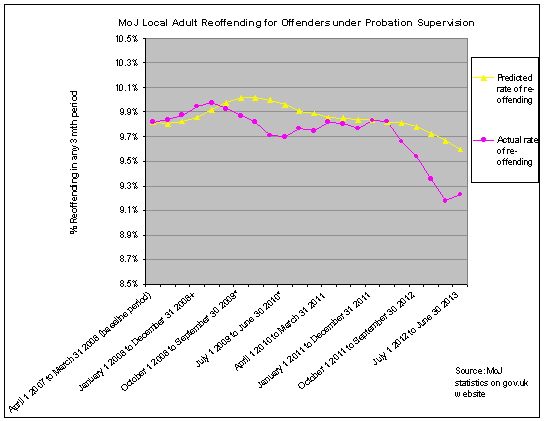
The graph that says it all. The official MoJ proof that probation works with the fifth consecutive quarter confirming a fall in reoffending by people being supervised:-   

Embedded image permalink

So why is the government pressing ahead with destroying a well-performing public service? We could do the same for the under 12 month custody people if Chris Grayling saw sense and abandoned his ideological stance. It puts into perspective the nonsense Max Chambers was trying to get away with on last Thursday's BBC2 Newsnight programme:-

Embedded image permalink

Professor Paul Senior tweeted what he thought about it:-

not sure this is anything to boast about. After all the spin was so off the mark you were clearly badly briefed.

Talking of twitter, I really do feel it's worth highlighting the nonsense that Debbie Ryan, Director of Rehabilitation and Resettlement at G4S has recently been engaging in:-

I would welcome all & any probation individuals to come to # and see for themselves. Anyone interested??

Rr u passionate about probation? Want to help shape the G4S TR bid? I am ready to listen. Would u attend workshop to share ur frontline exp?

If you want to contribute to the G4S bid. Have your say and shape the future - let me know. Happy to host workshops if enough interest???

Have had soo many tweets- emotions are high. Have your say and let's work together to make sure your experience shapes the future??

if you get involved you will know exactly what the future holds. You will help shape it. Take control.

Get involved in The G4S TR bid. Help shape the model? Want to hear what you would do??

I agree the spec is key. But you want us to be transparent so help us to make this work?

I know you are entrenched in this. It affects your lives and careers. My offer is for you to b able to input!

on going experience is essential to manage risk and protect the public. Tell us what YOU think works.

I see that the MoJ has had a stab at trying to explain exactly how partnership working is expected to work in the brave new TR omnishambles world of CRC's and NPS. I think it can best be described as a dog's breakfast, but according to the MoJ, it all sounds so simple and straightforward:-

This paper will be used to inform the partnership working aspect of the exit strategy for 
Probation Trusts and enable them to plan the allocation of resources for the statutory 
partnerships between the NPS and the CRC in the contract package area during the 
transition period once the Probation Trusts split in April 2014. This will enable providers to take on an existing structure within the CRCs and ensure providers are fully aware of their statutory partnerships and responsibilities once they begin to deliver services. However, once providers begin to deliver services we will seek to ensure that contracts retain the flexibility for these arrangements to be negotiated to reflect local variations and wider changes including new legislation, where appropriate. 

This paper does not cover non-statutory partnerships. Trusts are currently mapping these 
partnerships to ensure all local relationships are captured and to test the resourcing of 
partnership activity as part of their transition planning. We committed in the strategy 
document that providers will need to demonstrate how they will sustain and develop IOM 
arrangements in their area – a key non statutory partnership. 

We are also considering how best to ensure that all providers engage appropriately in 
those non-statutory partnership working arrangements which make an important contribution to protecting the public. 

Margaret Hodge, Chair of the Commons Public Accounts Committee, continues to prove what good value she is, and as reported here in the Independent, is due to try and lift the veil of secrecy that currently exists in relation to government contracts:-

A powerful group of MPs will today push top civil servants to agree to sweeping reforms of how Government contracts are run by the private sector following headline-grabbing failures at outsourcing giants Serco and G4S.

Margaret Hodge, the Public Accounts Committee chairman, wants to see financial information on all Government contracts revealed under what is known as open-book accounting. The former Labour minister is also demanding that the National Audit Office has full access to contractual and financial details of these deals, which should also be subject to greater public disclosure under Freedom of Information laws.

Stephen Kelly and Bill Crothers, chief operating officer and chief procurement officer respectively at the Cabinet Office, will face the committee this afternoon. They will be joined by top Ministry of Defence civil servants who could be questioned over the semi-privatisation of the £14bn agency that buys tanks and guns. Plans to let the private sector run such a sensitive part of national security have been widely criticised and the process is on the brink of collapse after one of only two bidders pulled out last week.


Meanwhile, as reported in yesterday's Sunday Times, Margaret hasn't given up on that other infamous example of the MoJ's contract drafting skills:-  

THE National Audit Office has launched a new investigation into the Ministry of Justice’s outsourcing of court interpreters, after nearly 10,000 complaints about the service offered by contractor Capita.


Judges, barristers and court officials are arguing that the £90m contract is delaying proceedings by up to a year and jeopardising cases, including those involving rape and murder.
They claim interpreters often do not turn up or are so bad they are dismissed. As a result, Margaret Hodge, chairwoman of the public accounts committee (PAC), has started an investigation.

Sunday, 24 November 2013

Reasons to be Positive

Trying to keep tabs on this whole TR omnishambles is not easy and with some Trusts moving to issue re-assignment letters, understandably there is widespread confusion, dismay and anger. But despite all the waves of negativity, I feel the need to try and take stock of the positive and a good place to start is provided by Mike Guilfoyle and his summary following a successful meeting in London on Friday. This is the gist of what he posted recently on here:-

Greater London Napo branch meeting yesterday...packed room heard from John McDonell MP, Frances Crook & Napo Assistant General Secretary... clearly much anxiety, anger & uncertainty around pending changes ..but some salient points...

1. Parliamentary Human Rights Committee critical report on Offender Rehabilitation Bill this week..

2. Grayling's forced decision NOT to pursue privatisation of 3 prisons..

3. Labour front bench mounting opposition to TR - JM stated that until 3 days before debate on TR - Labour had planned to abstain...change of approach based on efficacy & evidence of TR Omnishambles.. Now commitment to 'restore' Probation Service!

4. Newsnight programme - Serco/LPT (not barnstorming!) but indicative of changing popular mood on outsourcing.. Public Accounts Committee - excoriate-change-gentle grilling of privateers..

5. Egregious examples of faltering outsourcing -Serco-Health- Atos -Disability...that appear to have seen shift of gear & mobilised resistance..


6. Liberal Democrats - approaches made to NC & dawning appreciation that TR could begin to unravel & associated risk to credibility pre-election..


7. Sheer ineptitude of MoJ - at this weeks 'negotiations' Napo reps requested for the ** time - copy of Equality Impact Assessment - document provided at the 11 th hr.. when queried - MoJ reps - 'Grayling had this all the time, but did not want to share it!!!!

8. Unison (belatedly) have mustered support for mandate for industrial action...

9. 2 Amendments to Offender Rehabilitation Bill - Harry Fletcher using his 'contacts' to max impact...

10. 'Soft' Tory MP's - behind the scenes some mounting concerns at the implications on marginals .. if public safety fears become more pronounced..

11. Frances Crook invited colleagues to send any scraps of info' to her that she might put out to media that would have quick fire impact..

12. If timetable can be stalled due to proposed actions & comments from tob table - already speculation that slippage to 'end of year '- 2014 from MoJ sources.. with electoral buffer - 6 months - TR could be scuppered??


Appreciate that his is brief snapshot from one meeting & having spent 20 yrs as a PO - I do not underestimate that toil & moil ' that colleagues are having to endure....

But the resounding message from MP's + Gen Sec... ' The Fight is still very much 'on' ..


Hope this assists..


In relation to point 1, a reader has kindly pointed us in the direction of the report and identified some particularly salient points:-

12. We are not satisfied with the information and analysis provided by the Government in relation to the Bill's compatibility with other relevant international standards. We expect human rights memoranda to go beyond assertions that all relevant human rights obligations have been considered, and we repeat our general recommendation that Departments should provide detailed information explaining why the Government is satisfied about the compatibility of a Bill with relevant international human rights obligations, not just the ECHR, in their human rights memoranda.

We are disappointed that we did not receive any additional information from the Department about the Government's amendment on women offenders, and we repeat our general recommendation that Departments should, as good practice, provide us with a supplementary human rights memorandum on Government amendments with significant human rights implications, such as the Government amendment relating to women offenders in this Bill.

18. On 19 November 2012, the Prime Minister announced that the Government is "calling time on equality impact assessments".[41] However, the legal duty established in Brown remains for public authorities to demonstrate that they have had 'due regard' to their equality obligations.

30. The provision of information by the Government in relation to its consideration of the Bill's impact on protected groups has been piecemeal, lacking in detail, and has been produced only in response to parliamentary scrutiny of the Bill and the Transforming Rehabilitation reforms. This does not provide much reassurance that the Government has properly complied with its equality duty in the formulation of the policy.


Following a period of radio silence, I notice that Joe Kuipers, Chair of the Avon and Somerset Probation Trust, has published another blog post and as usual, it makes for very interesting reading. First off, he highlights a key message contained in the ministerial announcement regarding the decision not to hand the three South Yorkshire prisons over to Serco:-
All of the South Yorkshire prisons will immediately become part of the ongoing process of applying a new public sector benchmark. This process is delivering swift reforms and impressive savings across the public sector prison estate. All HM Prison Service managed prisons are significantly reducing unit costs, improving outcomes and delivering value for money for the taxpayer. 
Although making a point about the prison service, I agree it is just as significant a message for the probation service and will be extremely relevant if any plan 'B' is forthcoming. He goes on to quote from an e-mail sent by the ASPT board to MoJ/Noms and which gives an indication of how one Trust continues to play things quite a bit differently:-
"Sally, Annette and I listened intently to, and noted, the teleconference on 13 November. We have also looked carefully at the letters from Michael Spurr of the same date and that from Colin of the 15th. Yesterday, the 21st, at our Board meeting the Board was fully briefed by Sally and Anne to consider (over a period of some 2 hours) the information and to reach a view about the next steps for our Trust. We noted in particular the request that Trust Boards now agree to impose the processes and conditions of transfer as set out in Michael's letter. In the teleconference Michael also offered the option of a mandatory contract variation to achieve the same.The other key information received was from the PA (after this was requested) that on the 20th no agreement was reached on some outstanding matters and that now, from the MoJ perspective, there was no more time for further negotiations. 
Our Board exercises its duty as a good and responsible employer and agreed that we faced three options in the light of the current position:
  • to agree to voluntarily impose the current arrangements, despite needing clarification on a number of matters;
  • to seek further clarification on a number of matters where there remains lack of certainty;
  • to seek a contract variation requiring the Board to fully implement the arrangements.
In considering the issues and reporting on our decisions the Board makes it absolutely clear that it is not the Board’s intention to delay or frustrate the Transforming Rehabilitation process or to act against its contractual obligations. In fact, we have responded fully to all requests made and are in regular communication with the TR Transition team. Any decision taken by the Board, as the employer, about these issues is based entirely on the Board being satisfied that it is acting properly.

The Board took into account the fact that the legal advice on the staff transfer has been taken by the Ministry of Justice and as such is ‘privileged’ advice which has not been shared with Trusts who are the employers of staff and that there still remained a number of issues that are subject to further clarification which staff need in order to make informed decisions. Although Colin's letter offers indemnity Board members rightly also have to consider personal reputational implications.

In light of the above, the Board agreed unanimously that the right thing to do was for the Trust Board to await instruction by MOJ / NOMS in terms of a mandatory contract variation being issued. This is consistent with the whole exit process being managed through the contract, as has been previously agreed, and it clearly places the responsibility for the decision to transfer staff to either the CRC or NPS with NOMS / MoJ."

He ends by making this extremely interesting observation on the whole shenanigans:-

As we await the announcements of the new CRC and Divisional NPS leads, at our Board meetings we are careful to declare any potential conflicts of interest. Neither the CEO nor I have anything to declare that might interfere with reaching unimpeded decisions. We struggle to understand how colleagues hoping to or actually moving to new jobs in the new world can balance a natural concern about their futures with absolute impartiality as the professional advisers to probation Trust Boards?

PS - Talk about havin a laugh - just noticed this tweet from Debbie Ryan yesterday - 

NAPO - would you like to help shape the G4S TR bid? Work together to shape the model????

Saturday, 23 November 2013

Omnishambles Update 28

I know discussing the misfortunes of G4S and Serco will not please at least one reader, but the news that Chris Grayling really had no alternative but to halt the proposed transfer of the three South Yorkshire prisons to Serco is excellent and confirms that the TR omnishambles is in serious trouble.

In any conflict situation misinformation is a valuable weapon, and the MoJ saying that the enquiries into both companies will produce a result by Christmas is pure wishful thinking, now effectively confirmed by Serco losing the prison contract. I notice that the Daily Mail thisismoney column reports that analysts feel both of the big boys are out of the game until 2015:-

Grayling said the ‘delay and uncertainty’ caused by these investigations into Serco’s government work meant the group could not begin running the prisons. It comes as analysts warned that Serco and rival G4S could be frozen out of government work until 2015.

Robin Speakman at Shore Capital blamed political wrangling ahead of the general election, which is in May 2015, and next year’s Scottish independence vote.
‘It is likely to be well in calendar year of 2015 before earnings momentum begins to rebuild for these companies,’ he said.
Analyst Hector Forsythe at Oreil said: ‘The biggest threat to Serco is Serco itself,’ adding the company’s business ‘has hit a wall’.


Serco has undergone a radical overhaul to try and win back government trust.
‘The rational response by the government should be to ensure that Serco is viable supplier to maximise competition in bidding,’ Forsythe added.
But he said he feared more shortcomings being exposed by current probes, which would ‘make embracing Serco’s rehabilitation that much harder for the Government’.


This all comes on top of the recent BBC2 Newsnight investigation into the London Community Payback scandal involving Serco and it's rumoured they'd like to get out of it as it's not proving financially worthwhile for them. Maybe they got into it as a bit of a 'loss leader' in order to try and win the bigger TR contracts?

Whatever, like G4S, they now have the significant costs associated with reputational damage to contend with which affects investor confidence and ultimately share price. Michael Spurr might be telling people that 'TR must proceed in order not to prolong uncertainty' but in reality the need for a plan 'B' grows daily.

As ever-more colleagues start receiving reassignment notices, I see that Humberside Napo have been quick to register a local dispute and General Secretary Ian Lawrence tweeted yesterday this concerning Unison:-

Unison now moving to Industrial Action - very welcome indeed! MoJ on the ropes after disastrous week for Grayling (again).Save Probation!

Finally, Napo e-mailed the following to all members yesterday:-

Dear Members,

Important information and facts about the failure to agree at NNC

At the conclusion of the NNC/SCCOG negotiations on 20th November the MoJ stated that it will instruct Trusts to implement arrangements to automatically assign staff to the National Probation Service or to the local CRC, or to facilitate staff expressing an interest in joining either arm. Arrangements have not been agreed by the recognised trade unions who have registered a failure to agree.
It is now probable that some Trusts will follow the MoJ instruction. We have re-iterated earlier advice to branches to immediately register local disputes in tandem with Unison and a model letter is being sent to Branches today. It is hoped that more news will follow next week as to Unison’s position regarding a National Dispute. Both Napo and Unison are also referring the failure to agree at NNC to the Conciliation and Advisory Service (ACAS). SCOOP/GMB are reserving their position following the threat to withdraw the VER scheme.

Individual Grievances

In addition to a collective local dispute Napo members are strongly advised to register individual grievances as soon as they receive notice of an assignment or a request to provide an expression of interest. This grievance should be submitted regardless of whether you believe you will be assigned to the NPS or CRC. It can also cover staff who will have anticipated seeking to express an interest in either the NPS or CRC.
Napo is asking members to register individual grievances for three important reasons –
a) At present there are too many uncertainties relating to future terms and conditions to safely accept or apply for any specific roles in either the NPS or CRC's. Despite the MoJ propaganda concerns include: conditions of service, job roles and responsibilities, staffing levels and risk of redundancies post transfer, and protections supposedly guaranteed under COSOP. Specifics relating to these will be included in comprehensive guidance to be issued early next week.

b) The staff transfer assignment process imposed by the MoJ does not include all of the safeguards and protections provisionally agreed during NNC/SCCOG negotiations with the PA and MoJ employers' side over many months, and therefore the MoJ's instructions are not fit for purpose.
 
c) The proposed split and subsequent share sale is dangerous for staff and the public. By registering a grievance you are making clear your personal concern about the transfer and legally affording yourself some protection. You’re also registering your support for our ongoing campaign against the Transforming Rehabilitation shambles by forcing Trusts to address your relevant concerns and demonstrating to MP's, peers and the public the strength of feeling against the plans amongst professionals and those closest to probation.
Early next week detailed guidance will be issued on how to structure a grievance. Essentially this will cover all situations: – assignment to the NPS; allocation to the CRC; or being denied the opportunity to make a considered, informed choice where one could have been expected to exist.

It is important that your grievance reflects your specific concerns relevant to your situation. It isn't appropriate for Napo to construct the grievance for you. Firstly, doing so would weaken its relevance when the local Trust has to consider it. Secondly, the MoJ will, we anticipate, seek to pressure Trusts into dismissing the grievances by claiming they are merely part of a collective action by Napo. If the grievances can be individually separated this is much more difficult for the MoJ to sustain.

Why this is vital to the Napo campaign

As stated above, the primary purpose of the grievance is to register your valid concerns about Trusts being forced to do a reassignment. However, you will also understand the reason why the MoJ is seeking to impose a system that everyone knows isn't safe or complete. Without the assignments being pushed through to meet the commercial timetable, this sale to potential providers is more difficult, more dangerous, and more unsustainable. By legitimately registering an individual grievance about your concerns on the allocation process you are also directly contributing to the aim of frustrating the sell-off process and thereby helping to scare off potential bidders. This will not go unnoticed by MP's, Peers, Parliamentary Committees, the media and the public.

Sticking with Napo

We want to take this opportunity to again express our appreciation or your support so far in our influential campaign to save the probation service, and in anticipation of your ongoing solidarity with Colleagues. Further guidance and support will be issued shortly to supplement this initial advice.

Yours sincerely,

Ian Lawrence                      Tom Rendon
General Secretary               National Chair

Friday, 22 November 2013

Problem? What Problem?

The BBC Newsnight piece cataloguing Serco's performance with the London Community Payback contract duly went out last night and struck me as being reasonably thorough in highlighting the dangers to come if the TR omnishambles goes ahead. 

Of course smug Serco and MoJ refused to grace the programme with their presence and according to long-winded statements from both, everything's just dandy and there's nothing to worry about. Sue Hall, Chair of the PCA, tried to put up a response to the equally smug Max Chambers from the Tory-financed Policy Exchange think tank, but not being a seasoned politician and lacking the killer instinct, sadly failed to make much of an impression in my view.

It would have been interesting if CEO of the London Probation Trust Heather Munro had put in an appearance, but that was never likely, the MoJ having effectively 'gagged' her earlier in the year for questioning the savings being claimed by Serco. 

Max Chambers was allowed to recite the usual MoJ misinformation crap that included references to the HM Peterborough pilot in order to justify TR. Who is Max Chambers I hear you ask and what are his credentials to be an MoJ mouthpiece? He really does need some serious challenging...........

"Max Chambers is Head of Crime and Justice at Policy Exchange. Before joining Policy Exchange, Max worked for a leading welfare-to-work provider, where he was recruited to help establish and grow a new justice services division. As Commercial Development Manager, he led the company’s bids for Ministry of Justice payment-by-results pilots, probation contracts and as part of a major programme of prison competition. Prior to this, Max worked for Policy Exchange as Senior Research Fellow, authoring seven influential reports on police reform, criminal justice and health. Max has also worked in Parliament for the Shadow Justice and Home Affairs teams. He read law at the University of Nottingham."

Meanwhile, the first reassignment notices were reported to have been issued in Wales.            

Referring to the failed negotiations on Wednesday and as reported on the Napo forum, tailgunner managed to get this further transmission off yesterday:-

There has been much chatter on the airwaves, on websites, elsewhere in this forum and in communications by both UNISON and Napo with their respective members about what transpired at the NNC yesterday. All of this gives a fairly accurate representation of the days events.
The NNC Constitution requires that papers are tabled for negotiation 7 days in advance of any meeting. This is for fairly obvious and sensible reasons - to enable both Sides to adequately prepare. As it was yesterday, the MoJ ( who have a seat at the negotiating table as part of the Employers Side), tabled a paper at the beginning of the day which essentially sought to undo most if not all of the progress towards agreement that had been made at a previous NNC meeting on the 11th. Most of the day was then taken up with considering this paper which had not properly been tabled anyway. This did not go down well with other members of the NNC on both sides of the table. Towards the close of play, the MoJ then withdrew this paper, essentially returning the meeting to where it had been at the beginning of the day - preparing to consider the final draft version of the National Agreement on Staff Transfer and Protections but with no time left in which to conduct these negotiations. The matter was brought to a close with a failure to agree being registered by Napo/UNISON jointly.

The not unimportant issue of the pay offer was not reached, again due to lack of time but it is expected that this will now be progressed shortly by the Employers making a formal offer in writing.

What happens next? Trusts are in possession of a "requirement' from the Secretary of State to implement a staff assignment process and letters of Automatic Assignment and even letters of Expression of Interest my begin to be issued in some areas. It remains the case that there is still preparatory work that Trusts should undertake before moving forwards with this. So, for example, an Equality Impact Analysis (the impact of the split) should be undertaken, published and consulted upon with the unions locally. Such preparatory work is non-inflammatory and might be proceeded with, but as soon as letters start to be sent, local union branches (Napo & UNISON) are likely to register local disputes.

It seems likely that the MoJ will be communicating with Trusts in the light of yesterdays NNC. Quite what they will be telling Trusts to do remains to be seen. 

Further news as and when available. There is a TR Consultative Forum this afternoon. This involves members of the TR Programme, the employers and the unions.


Information note for my MoJ readers:- another record day with 3985 hits. 

PS I've just spotted this comment from yesterday which makes an extremely valid point which requires answering I think:-

Having just read tailgunners post on the napo forum for today, I am both surprised and angry that the meeting yesterday went the way it is described in the post. If, as is stated, the MoJ tabled a paper that had not been made available 7 days in advance as required, why was it then even looked at, let alone allowed to dominate the day to the extent that when it was then withdrawn by the MoJ late in the day there was no time left to discuss the paper originally tabled for the day, at which point the MoJ announced the process was out of time! A disgusting and blatant piece of game playing if ever there was one, with the employers and the unions walking straight in to the trap. It only confirms my view that there has never been any intention from the MoJ to negotiate seriously about anything to do with TR, so why they even bothered pretending beats me. Far more honest to have just imposed the change and say 'like it or lump it' rather than this charade. I've seen more honesty in my 13 years of working with probationers than I have in any of this debacle.